Most travelers rushing through Cappadocia miss Mustafapasa, and that is precisely why you should not. This small town near Urgup was once the prosperous Greek settlement of Sinasos, and its stone mansions, rock-cut churches, and quiet lanes tell a story that Goreme‘s crowds never reveal. You come here for the slower rhythm of Cappadocia: morning light on carved facades, the scent of vineyards, and wine cellars tucked beneath old houses. This guide walks you through what to expect, how to get around, and where to spend your time so that your first visit feels easy. Plan a day and you will leave wanting a week.
Why Mustafapasa Works for First-Timers
Mustafapasa is small enough to explore entirely on foot, which makes it ideal for a first visit to the region. You can arrive without a tour, drop your bag, and be standing in front of a nineteenth-century mansion within ten minutes. The town sits in a valley surrounded by the soft tuff rock that defines Cappadocia, so you get the famous scenery without the crowds.
Because so few tourists stay overnight, the streets keep a genuine everyday character. Children head to school, bakers unload trays of bread, and old men play backgammon in courtyards. For a first-time visitor, this feels like the real Cappadocia rather than a stage set, and it gives you confidence to explore at your own speed.
The town also works as a base. Urgup is just down the road, and the main valley sights are within easy reach. You get the calm of a small village and the convenience of the region’s transport network, which is a rare combination in Cappadocia.
Getting to Mustafapasa
The nearest airports are Nevsehir Kapadokya Airport and Kayseri Erkilet Airport, both about an hour away by road. Most visitors fly into one of these and take a shuttle, taxi, or rental car to the region. Mustafapasa itself has no airport, so the final leg is always by road.
If you are already in Cappadocia, reaching Mustafapasa is simple. Regular minibuses run between Urgup and the town, and taxis cover the short distance quickly. Many hotels in the region also arrange transfers, so you can often arrange the journey before you leave home.
The town’s own streets are narrow and mostly pedestrian-friendly, so you will park at the edge of the old quarter and walk. This is part of the charm, and it means you can forget about traffic once you arrive. Bring comfortable shoes and let the lanes lead you where they want.
The Old Town on Foot
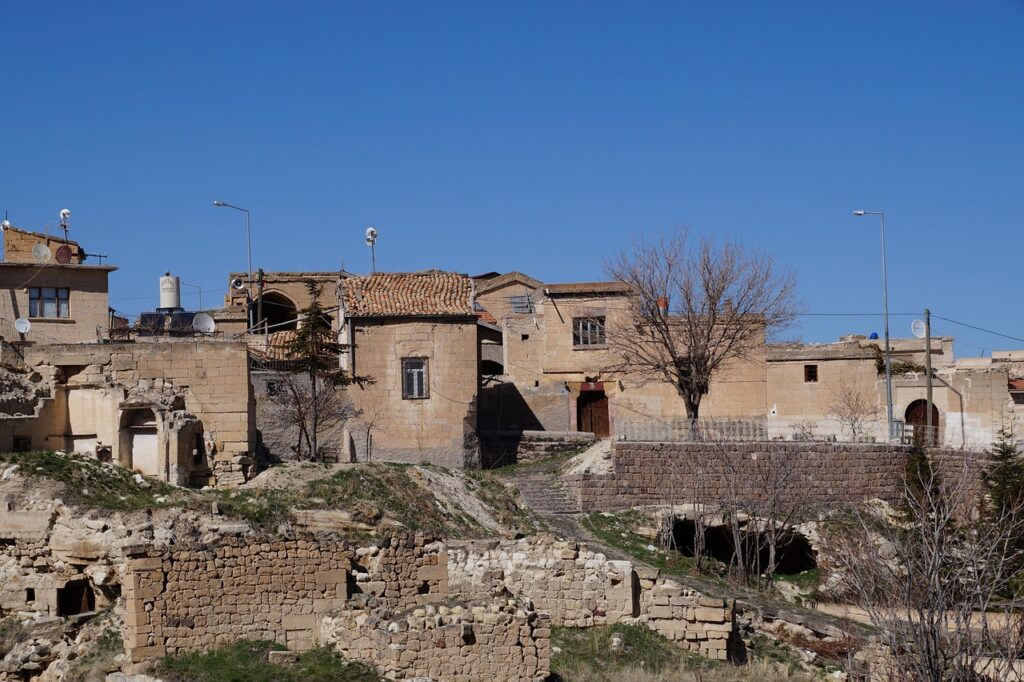
The heart of Mustafapasa is its old quarter, a web of cobbled lanes climbing the valley slopes. Here you will find the grand stone houses that made the town famous, with carved facades, arched windows, and wooden doors that have stood for well over a century. Wandering without a map is the best approach.
Allow at least two hours for a proper stroll. Start at the lower streets near the stream and work your way uphill, where the views open across the rooftops toward the vineyards. Many of the old houses are now guesthouses, and their courtyards offer glimpses of a slower way of life.
Keep your camera ready around every corner. The light changes through the day, painting the stone in warm tones at sunrise and soft gold before sunset. Even the smallest details, the iron balconies, the carved lintels, the climbing vines, reward a closer look.
The Greek Heritage of Sinasos
Before the population exchange of 1923, Mustafapasa was known as Sinasos, a thriving Greek Orthodox town whose merchants traded as far away as Egypt and Europe. The wealth they brought home paid for the elaborate mansions and churches you still see today, and the town’s identity is inseparable from this heritage.
When the Greek families left in the exchange, Turkish families from Greece arrived to take their place, and the town was renamed Mustafapasa. The buildings remained, which is why walking through today feels like stepping into a preserved chapter of Ottoman-era multicultural life.
Understanding this history changes what you see. The fine stonework, the school buildings, the fountains, and the churches all belonged to a community that shaped the town’s character. A local guide can point out details you would otherwise miss, from Greek inscriptions to the layout of the old market quarter.
The Old Mansions
The mansions of Mustafapasa are the town’s most photographed feature, and they deserve the attention. Built in the eighteenth and nineteenth centuries, they combine Anatolian stonework with touches of European style that the Sinasos merchants picked up on their travels. Some rise three storeys high with elaborate stone carving.
Several mansions now operate as boutique hotels and guesthouses, which means you can actually stay inside one. If you are not overnighting there, some still welcome visitors for meals or coffee in their courtyards, and the hotel staff are usually happy to tell you about the building’s history.
Look closely at the details: the arched entrances, the rows of narrow windows, the carved frames around doors. These were status symbols, and their quality reflects the rivalry between wealthy families. The restoration work across the town has been careful, keeping original features while making the houses livable again.
The Churches of the Valley
Mustafapasa is ringed by churches and monasteries carved into the soft rock, and they are among the town’s greatest treasures. The Church of St. Basil and the Church of St. Stephen are the best known, reached by short paths from the town center. Their frescoes, painted in warm earth tones, survive in remarkable condition.
A little farther out, the monastery complex of Keslik is a highlight for many visitors, with its rock-cut chapel, refectory, and wine press still visible. These sites are quieter than those in the main valleys, and you often have them almost to yourself, especially outside peak season.
Give yourself time to sit in the cool interior of a church and let your eyes adjust to the dim light. The paintings reward patience, and the silence is part of the experience. Flash photography is usually discouraged, so rely on natural light and steady hands.
Wineries and Wine Tasting
Vineyards surround Mustafapasa, and winemaking is woven into the town’s history. The volcanic soils and high altitude give Cappadocian grapes a distinctive character, and several producers welcome visitors for tastings. You can often walk from the town center to a winery among the vines.
Tastings typically include the local whites, which suit the warm climate, alongside reds made from native grapes. Many cellars are built into the rock, keeping the bottles at a constant temperature, and the setting adds to the experience. Ask about the stories behind the labels; the family history is part of the taste.
If you are visiting in late summer or autumn, you may see the harvest in action. For a first-timer, even a short tasting gives you a reason to slow down, watch the sun move across the valley, and understand why this landscape has been prized for its wine for so long.
Where to Eat
Dining in Mustafapasa is a relaxed affair built around local ingredients. Many of the best meals happen in guesthouse courtyards, where the menu is small and seasonal. Expect dishes built around vegetables from nearby gardens, beans, and meats cooked slowly, with bread fresh from the oven.
For lunch, look for the simple lokantas and cafes in the center, where the day’s dishes are laid out for you to choose. These places are honest, inexpensive, and popular with locals, which is always a good sign. Menemen, grilled kebabs, and lentil soup all appear regularly.
In the evening, wine joins the table, often a local vintage that pairs naturally with the food. Desserts tend toward the simple and sweet, and tea or Turkish coffee closes the meal. Do not rush; the slow pace of the meal is part of the pleasure of this town.

Where to Stay
Staying in a restored mansion or a cave room is one of the great joys of Mustafapasa, and it is easier on the budget than in the more famous villages. The old stone houses have been converted into guesthouses with modern bathrooms tucked into centuries-old walls, and the atmosphere is unmatched.
Many properties are family-run, which means a warm welcome and honest advice about the town. Breakfast is usually a generous spread of local produce, served in a courtyard or on a terrace with a view. The quiet nights are a bonus; Mustafapasa sleeps early and wakes gently.
For first-timers, a central location is worth a little extra, since it puts the churches, restaurants, and wineries within walking distance. Book ahead in spring and autumn, when the region is busiest, and ask about parking if you arrive by car, since the old streets are narrow.
Practical Tips for Your Visit
A few practical habits will smooth your first visit. Carry cash, because small shops and some cafes do not accept cards, and take layers even in summer, since the valley can feel cool after sunset. Comfortable shoes matter more than any other item you pack.
Respect the churches and monasteries as sacred places, dressing modestly and speaking quietly. If you want to understand the frescoes and the history, hire a local guide for a morning; their knowledge transforms the experience far more than any guidebook.
Finally, build in time to do nothing. Sit in a courtyard, watch the light on the stone, taste the local wine. Mustafapasa reveals itself slowly, and the visitors who hurry through it miss the very thing that makes it special.
Frequently asked questions
How long should you spend in Mustafapasa?
A full day covers the old town, the main churches, and a winery visit comfortably. Two days let you explore the surrounding valleys and the Keslik Monastery at a relaxed pace, with two evenings in the town’s atmospheric courtyards. Many visitors stay longer and use the town as a base for Goreme and Urgup, since both are close and the nights here are wonderfully quiet.
Is Mustafapasa easy to get around?
Yes, the town is compact and best explored on foot, with most sites within a short walk of the center. The old quarter has no traffic to worry about, only uneven stone underfoot. For outlying monasteries and wineries, local minibuses and taxis are available from Urgup and the town itself. Parking is limited in the old quarter, so leave your car at the edge of town and walk in.
What should you know about the churches before visiting?
The churches and monasteries are active heritage sites, so dress modestly and keep your voice low out of respect. The frescoes are sensitive to bright light, so avoid flash photography and rely on natural light instead. Some sites charge a small entry fee, while others are open freely, so carry a little cash. Early morning visits offer the best light and the fewest people, and a guide adds real depth to the experience.

All Over Information
The All Over Information editorial team researches and writes practical English-language guides to Turkey. Facts are checked against official and local sources before publication, prices are published as dated ranges rather than quotes, and guides are revised when things change. We accept no sponsored posts, paid placements or paid links.
More guides like this

Mustafapasa in Winter: What to Expect
Winter transforms Mustafapasa into one of the most atmospheric corners of Cappadocia.

A Solo Traveler’s Guide to Mustafapasa
Mustafapasa is one of the best places in Cappadocia for solo travelers.
Mustafapasa in Summer: A Complete Travel Guide
Summer in Mustafapasa is warm, golden, and full of long evenings.

The Best Day Trips from Mustafapasa
Mustafapasa is a perfect base for exploring the wider Cappadocia region.
Hidden Gems of Mustafapasa Most Tourists Miss
Mustafapasa rewards the visitor who looks past the famous facades.

Photography Spots in Mustafapasa You Can’t Miss
Mustafapasa is a photographer's gift. The town combines carved stone mansions, rock-cut churches, vineyards, and valley views into a compact setting where…