Turkey is so crowded with ancient wonders that building a bucket list feels like choosing favourites among impossible riches. Perge deserves a place on yours, and not as a filler between bigger names. It offers what few sites can: a complete ancient city you can walk through end to end, from its monumental gate to its colonnaded streets, its vast baths, its theatre and one of the finest stadiums the Roman world has left us. It is easy to reach, cheap to enjoy and, most precious of all, wonderfully uncrowded. Here is why Perge should be on your list.
The Completeness Factor
Most archaeological sites in Turkey show you one great thing: a temple, a theatre, a tomb. Perge shows you a whole city. You enter through the great Hellenistic gate with its two round towers, follow the main street past the agora and the baths, and end at the stadium and the theatre. Everything an ancient city needed is here, and it is all readable, all walkable and all in one place.
That completeness changes how you experience the site. Instead of standing before a single monument and imagining the rest, you live inside the layout of a real community: where people shopped, bathed, watched races and prayed. For anyone curious about how the Romans actually lived, Perge is the closest thing to time travel that a day trip from Antalya can offer, and no other site in the region packages it so completely.
The Gate You Will Never Forget
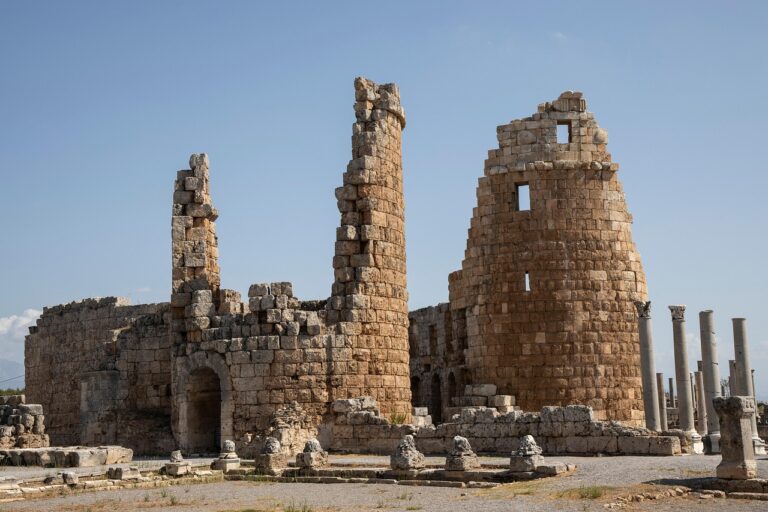
Every great site has its signature image, and for Perge it is the Hellenistic gate. Two massive round towers frame a narrow entrance, surviving almost intact, and you approach it exactly as a traveller would have two thousand years ago. The gate is a masterpiece of defensive architecture that somehow feels welcoming, and it sets the tone for everything that follows.
Beyond the towers you will find the courtyard of the later Roman gate, and the contrast tells the city’s story in stone: the careful, muscular engineering of the Hellenistic period giving way to the showy marble of the Roman age. The gate is also your first and best photograph of the site, especially in the low light of morning, when the towers cast long shadows across the approach.

The Main Street of an Ancient City
The heart of Perge is its colonnaded street, a dead-straight avenue that runs north through the city with a water channel flowing down its centre. Along its length stood covered colonnades, their columns long since fallen but their bases and capitals still marking the line. This was the spine of Perge, the street where citizens gathered, traders set up stalls and processions passed.
What makes it special is how much survives. The crossing stones are still in place, letting you step across the water channel exactly as the ancients did. The paving is worn by two millennia of feet. When you walk it, especially in the quiet of the morning, the distance between you and the Roman world suddenly feels very small, and few streets in Turkey give you that feeling so directly.
The Stadium That Outshines the Famous Ones
Perge’s stadium is one of the best-preserved ancient stadiums in existence, and it is barely celebrated outside the specialist guidebooks. It is a long, vaulted arena with tiers of seating on three sides, and beneath the stands runs a complete circuit of galleries where spectators sheltered and traders kept shop. You can climb through those galleries and walk the length of the arena itself.
Compare that with the stadiums at more famous sites, often reduced to foundations, and Perge’s advantage is obvious. You can stand in the middle of the arena and feel the shape of the crowd around you. You can wander the dark, cool galleries and understand the building’s ingenious engineering. For many visitors, this single structure justifies the whole trip to Perge.

The Theatre Without the Tourist Crowds
Perge also has a theatre, seated into the hillside and capable of holding audiences on the order of fifteen thousand. Its near-twin at Aspendos, twenty minutes away, is famous worldwide and constantly busy; Perge’s is quietly magnificent and often nearly empty. You can climb through the seating, explore the stage area and take your photographs without a crowd in the frame.
The theatre gives you the same thrill of scale as its more famous neighbour, with the bonus of solitude. From the top rows you look out over the plain toward the sea, the same view the ancient spectators enjoyed. If you want the experience of a great Roman theatre without the tour groups, Perge delivers it in spades.
The Baths and the Everyday City
Roman Perge was a city of public luxury, and its bath complex is among the most impressive remains of its kind in Anatolia. The walls still tower above you, showing the scale of the vaulted halls where citizens soaked, sweated and socialised. Around the baths you can trace the palaestra, the exercise ground, and the water channels that fed the whole system.
These everyday buildings matter more than the monuments, because they tell you how ordinary Romans lived. The agora, the market square, is a vast open space you can stand in and imagine full of merchants and debate. The nymphaeum fountain at the north end of the street still hints at the glory of running water in a hot land. Perge makes daily Roman life legible in a way that the great temples never can.

It Fits Any Turkey Itinerary
Perge sits on the flat plain just east of Antalya, one of Turkey’s most popular resort bases, and it could not be easier to reach. It is a half-day trip from the city centre, doable in the same excursion as Aspendos, and it works equally well for a couple on a beach holiday, a family looking for something educational or a culture traveller crossing Turkey by road. No long hike, no complicated logistics, no remote mountain road.
That accessibility is a bucket-list virtue in itself. Some of Turkey’s greatest sites demand real effort and planning; Perge simply requires you to leave Antalya after breakfast and be back by lunchtime. It slots into almost any itinerary without displacing anything else, and it gives back more history per hour than almost any site in the country.
Quieter Than the Famous Names
The crowds at Turkey’s most famous ruins can test your patience. Perge’s blessing is that it sits just off the main circuit, famous enough to be well cared for but not famous enough to be overrun. On most days you will share the site with a handful of other visitors rather than a flood, and you can enjoy the ruins at your own pace and in your own silence.
That calm changes the quality of the visit. You can linger at the stadium, sit in the theatre, photograph the gate without strangers in the frame. For travellers who find the great sites exhausting, Perge is the antidote: all the wonder, none of the crush, and the space to feel the past properly.
A Perfect Pairing with Aspendos
The best argument for Perge may be how well it pairs with its near neighbour. Aspendos has the world’s most famous ancient theatre; Perge has the gate, the streets, the baths and the stadium. Together the two sites give you the complete picture of a Roman city in the region, and the combination is easy, close and logical.
Visit Perge first, in the morning calm, then drive east to Aspendos and finish your day beneath the great theatre’s stage. It is one of the finest one-day double bills in Turkey, and it proves the point of this article: Perge is not a stopgap for your bucket list. It is one of the reasons the list exists.
The History You Can Actually Feel
Perge is not just a pretty collection of ruins; it is a history book you walk through. The story begins in legend, with Trojan War heroes founding the city, continues through Persian tribute and Alexander the Great’s arrival in 333 BC, and reaches its golden age under Rome in the 2nd and 3rd centuries AD. The Apostle Paul preached here, the goddess Artemis Pergaea drew pilgrims from across the region, and the city minted its own coins for centuries.
Every layer of that story left a mark you can still see. The Hellenistic gate speaks of the age of city walls and defensive towers. The marble columns and the water channels speak of Roman prosperity. The remains of the Christian basilica speak of a world changed by a new religion. When you stand at the nymphaeum fountain at the end of the main street, you are standing at the point where all those centuries converge, and the site becomes far more than a photo opportunity.
The Case for Putting It on Your List
If you are still weighing Perge against the famous names, consider what it offers that they cannot. It is complete where others are fragments. It is calm where others are crowded. It is near a major city where others require expeditions. And it pairs perfectly with Aspendos, giving you the great theatre and the great city in a single effortless day.
A bucket list is supposed to hold the experiences that define a country. Perge gives you one of the purest ancient city experiences Turkey has to offer, with a fraction of the effort and a fraction of the crowd. Add it to your list, go early, walk the main street to the stadium, and you will understand why the people who know Turkey best keep coming back to this unassuming plain.
Frequently asked questions
What makes Perge different from other ancient cities in Turkey?
Perge’s unique strength is completeness. You walk through an entire city, from the Hellenistic gate and colonnaded street to the agora, baths, theatre and one of the best-preserved ancient stadiums in the world, all in one walkable site that stays refreshingly uncrowded.
How much time should I give Perge?
Two to three hours is the right amount to see the site properly. Because it is so close to Antalya and combines so naturally with Aspendos, it works beautifully as half of a full day among the Pamphylian ruins, or as a calm half-day visit on its own.
Is Perge suitable for families and less mobile visitors?
Yes, with caveats. The site is large and the ground uneven, so it is not wheelchair-friendly everywhere, but the main street is flat and walkable, and children enjoy the gate, the stadium galleries and the sense of adventure. Bring water, shade and sturdy shoes.

All Over Information
The All Over Information editorial team researches and writes practical English-language guides to Turkey. Facts are checked against official and local sources before publication, prices are published as dated ranges rather than quotes, and guides are revised when things change. We accept no sponsored posts, paid placements or paid links.
More guides like this

Visiting Derinkuyu Underground City: Tickets, Hours, and Tips
Derinkuyu Underground City is one of the great experiences of Cappadocia, a descent into a world carved from rock that sheltered thousands…

Why Kaymakli Underground City Should Be on Your Turkey Bucket List
Every traveler to Cappadocia hears about the underground cities, and most of them rush straight to Derinkuyu, the largest and deepest of…

The Complete History of Pergamon
Pergamon, in the Bergama district of Izmir province, is one of the great forgotten capitals of the ancient world.

Ephesus Through the Centuries
No ancient city in Turkey tells a longer or richer story than Ephesus, and the secret of enjoying it fully is to…
Visiting Perge: Tickets, Hours, and Tips
Perge is one of the easiest great ancient sites in Turkey to visit, and one of the most rewarding to walk.

Visiting Cappadocia’s Underground Cities: Tickets, Hours, and Tips
Few experiences in Turkey are stranger or more memorable than descending into a Cappadocian underground city.