Pergamon, in the Bergama district of Izmir province, is one of the great forgotten capitals of the ancient world. For a century and a half, this city on a steep hill in northwestern Anatolia ruled a kingdom that rivaled the successors of Alexander, built the steepest theatre in antiquity, housed a library that challenged Alexandria, and invented the golden age of parchment. Its story runs from a humble fortress to a Roman provincial capital, from a healing sanctuary to a Christian see, and finally to the world heritage site you can visit today.
The Beginnings: A City on the Hill
The site of Pergamon was occupied long before it became famous. The steep hill above the Caicus plain, now the acropolis of Bergama, was a natural fortress, and settlement on and around it goes back to the early first millennium BC, when Aeolian Greeks settled the region.
The hill commanded the plain and the roads inland, and its defensive value was obvious. The name Pergamon, sometimes written Pergamum, is ancient, and the city appears in the stories of the Greek world as a place of the Mysian region, associated in legend with the hero Telephus, son of Heracles.
For centuries it was a modest place. Everything changed in the years after the death of Alexander the Great, when his generals divided his empire and the region became a battleground, and Pergamon’s hill finally found its moment.
Philetaerus and the Birth of the Dynasty
The founder of Pergamon’s greatness was Philetaerus, a Macedonian officer who served Lysimachos, one of Alexander’s successors, in the early third century BC. Lysimachos entrusted him with a treasury of nine thousand talents, held in the fortress of Pergamon.
In 282 BC, Philetaerus turned against his master, declared Pergamon independent, and used the treasury to build the city’s power. He ruled until 263 BC, and though he never took the title of king, he founded the dynasty that would make Pergamon famous.
His successors, his nephew Eumenes I and then Attalus I, expanded the state and its ambitions. The Attalids, as the dynasty came to be called, were patrons of art, learning, and building on a scale that astonished the Greek world.

Attalus I and the Victory Over the Gauls
The first great test of the new kingdom came from the Gauls, Celtic warriors who had swept into Anatolia and terrorized the Greek cities, exacting tribute and plundering at will. Around 230 BC, Attalus I met them in battle and defeated them decisively.
The victory was celebrated across the Greek world, and Attalus took the title of king. He commemorated his triumph with dramatic monuments, including the famous sculptures of dying Gauls, which became some of the most admired works of ancient art.
From this moment, Pergamon was a major power, allied with Rome against the Seleucid kings of Syria. The city’s confidence, its art, and its building program all grew in the shadow of that victory over the barbarian enemy.
Eumenes II: The Golden Age
The golden age of Pergamon came under Eumenes II, who ruled from 197 to 159 BC. Allied with Rome, he defeated the Seleucid king Antiochus III and gained control of much of western Asia Minor, making Pergamon the greatest city of the region.
Eumenes transformed the acropolis into one of the most spectacular urban centers of the ancient world. He built the great theatre, the library, the gymnasium, and the palaces, and he commissioned the Great Altar of Zeus, the masterpiece that crowned the city.
Under Eumenes, Pergamon became a center of culture that rivaled Alexandria. The city attracted scholars, artists, and craftsmen, and its school of sculpture developed a dramatic, emotional style that influenced the whole of the ancient world.

The Great Altar of Zeus
The most famous monument of Pergamon is the Great Altar of Zeus, built by Eumenes II on a terrace of the acropolis. It was a monumental structure raised on a high platform, approached by a broad flight of steps, and encircled by a frieze of sculpted marble.
The frieze, over one hundred meters long, depicted the Gigantomachy, the battle of the gods against the giants, in a swirling, theatrical style that is among the greatest achievements of Greek art. It was a statement of the city’s power and its claim to stand with the gods.
The altar survived the ancient world but was dismantled in the nineteenth century, when German excavators carried its blocks to Berlin, where the Pergamon Museum was built to house it. The altar remains in Berlin today, and its absence is the great loss of the site.
The Library and the Invention of Parchment
Pergamon’s library was one of the wonders of the ancient world, holding an estimated two hundred thousand volumes and rivaling the great library of Alexandria. It was housed on the acropolis, with reading rooms and shelves of scrolls.
The most famous story of the library concerns its material. When the Ptolemies of Egypt, jealous of the rival library, banned the export of papyrus, the Pergamenes are said to have developed writing on treated animal skins, which the Greeks called pergamene, from the city’s name: parchment.
The story may be partly legend, but the connection is real, and parchment became the standard writing material of the medieval world. The city that invented it lent its name to the very word for the skin on which books were written for a thousand years.

The Last Attalids and the Roman Bequest
The successors of Eumenes II, his brother Attalus II and his nephew Attalus III, continued the building and the patronage. Attalus II gave his name to the stoa that still stands in Athens, and the kingdom remained rich and stable.
Attalus III, the last king, ruled only a few years and died in 133 BC without an heir. In his will, he bequeathed his kingdom to Rome, and Pergamon became the first capital of the new Roman province of Asia.
The bequest was one of the great turning points of ancient history, delivering the richest part of Asia Minor to Rome without a war. Pergamon itself, once a royal capital, now entered a new age as a city of the Roman empire.
The Roman transformation of Pergamon began with a famous act of generosity. When Attalus III bequeathed the kingdom to Rome in 133 BC, the city lost its throne but gained a new role as the first capital of the province of Asia, and later, after the honors passed to Ephesus, it remained one of the richest and most respected cities of the province. The Romans built new baths, a stadium, a theatre in the plain, and monumental temples, and the city on the hill became the showpiece of the province, its acropolis a symbol of the civilized world the empire had inherited.
The Asclepieion: Medicine for the Roman World
Under Roman rule, Pergamon gained a new claim to fame: its sanctuary of Asclepius, the god of healing. The Asclepieion, about two kilometers from the acropolis, became one of the most famous medical centers of the ancient world.
Patients came from across the empire to sleep in the incubation hall, where the god was said to appear in dreams and prescribe cures. The sanctuary had a theatre, baths, a library, and a sacred spring, and its physicians practiced a sophisticated mixture of medicine, therapy, and faith.
The most famous doctor of the ancient world, Galen, was born in Pergamon in 129 AD and trained at the Asclepieion before serving Roman emperors in Rome. His name kept Pergamon’s medical fame alive for two thousand years.

Christianity and the Byzantine Centuries
Pergamon appears in the Book of Revelation as one of the seven churches of Asia, addressed by the writer as the place where the throne of Satan is, a reference scholars connect to the great altar and the imperial cult of the city.
Christian communities grew in the city, and the church of Pergamon survived into the Byzantine centuries, when the city on the hill was a fortress of the Byzantine state. The acropolis was ringed with new walls, and the old pagan monuments were abandoned or built over.
The Seljuk Turks took the region in the early fourteenth century, and the city on the hill was gradually abandoned for the town below, which grew under Turkish rule and became the modern Bergama. The ancient capital became a ruin, its marble quarried for centuries.
There is a human scale to Pergamon that many great sites lack. Because the ruins sit above a living town, the ancient and the modern share the same streets, and the same families who farm the plain have watched the excavations grow. The result is a site that feels inhabited, a place where the past is not a museum but a neighborhood, and where the story of the Attalids, the Roman governors, and the Byzantine soldiers is still part of the daily landscape of Bergama.
Excavation, Museums, and UNESCO
Modern interest in Pergamon began in the nineteenth century, when European travelers identified the site and German archaeologists began systematic work. The excavation of the Great Altar, the theatre, and the acropolis, beginning in the 1870s, made Pergamon famous again.
The German teams carried vast quantities of sculpture and architecture to Berlin, where the Pergamon Museum was built to display them. The work continues, and the acropolis, the Asclepieion, and the Red Basilica in the town are all under excavation and restoration.
In 2014, UNESCO inscribed Pergamon and its multi-layered cultural landscape on the World Heritage List. Today the steep theatre, the terraces, and the sanctuary tell the story of a city that was, for a moment, the rival of Alexandria and the jewel of the ancient world.
Frequently asked questions
Who founded the Attalid dynasty?
The dynasty was founded by Philetaerus, a Macedonian officer who controlled the treasury of Lysimachos at Pergamon. He declared the city independent in 282 BC and ruled until 263 BC. His successors, Eumenes I and Attalus I, took the title of king and built Pergamon into a major power.
What happened to the Great Altar of Pergamon?
The altar was excavated by German archaeologists in the 1870s and 1880s, and its blocks and friezes were shipped to Berlin, where the Pergamon Museum was built to house them. The reconstruction stands there today. Turkey has long sought the return of the altar and other objects taken during the excavations.
Why was Pergamon’s library so famous?
It rivaled the library of Alexandria with an estimated two hundred thousand volumes, and it is credited with the development of parchment, the treated animal skin that became the standard writing material of the medieval world. The Greek word for parchment, pergamene, comes from the city’s name.

All Over Information
The All Over Information editorial team researches and writes practical English-language guides to Turkey. Facts are checked against official and local sources before publication, prices are published as dated ranges rather than quotes, and guides are revised when things change. We accept no sponsored posts, paid placements or paid links.
More guides like this

Why Ani Ruins Should Be on Your Turkey Bucket List
Ani is the ghost city that haunts every traveller who visits.

The Architecture of Cappadocia’s Underground Cities Explained
The underground cities of Cappadocia are among the most remarkable pieces of architecture ever created, not because they are beautiful but because…

The Architecture of Aspendos Explained
The theatre of Aspendos is the best-preserved ancient theatre in the world, and it earned that title through architecture.
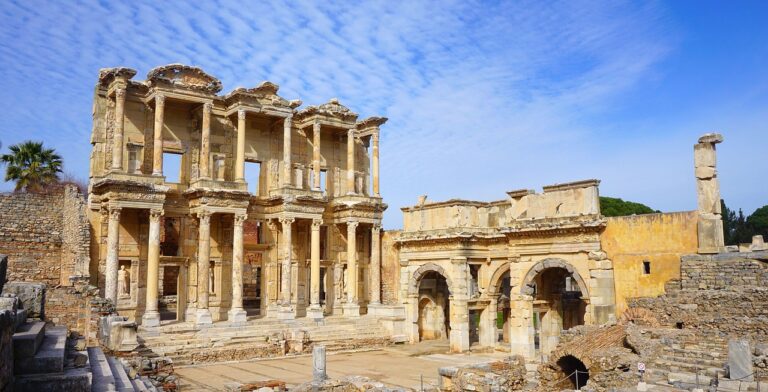
The Architecture of Ephesus Explained
The ruins of Ephesus are beautiful, but they are also a lesson in ancient engineering.

Why Miletus Should Be on Your Turkey Bucket List
Every traveler to Turkey knows Ephesus, and every list of ancient cities starts with the same famous names. But Miletus, a short…

Why Cappadocia’s Underground Cities Should Be on Your Turkey Bucket List
Cappadocia is famous for its sky, but its most extraordinary secret lies beneath the ground.