The Zeugma Mosaic Museum in Gaziantep is one of the great museums of the ancient world, but its story is as dramatic as its treasures. It began on the banks of the Euphrates, where a Greek city grew rich on the trade between East and West, and it was reborn in the early 2000s when archaeologists raced against the rising waters of a new dam to save the finest mosaics ever found in Turkey. This is the complete history of the museum, from a city named for a bridge to one of the world’s greatest collections of Roman art.
The City on the Euphrates
The story begins with the river. On the west bank of the Euphrates, where the great waterway bends through what is now southeastern Turkey, a city grew up that would become one of the most important in the Roman East. The site, near the modern town of Nizip, is today known as Belkis, but its ancient name was Zeugma.
The city’s fortune was geography. It stood at one of the few points where the Euphrates could be crossed, and every traveller, army, and caravan moving between the Mediterranean and the East passed through it. The river was the border of worlds, and Zeugma guarded the crossing.
That position made Zeugma rich, and wealth made it cultured. The city’s inhabitants decorated their homes with the finest art money could buy, and beneath the modern fields along the Euphrates lay a city paved with masterpieces. For two thousand years, that art slept under the earth.
The Seleucid Foundation
Zeugma was founded around 300 BC by Seleucus I Nicator, one of Alexander the Great’s generals, who carved out a vast empire in the East after Alexander’s death. Seleucus settled the crossing point with his veterans and colonists, and the new city took its place in the network of Seleucid foundations that stretched from the Mediterranean to Persia.
The city was originally called Seleucia, after its founder, and it flourished as a frontier town of the Seleucid empire. When the empire weakened, the region passed through the hands of competing powers, including the kingdom of Commagene, before falling into Rome’s orbit in the first century BC.
From its foundation, Zeugma was a meeting place. Greeks, Syrians, Persians, and later Romans mixed in its streets, and the city developed the cosmopolitan character that would make it famous. Its real golden age, however, still lay ahead, under the rule of Rome.
The Name: Bridge and Passage
The city’s name tells its story. Zeugma comes from the Greek word for a bridge or a junction, the point where things are joined together, and it described the city’s function perfectly: the place where the road crossed the river, and where East met West.
For the Romans, Zeugma was the gateway to the East. The great road that carried armies and trade toward Mesopotamia and Persia crossed the Euphrates here, and the city became a staging post for every campaign eastward. Legions, merchants, and ambassadors all passed through its gates.
The crossing shaped the city’s identity. Zeugma was a frontier town in the truest sense, wealthy from the traffic, exposed to the dangers of the border, and constantly renewed by the people who passed through. The bridge of the name became the city itself.
Zeugma Under Rome
In 64 BC, the Roman general Pompey brought the region under Roman control, and Zeugma entered its greatest age. The city grew into a major centre of the Roman province of Syria, and at its peak it may have held tens of thousands of people, making it one of the largest cities of the Roman East.
Roman rule brought the Legio IV Scythica, a legion based at or near the city, and the military presence added to the city’s wealth and importance. Zeugma became a proper Roman city, with temples, baths, a theatre, and the villas of the rich lining its streets.
It was this prosperity that produced the mosaics. The city’s merchants and officials, grown wealthy on trade and empire, built themselves grand houses and decorated them with the finest floor art of the age. The second and third centuries AD were the golden age of Zeugma’s art.

The Villas and the Mosaics
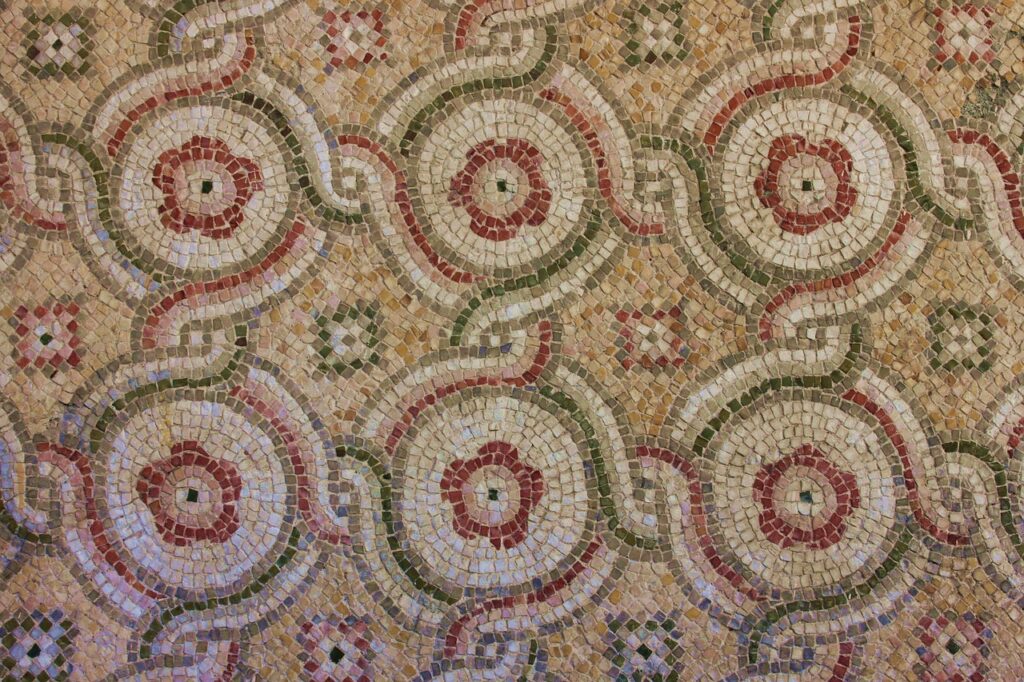
The wealth of Roman Zeugma was displayed on its floors. The city’s great houses, known to archaeologists as the villas or houses of Zeugma, were paved with mosaics of extraordinary quality: scenes of mythology, gods, heroes, and daily life, worked in thousands of tiny stone cubes.
These were not modest decorations. The mosaics covered entire rooms, with central panels framed by elaborate borders, and they were made by professional workshops whose work rivalled the best in the empire. The subjects ranged from the gods of Olympus to the heroes of Troy, and from the sea creatures of Oceanus to the faces of real people.
The finest of them all is the portrait known as the Gypsy Girl, a young woman’s face worked in such fine detail that her expression seems to change as you move. It is one of the greatest surviving works of ancient art, and it came from one of the villa floors of Zeugma.
The Craft of the Mosaicists
Behind the art lay a demanding craft. Mosaic floors were built from tesserae, small cubes of stone, glass, and ceramic, cut and laid by hand to form images that could cover entire rooms. The finest work used tiny tesserae, sometimes only a few millimetres across, to achieve detail almost like painting.
The mosaicists of Zeugma were masters of their trade. They worked in the technique known as opus tessellatum, laying the tesserae into a bed of mortar, and the best of them could render faces, fabrics, and movement with astonishing naturalism. The Gypsy Girl uses around a thousand tesserae for the face alone.
The craft was expensive, and it was paid for by the city’s elite. The villa owners competed to commission the finest floors, and their rivalry produced the astonishing density of high-quality mosaics that made Zeugma famous. It was the patronage of the rich that created the collection.

Decline and Burial
Zeugma’s golden age did not last. From the third century AD, the Roman East faced invasion, economic crisis, and plague, and the frontier city suffered with the empire. The Sassanian Persians attacked the region, the trade routes shifted, and the city’s wealth ebbed away.
By late antiquity, Zeugma had shrunk to a shadow of its former self. The great villas were abandoned, and the city slowly decayed into a modest settlement. In the following centuries it was gradually abandoned, and the Euphrates carried silt across the ruins, burying the mosaics under meters of earth.
The burial was the mosaics’ salvation. Sealed under the soil, away from the plough and the weather, the floors survived in extraordinary condition. The city died, but its art slept, waiting for the archaeologists who would come two thousand years later.
The Rescue Excavations
The twentieth century brought Zeugma back into the light. Archaeologists had long known that a great city lay near Belkis, and excavations in the late twentieth century began to reveal its riches. The discovery that the site held mosaics of exceptional quality drew international attention.
The urgency came from water. In the 1990s, Turkey built the Birecik Dam on the Euphrates, and its reservoir was to flood the site of Zeugma. With the waters rising, an international rescue operation was launched, led by Turkish archaeologists with teams from around the world, to save what could be saved.
The rescue excavation of 2000 became a race against time. As the dam filled, archaeologists worked around the clock, lifting the mosaics in sections and recording the villas. It was one of the most dramatic rescue operations in the history of archaeology, and it captured the world’s imagination.
The Gypsy Girl and the Race Against the Dam
The symbol of the rescue was the Gypsy Girl. The portrait, found during the excavations in 1998, was lifted from its villa floor and became the face of the Zeugma campaign, appearing in newspapers and broadcasts around the world. Her gaze, at once shy and direct, made her a celebrity.
The rescue was a logistical masterpiece. Mosaics were cut into manageable sections, rolled or mounted on supports, and transported to safety, while the archaeologists documented every find. When the waters closed over the site, the greatest treasures were already on their way to the museum.
The Gypsy Girl and her companions found a new home in Gaziantep. The city, already famous for its museum, began planning a building worthy of the collection, and the rescued floors were conserved and prepared for display. The race against the dam had been won.
The Museum Is Born
The Zeugma Mosaic Museum opened its doors in September 2011, in a purpose-built complex near the old city of Gaziantep. It was an instant sensation, one of the largest mosaic museums in the world, and the Gypsy Girl, displayed in a hall of her own, became one of the most famous works of art in Turkey.
The museum tells the full story of Zeugma. The great floors of the villas are laid out across the galleries, with the scenes of gods, heroes, and sea creatures arranged as they would have been in the houses of the city. Around them are the other finds: statues, coins, jewellery, and the everyday objects of Roman life.
The result is more than a museum of art; it is a city brought back to life. The mosaics that lay under the Euphrates fields for two thousand years now fill a great modern hall, and the city that died by the river lives again in its collection.
Frequently asked questions
When was the Zeugma Mosaic Museum opened?
The museum opened in September 2011 in Gaziantep, after the rescue excavations at the ancient city of Zeugma in the late 1990s and early 2000s. It was built to display the mosaics saved from the rising waters of the Birecik Dam reservoir, and it became one of the largest mosaic museums in the world.
Who was the Gypsy Girl?
The Gypsy Girl is the modern nickname for a mosaic portrait of a young woman found at Zeugma in 1998. It is not an actual image of a Roma girl but a Roman portrait, possibly of a woman of the city, and its fine craftsmanship and expressive face made it the symbol of the rescue.
Why was Zeugma flooded?
Zeugma was flooded by the reservoir of the Birecik Dam, built on the Euphrates in the 1990s for power generation and irrigation. The rising waters threatened the archaeological site, prompting a major international rescue excavation in 2000 that saved the most important mosaics before the site was flooded.

All Over Information
The All Over Information editorial team researches and writes practical English-language guides to Turkey. Facts are checked against official and local sources before publication, prices are published as dated ranges rather than quotes, and guides are revised when things change. We accept no sponsored posts, paid placements or paid links.
More guides like this
Why Pergamon Should Be on Your Turkey Bucket List
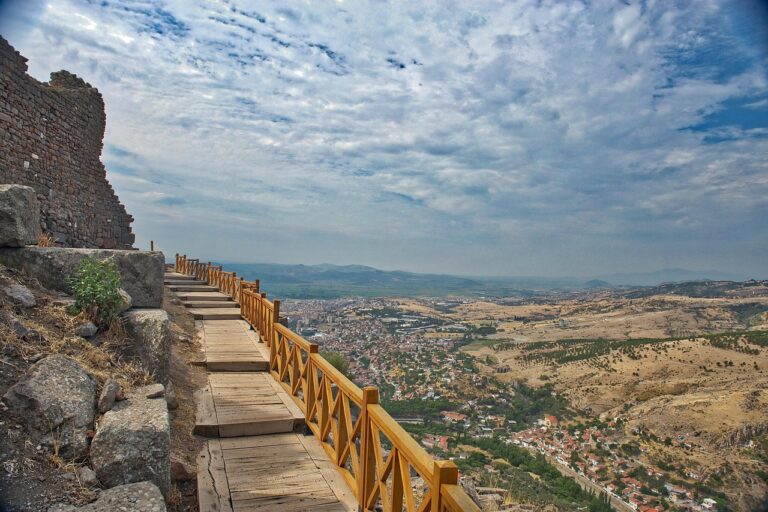
Every traveler to Turkey knows Ephesus, and far fewer know Pergamon, which is precisely why it deserves a place on your list.

Gobekli Tepe Through the Centuries
Few places on earth rewrite human history as completely as Gobekli Tepe.

Hierapolis Through the Centuries
Hierapolis lived for over a thousand years, and its history reads like the history of the ancient world in miniature: Hellenistic kings,…

Visiting Mount Nemrut: Tickets, Hours, and Tips
Mount Nemrut is one of the most dramatic destinations in Turkey: a 2,100-metre peak crowned with the fallen heads of colossal statues,…
The Architecture of Termessos Explained
Termessos is an architectural marvel, a city built into a mountain so steep that its builders had to cut the rock itself…

Visiting Xanthos: Tickets, Hours, and Tips
Xanthos is one of the great ancient sites of the Turkish coast, a UNESCO World Heritage city with a story that has…