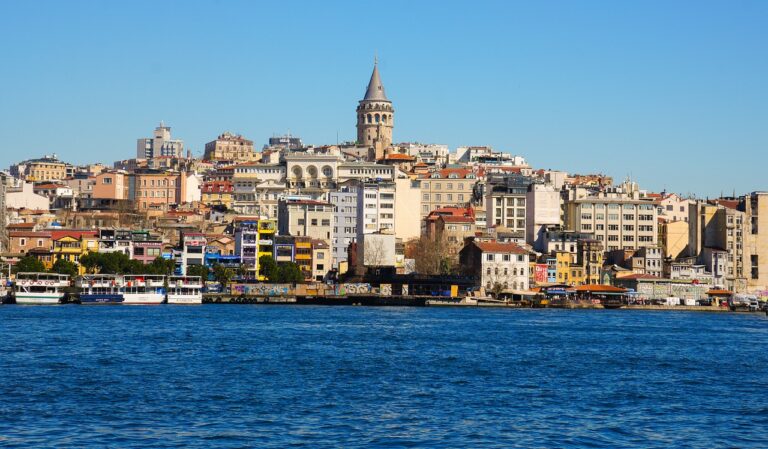
Galata may be compact, but it overflows with things to see and do. This historic quarter below the Galata Tower carries the heritage of its medieval Genoese founders, its Ottoman-era bankers, and its modern creative scene all at once. Cobbled lanes lead to the graceful Kamondo Steps, music shops, art galleries, boutiques, and cafes with skyline views, while the Tünel funicular links the hill to the waterfront bustle of Karaköy. In this guide, we count down ten of the best experiences in the quarter, from climbing the legendary tower to tracing the remnants of the medieval walls. Mix and match them as you like, and you will discover why travelers keep coming back to Galata.
1. Climb the Galata Tower
The Galata Tower is the reason most visitors come, and for good reason. Built in 1348 by the Genoese as part of the fortifications of their trading colony, it has watched over the Golden Horn for nearly seven centuries. Today it functions as one of the best observation points in Istanbul, with a viewing gallery encircling the top.
From the summit, the city unfolds in every direction: the Old City with its domes and minarets, the ferries crossing the Bosphorus, the rooftops and terraces of Galata itself. On a clear day, visibility stretches far across the sea. The climb is part of the ritual, and the reward at the top is worth the wait.
To avoid the longest queues, arrive when the tower opens or in the late afternoon. Sunset is magical but busy, and the gallery gets crowded. If you prefer, you can admire the tower from the streets below, where it appears and disappears between the buildings like a giant chess piece.
2. Photograph the Kamondo Steps
The Kamondo Steps are Galata’s most elegant surprise. Built in the 1860s for the banker Abraham Salomon Kamondo, the sweeping curved staircase connects Bankalar Caddesi to the upper lanes of the quarter. Its double curve is strikingly modern for its age and has become a favorite subject for photographers.
The steps look different from every angle. From below, they rise like a ribbon of stone; from the top, they frame the Golden Horn and the Old City beyond. Early morning, when the streets are quiet, is the best time for an unobstructed shot, and the soft light flatters the old stone.
The Kamondo Steps are also a real part of daily life in Galata, used by residents and workers every day. Sit for a few minutes and watch the flow of people, deliveries, and cats, and you will understand the quarter in a way no museum could teach you.

3. Ride the Tünel Funicular
The Tünel is the oldest underground funicular in continental Europe. Opened in 1875, it climbs the hill between Karaköy and Tünel Square in about a minute, and it has been doing so continuously for nearly a century and a half. It is the second-oldest underground railway in the world, after London’s Underground.
Riding it is a tiny time-travel experience. The short route, the retro carriages, and the sense of emerging at the top of the quarter make it feel like a fairground attraction rather than a commute. It is also practical: the funicular saves you the steepest climb in the district.
Use the Tünel whenever your legs need a rest, or simply for the pleasure of the ride. At the top, Tünel Square connects to İstiklal Avenue; at the bottom, you step out among the ferries and trams of Karaköy. One ticket, two worlds.
4. Wander Galip Dede Street
Galip Dede Street is Galata’s music lane, a narrow cobbled street where shops sell guitars, violins, and traditional instruments. Walk down it and you will hear the sound of instruments being tested, tuned, and repaired, a soundtrack that gives the street its distinctive character.
The street is named after the poet Galip Dede, associated with the nearby Mevlevi lodge, and it connects Tünel Square to the lanes around the tower. Music shops have clustered here for decades, and even if you are not buying, the windows are a joy to browse. It is a favorite street for musicians and collectors from across the city.
As you walk, notice the mix of old buildings, small workshops, and modern cafes. Galip Dede is one of those streets where the quarter’s history and its contemporary life overlap, and it rewards slow, curious strolling.

5. Explore Serdar-ı Ekrem and the Side Lanes
Serdar-ı Ekrem Street has become the face of modern Galata. Boutique shops, vintage stores, galleries, and cafes line the lane, and their tables spill onto the cobbles in good weather. It is the place to see the quarter’s creative energy at close range.
But the side lanes are where Galata reveals its secrets. Step off the main routes and you will find courtyards, stairways, and tiny squares that feel untouched by the crowds. Look up at the ornate facades, many of them nineteenth-century apartment buildings with balconies and bay windows.
Give yourself permission to wander without a destination. In Galata, the getting lost is the point, and the side lanes hide some of the best cafes, the friendliest shopkeepers, and the most photogenic doorways in the whole quarter.
6. Visit the Galata Mevlevi House
Near Tünel Square, behind a modest facade, lies the Galata Mevlevi House, a former lodge of the Whirling Dervishes. Founded in the late fifteenth century, the lodge became one of the most important centers of Sufi culture in Istanbul, a place of music, poetry, and spiritual practice.
Today it operates as a museum, and its garden, with the tombs of dervish masters, is one of the calmest corners of the busy quarter. The collection includes manuscripts, musical instruments, and objects used in the rituals of the order, offering a window into a tradition that is still alive in Turkey.
The museum is small, and it rewards those who take time to read and look. Combine it with a walk along Galip Dede Street, named for the poet of the lodge, and you will understand a side of Galata that the tower alone can never show.

7. See the Arap Mosque
The Arap Mosque stands on the site of a medieval Dominican church, a reminder of the Catholic community that once flourished in Genoese Galata. The church was founded in the thirteenth century and served the European merchants of the quarter before being converted into a mosque in the Ottoman period.
Its minaret and interior carry marks of the building’s earlier life, and its courtyard is a quiet refuge from the surrounding streets. The mosque takes its name from the Arab merchants who later prayed here, and it reflects the layered, cosmopolitan history of the quarter.
Visitors are welcome outside of prayer times, and modest dress is expected. Stand in the courtyard for a moment and imagine the scene in the Middle Ages, when the bells of this church called sailors and traders to Mass at the foot of the Genoese walls.
8. Trace the Genoese Walls
Few visitors realize that medieval Galata was a walled city. The Genoese, who held the quarter as a trading colony, surrounded it with fortifications in the fourteenth century, and the Galata Tower was originally part of this defense system. Today, only fragments of the walls survive, tucked into the modern streetscape.
The most visible remains stand near the waterfront around Azapkapı and along the line where the walls once met the Golden Horn. You can trace fragments of the old fortifications as you walk between Karaköy and the tower, reading the interpretive markers that note their course.
Hunting for the walls turns your walk into a treasure hunt, and it connects the Galata you see today to its medieval past. The tower, the walls, and the Tünel together tell the story of a quarter that was once a self-governing European enclave inside an Eastern empire.

9. Watch the Sunset from a Terrace
Galata’s steep slopes have produced one of Istanbul’s great pleasures: the view terrace. Hotels, restaurants, and bars across the quarter offer rooftop seating with panoramic views, and the classic prospect takes in the Golden Horn, the Galata Bridge, and the domes and minarets of the Old City.
Arrive before sunset, order a drink, and watch the transformation. As the sun drops behind the Old City, the water turns to gold, the sky to rose, and the city’s lights begin to flicker on. It is a slow, theatrical spectacle that draws visitors and locals alike.
Every terrace has its own character, from casual rooftop bars to elegant dining rooms, and the good news is that there is no single best one. Try a different terrace on each evening of your stay, and compare the views like a connoisseur.
10. Descend to Karaköy and the Galata Bridge
The final essential experience is the descent. Walk down from the tower through the lanes of Galata to Karaköy, where the waterfront buzzes with ferries, trams, and the life of the port. The two quarters belong together, and the walk between them is as rewarding as either destination.
At the Galata Bridge, you can join the fishermen at the railings, cross the Golden Horn on foot, or sample the fish sandwiches sold from the boats alongside. The bridge is the city’s most democratic meeting point, connecting the old and new worlds of Istanbul with a constant stream of pedestrians.
End your visit here, with the tower rising behind you and the Old City ahead. Few cities offer such a compact, layered introduction to their history, and Galata is the key to reading it all.
Frequently asked questions
How many of these can I fit into one day?
All ten are possible in a long day if you move efficiently, but you will enjoy them more spread over two days. The tower, the lanes, and the descent to Karaköy form a natural loop that can be done in half a day. Save the terrace sunset for the evening.
Which of these are free?
Most of the list costs little or nothing. Wandering the lanes, visiting the galleries, tracing the Genoese walls, and watching the sunset are free, and the Tünel ride is inexpensive. The main costs are the tower entrance, meals, and drinks on the terraces.
When is the best time for the Kamondo Steps photo?
Early morning, before the lanes fill with visitors, is best, when you can frame the steps without a crowd. Golden hour gives the stone a warm glow, and the evening lights add charm to the surrounding buildings. All times have their appeal, but morning light is cleanest.

All Over Information
The All Over Information editorial team researches and writes practical English-language guides to Turkey. Facts are checked against official and local sources before publication, prices are published as dated ranges rather than quotes, and guides are revised when things change. We accept no sponsored posts, paid placements or paid links.
More guides like this

Galata Airport and Transport Guide
Getting between Galata and Istanbul's airports is simpler than it looks, because the quarter sits directly above Karaköy, one of the best-connected…

48 Hours in Galata: The Perfect Itinerary
Two days may sound generous for a single neighborhood, but Galata rewards a slow pace.

A Solo Traveler’s Guide to Galata
Galata is one of the best neighborhoods in Istanbul for traveling alone.
Best Local Restaurants in Galata
Galata has been a place to eat and drink well for centuries.

Galata in Summer: A Complete Travel Guide
Summer transforms Galata into the liveliest version of itself.
History and Culture of Galata
Few quarters of Istanbul carry as much history as Galata.