Few buildings can match the Basilica Cistern for the strangeness of its history. Built in the sixth century as a working reservoir, it served the Byzantine capital for centuries, was abandoned and half-forgotten under Ottoman rule, rediscovered by a curious scholar, and eventually reborn as one of the most beloved museums in the world. Its story runs from the age of Justinian to the present day, and it is a story of rise, decline, and extraordinary revival, told in water, stone, and light. Following the cistern through the centuries is following the history of Istanbul itself, from the bottom up.
The Sixth Century: Building for the Empire
The Basilica Cistern was born in one of the great building campaigns of history. In the years after the Nika revolt of 532, the emperor Justinian set out to rebuild his capital on a scale that would astonish the world, and the cistern was part of that ambition.
The church of Hagia Sophia rose above the city, and beneath the streets the cistern was carved out of the earth. Hundreds of columns were gathered, the walls were raised, and the reservoir was sealed and flooded, all within a few years of the revolt that had nearly toppled the throne.
The sixth century was the cistern’s golden age. New-built, carefully maintained, and full of clean water, it served the palace and the district with the efficiency of a new machine, and its builders could hardly have imagined the millennium and a half of history ahead.
The Byzantine Centuries: The Water of the City
Through the long centuries of the Byzantine era, the Basilica Cistern was a quiet, essential part of the city’s life. Its water fed the palace, the public buildings, and the households of the district, and its management was the business of the state.
The cistern was one of many that kept Constantinople alive. The city’s engineers had created a vast system of reservoirs and aqueducts, and the great covered cisterns, hidden and protected, were the strongrooms of that system, able to sustain the city through drought and siege.
The Byzantine centuries were not always kind. The city’s population ebbed and flowed, and the water system was maintained with varying care, but the cistern survived every crisis, its walls and vaults proving the quality of the sixth-century builders.

The Great Waterworks of Constantinople
To understand the cistern’s place in the world, you must understand the waterworks that surrounded it. Constantinople stood on a peninsula with limited springs, and its survival depended on engineering that brought water from far beyond the walls.
The great aqueducts carried the water to the city, and the cisterns stored it, and together they formed a system of extraordinary sophistication. The Basilica Cistern was one of the largest of the reservoirs, a giant in a network that served every district.
The system explains the cistern’s design and its dignity. This was not a humble cellar but an imperial installation, built with the same care as the public buildings above, and the architecture of the cistern reflects the importance of the water it held.
The Conquest: The Sunken Palace
When the Ottomans took Constantinople in 1453, the Basilica Cistern entered its most obscure chapter. The new rulers knew of the cistern, but the great Byzantine water system was not sustained as before, and the reservoir gradually slipped out of use.
The Ottomans gave the cistern its enduring name. The flooded hall, dark and columned, reminded them of the palaces of legend, and they called it the Sunken Palace, a name that captured the imagination even as the building itself was abandoned to neglect.
The centuries that followed were strange. The neighborhood above grew over the cistern, the water became stagnant, and the great hall was used for fishing and dumping, its existence half-remembered, half-denied, a legend beneath the houses.

Rediscovery: Gyllius and the Scholars
The cistern’s return to history began with a scholar’s curiosity. In the sixteenth century, a European traveler and antiquarian named Petrus Gyllius, exploring the antiquities of Constantinople, heard that the houses of the district stood over water and that fish were caught below.
Gyllius investigated and found the cistern: a vast columned hall, flooded, hidden beneath the streets. He explored it by boat, recorded its dimensions, and published his account, and his description brought the Sunken Palace back into the world of knowledge.
The rediscovery was the turning point of the cistern’s long life. From the sixteenth century onward, the scholars and travelers of Europe knew of the hidden hall, and its fame spread, preparing the way for its eventual rebirth as a museum.
The Nineteenth Century: Travelers and Torchlight
The nineteenth century saw the Basilica Cistern become an object of romantic fascination. The travelers who flocked to Constantinople made their way to the Sunken Palace, and their accounts of rowing through the black water by torchlight thrilled readers across Europe.
The cistern was in a state of decay, its water foul, its columns stained, and its walls crumbling, yet the travelers found it magnificent. The gloom, the silence, and the forest of columns made it a stage for the imagination, and its pictures filled the illustrated books of the age.
The century left the cistern much as it found it, but it transformed its reputation. The Sunken Palace had become one of the great curiosities of the East, a place that belonged as much to the world of romance as to the world of fact.

The Republican Era: Cleaning and Opening
The twentieth century brought the modern era to the cistern. As the Turkish Republic developed and tourism grew, the authorities turned their attention to the neglected wonder beneath Sultanahmet, and plans were made to restore and open it.
In the 1980s, the great transformation took place. The cistern was drained, cleaned, and repaired, the water was brought to a controlled level, and raised walkways were built through the hall. In a short time, the Sunken Palace was opened to the public as a museum.
The opening was a revelation. The cistern that had been a legend and a curiosity became an everyday wonder, and the visitors came in their millions, making the restored reservoir one of the most popular places in Istanbul.
The Modern Museum: The Sunken Palace Transformed
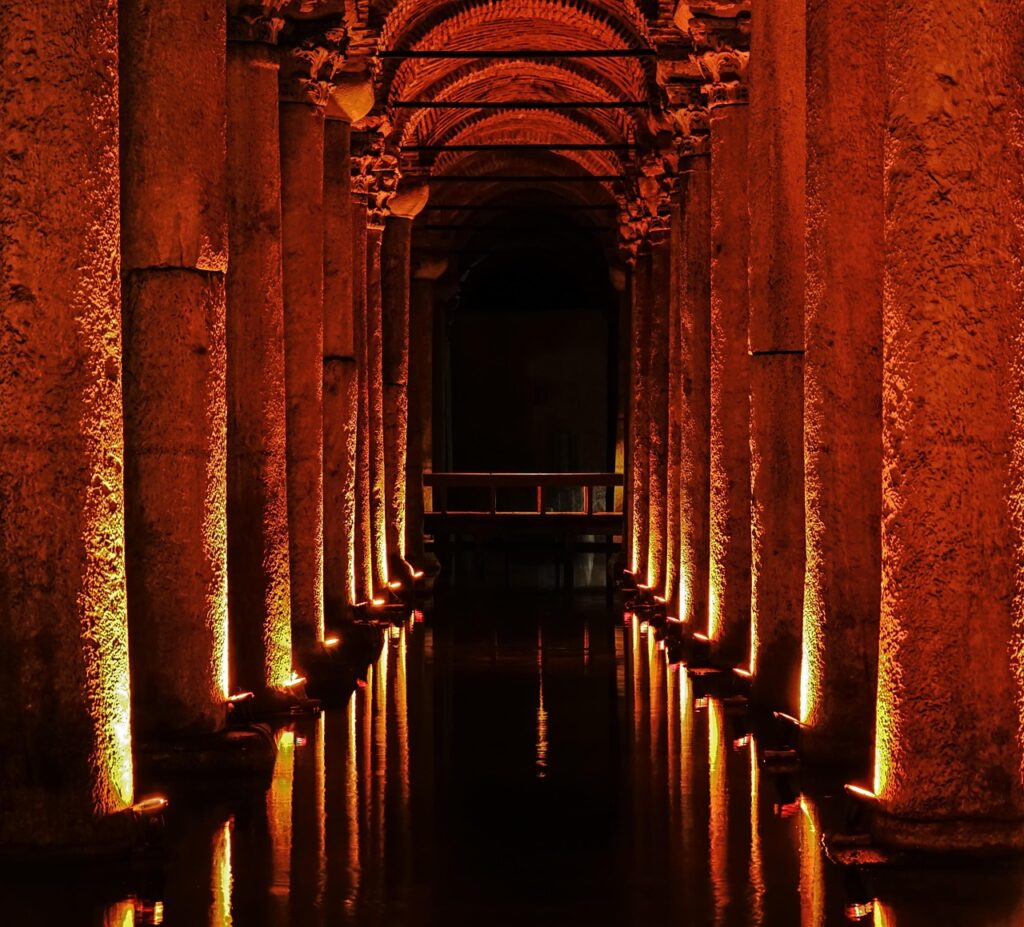
The museum era transformed the Basilica Cistern into the theatrical space that visitors know today. The lights were designed to show the columns and the water at their most beautiful, and the walkways were arranged to carry the crowds through the hall in comfort.
The new life of the cistern was immediate. Its images spread around the world, it appeared in films and features, and its fame grew far beyond anything its builders could have imagined, so that the working reservoir became a global icon.
The modern adaptation is a masterpiece in its own right. The balance of spectacle and sobriety, of light and shadow, of crowds and silence, is finely judged, and the museum has shown how a monument can be transformed without being diminished.
The Twenty-First Century Restoration
In the early twenty-first century, the Basilica Cistern received the most thorough restoration of its modern life. The great project cleaned the columns, repaired the ancient walls, and renewed the whole building, preparing it for another century of visitors.
The restoration was careful and respectful. The sixth-century fabric was preserved, the layers of history were kept, and the interventions were designed to be reversible, so that the cistern emerged from the work both refreshed and authentic.
The renewed cistern reopened to even greater acclaim. The restoration had burnished the Sunken Palace without tarnishing its mystery, and the visitors returned in their millions, drawn to the same dark wonder that had fascinated scholars, travelers, and emperors for fifteen centuries.
The Fish of the Cistern
One of the most beloved details of the cistern’s modern history is its fish. The shallow water has been home to schools of carp for decades, and the dark shapes drifting among the column bases have become part of the cistern’s atmosphere.
The fish are descendants of a tradition that reaches back to the cistern’s obscure centuries. The old accounts of the Sunken Palace mention fish in its waters, and the carp of today carry on that strange lineage, gliding through the reflections as their ancestors did when the hall was a forgotten legend.
For visitors, the fish add the living touch. The still water is suddenly alive, the ancient hall is inhabited, and the centuries compress into the glint of a silver side beneath the lights, one more layer in the endless story of the Sunken Palace.
The Cistern in the Imagination
The final chapter of the cistern’s story is its life in the imagination of the world. The Sunken Palace has become a symbol, a shorthand for the hidden wonders of Istanbul, and its image appears wherever the magic of the city is invoked.
The imagination was always part of its history. The Byzantines built it as a matter of survival, the Ottomans named it as a palace of legend, the travelers rowed through it as a romance, and the modern world photographs it as a dream. Each era has added its own layer of meaning.
That accumulation is the cistern’s true monument. More than the water, more than the columns, it is the continuity of wonder that defines the Basilica Cistern, and the visitor who descends into it today joins a procession that has been descending, in one form or another, for fifteen centuries.
Frequently asked questions
When was the Basilica Cistern rediscovered?
The cistern was rediscovered in the sixteenth century by the scholar Petrus Gyllius, who heard that houses in the district were built over water and found the flooded columned hall beneath them. His published account brought it back into history.
What was the Basilica Cistern used for in Ottoman times?
After the Ottoman conquest of 1453, the cistern gradually fell out of use as the Byzantine water system was not maintained. It was nicknamed the Sunken Palace, and for centuries it was neglected, flooded, and used for fishing and dumping before its restoration.
When did the Basilica Cistern become a museum?
The cistern was cleaned and opened to the public in the 1980s, after a major restoration that built the raised walkways and brought the water to a controlled level. It has since become one of the most visited monuments in Istanbul.

All Over Information
The All Over Information editorial team researches and writes practical English-language guides to Turkey. Facts are checked against official and local sources before publication, prices are published as dated ranges rather than quotes, and guides are revised when things change. We accept no sponsored posts, paid placements or paid links.
More guides like this

The Complete History of Aspendos Theatre
Near the south coast of Turkey, in the ancient region of Pamphylia, stands the best-preserved theatre of the Roman world.

Why Mevlana Museum Should Be on Your Turkey Bucket List
The Mevlana Museum of Konya — the tomb of the great mystic Rumi — is one of the most beloved monuments of…

Best Time to Visit Topkapi Palace to Avoid Crowds
Topkapi Palace is one of the most visited museums in the world, and its crowds are legendary: queues at the ticket gates,…

Galata Tower Through the Centuries
Galata Tower has outlived the empire that built it, the empire that adopted it, and most of the city that grew up…

Why Suleymaniye Mosque Should Be on Your Turkey Bucket List
Most travelers to Istanbul have the Blue Mosque and Hagia Sophia on their lists and treat the Suleymaniye as an optional extra.…

Why Maiden’s Tower Should Be on Your Turkey Bucket List
Istanbul is full of monuments you should see, but the Maiden's Tower is one of the few you should feel.