The underground cities of Cappadocia did not appear overnight, and they were not the work of a single century or a single people. They grew through thousands of years of history, each era carving new levels, adapting old chambers and leaving its mark on the subterranean world. From the ancient peoples of Anatolia to the Byzantine refugees, from abandonment to rediscovery in the 1960s, the story of the underground cities is a story told in layers of rock. This is that story, century by century.
The Deepest Origins
The first question about the underground cities is the hardest to answer: when did the carving begin? The soft tuff of Cappadocia has been cut, shaped and tunnelled by its inhabitants for thousands of years, and some scholars believe the earliest underground refuges may date back to the Hittite period, more than three thousand years ago, when the region was a troubled borderland of the ancient world.
The evidence is fragmentary, but the picture is clear enough: the habit of going underground is ancient in Cappadocia. The Hittites, the Phrygians and the peoples who followed them all lived among the region’s caves and carved dwellings, and the underground complexes may preserve the work of many of these eras. The cities as we see them are palimpsests, with the earliest carving deepest down and the newest nearest the surface.
The Persian Centuries
From the 6th century BC, Cappadocia lay within the Persian empire, and the region became a name in the wider ancient world. The Persian centuries brought the peoples of Anatolia into a single political system, and Cappadocia’s position, on the eastern edge of the Greek world and the western edge of the Persian, made it a land of contact and conflict.
It is plausible, though not proven, that the underground refuges were already in use in these centuries, hiding people and goods from the armies that passed through the region. The Persian era certainly established the pattern that would define Cappadocian history: a land that lay across the routes of empires, whose inhabitants learned that survival sometimes meant disappearing.

The Roman and Early Christian Age
Under the Roman empire, Cappadocia was a province, and later a frontier facing the revived Persian empire of the Sasanians. The region’s Christians, growing in number from the 1st century onward, took naturally to the rock-cut world, carving chapels, monasteries and hermit cells into the tuff. The underground tradition absorbed the new faith, and the carved landscape began to fill with Christian life.
The Roman centuries also brought the first written light on the region’s character. Roman authors noted that the Cappadocians lived in caves and carved dwellings, and the archaeological record shows growing use of the rock-cut world. By late antiquity, the pattern was fully formed: the tuff was not just a landscape but a city, and the underground complexes were its hidden quarters.
The Byzantine Age: The Great Expansion
The great chapter of the underground cities is the Byzantine period. From the 7th century, the Arab raids that swept Anatolia sent the population of Cappadocia underground in earnest, and the refuges were expanded on an extraordinary scale. It was in these centuries that complexes like Derinkuyu and Kaymakli reached their full depth and complexity, with chapels, storerooms and defensive systems carved level after level.
This was not improvisation but organised construction. The Byzantine communities planned their underground world, adding ventilation shafts, stone doors and all the apparatus of a functioning settlement. The scale of the work is the measure of the danger: these were cities built to hold out for weeks, and the fact that they were built at all tells you how terrible the raids were.
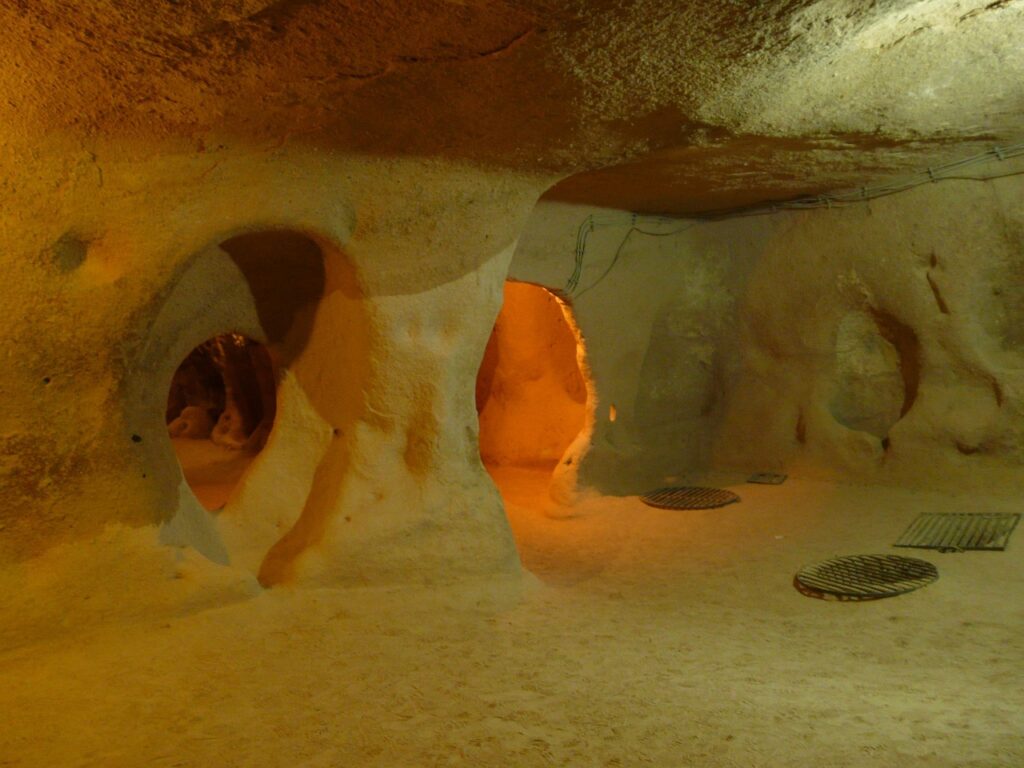
The Middle Ages: Life in the Rock
For centuries, the people of Cappadocia lived in and among the rock, and the underground cities were part of that life. Even in quieter times, the chambers served as storerooms, cellars and shelters, and the habit of carving continued. The medieval centuries saw the region’s rock-cut churches decorated with frescoes, and the monastic tradition of Cappadocia reached its height.
The underground cities in these centuries were less fortresses than a background to daily life, used when needed and abandoned when safe. The memory of the refuges persisted in the villages, passed down with the practical knowledge of where the tunnels ran and what they were for. The underground world was not forgotten; it was waiting.
The Seljuk and Ottoman Centuries
As the Seljuk Turks and then the Ottoman empire brought a new political order to Anatolia, the great invasions that had driven the population underground receded, and the underground cities fell out of use. The levels were sealed, the entrances were lost and the chambers were given over to storage, cellars and the slow accumulation of centuries of silence.
Under the Ottomans, the region’s villages carried on above the forgotten cities. Some chambers were used for wine and produce, and local people knew that tunnels ran beneath their homes, but the scale and purpose of the underground world had passed out of memory. The cities slept through the Ottoman centuries, preserved by the very rock that had hidden them, awaiting the moment when someone would break through again.

The Rediscovery in the 1960s
The modern history of the underground cities began in 1963, with a discovery that could have come from a novel. A resident of Derinkuyu, renovating his home, broke through a wall into a passage that led down and down, into a vast underground complex. The news spread, archaeologists arrived, and excavation revealed a multi-level city of astonishing scale and sophistication.
Derinkuyu was opened to the public, and the discovery prompted a search across the region. Kaymakli and other complexes were explored and excavated, and it became clear that Cappadocia’s underground world was not one city but many, a whole landscape beneath the landscape. The rediscovery transformed the region’s archaeology and added a new wonder to Turkey’s inheritance.
The Age of Conservation
Since the 1960s, the underground cities have entered a new chapter: the age of conservation. The sites are protected as part of Cappadocia’s extraordinary heritage, inscribed on the UNESCO World Heritage list, and they are managed as living archaeological sites, with stabilisation work, visitor routes and careful monitoring. The work of exploring the underground world continues, and new discoveries are still being made.
Conservation brings its own challenges. The soft tuff that made the cities possible is also fragile, and the footfall of millions of visitors must be managed carefully. The underground cities are being preserved not as they were in any single century but as the layered record of all of them, and the task of safeguarding that record will continue for generations.

The Underground Cities in the Twenty-First Century
Today, the underground cities are among the most visited attractions in Cappadocia, drawing travellers from every continent into the cool, dim world beneath the fairy chimneys. The visit has become one of the defining experiences of the region, and the cities’ fame has spread far beyond Turkey, as one of the most remarkable human creations ever discovered.
Yet the twenty-first century has also kept the mystery alive. The full extent of the underground world is still unknown, and new chambers continue to be found. The deepest questions, about who carved the first tunnels and when, remain open. The underground cities of Cappadocia are a story that is still being written, and every visitor who descends into the rock becomes part of it.
The People Who Lived Underground
Behind the engineering and the archaeology, the underground cities were homes, and the human story is the most moving part of their history. For the Byzantine families who descended into the rock, the chambers meant survival: the storerooms held their harvest, the stables held their animals, the chapels held their faith and the stone doors held their lives. Generations were born, raised and buried in the rhythm of the underground world.
The daily life of the refuges is written in the details. The wine presses show a community that kept its economy alive below ground. The kitchens and the smoke vents show meals cooked in the dark. The narrow tunnels worn smooth by feet, and the handholds carved into the steepest stairs, show the thousands of journeys made in fear and in hope. The underground cities are not abstract monuments; they are the traces of real people, and their presence is still tangible in the rock.
The Continuing Discovery
One of the most exciting facts about the underground cities is that their story is not finished. Archaeologists estimate that the known complexes may be only a part of a far larger underground world, and discoveries continue to be made across Cappadocia. New chambers, new connections between cities and new details of daily life emerge with every season of work.
The ongoing discovery means that every visit is, in a sense, a moment in the history of the sites. When you descend into the underground cities, you are not seeing a finished museum; you are seeing a landscape that is still being understood, century by century, chamber by chamber. The story of the underground cities, which began thousands of years ago, is still being written, and you are part of it.
Frequently asked questions
When were the underground cities built?
The earliest carving may date back thousands of years, perhaps to the Hittite or Phrygian periods, but the great expansion of complexes like Derinkuyu and Kaymakli came in the Byzantine period, from the 7th century onward, when Arab raids drove the population underground.
What happened to the underground cities after the Byzantine era?
As the invasions receded and the Seljuk and Ottoman empires brought a new order to Anatolia, the cities fell out of use and their entrances were lost. The chambers served as storage for centuries until the modern rediscovery in the early 1960s.
How were the underground cities rediscovered?
In 1963, a resident of Derinkuyu renovating his home broke through a wall into a vast underground complex. The discovery led to excavation, the exploration of Kaymakli and other sites, and the opening of the cities as one of the region’s greatest attractions.

All Over Information
The All Over Information editorial team researches and writes practical English-language guides to Turkey. Facts are checked against official and local sources before publication, prices are published as dated ranges rather than quotes, and guides are revised when things change. We accept no sponsored posts, paid placements or paid links.
More guides like this

Aspendos Through the Centuries
Aspendos is one of the oldest cities of the Turkish coast, and its story spans more than two and a half thousand…
The Architecture of Gobekli Tepe Explained
Gobekli Tepe is the oldest monumental architecture in the world, and its design is unlike anything built before or since.
The Architecture of Sardis Explained
Sardis was built on a site of extraordinary natural strength and beauty: a steep acropolis rock, a broad fertile valley, and a…
Best Time to Visit Mount Nemrut to Avoid Crowds
Mount Nemrut is one of the few ancient sites where the crowds gather at a specific hour, and that makes timing everything.
Best Time to Visit Zeugma Mosaic Museum to Avoid Crowds
The Zeugma Mosaic Museum is an indoor museum, and that changes the rules of crowd avoidance entirely.

Visiting Termessos: Tickets, Hours, and Tips
Termessos is the wildest of Turkey's great ancient cities, a Pisidian stronghold built high in the Taurus mountains above Antalya, surrounded by…