Aspendos is one of the oldest cities of the Turkish coast, and its story spans more than two and a half thousand years. Most visitors know only its theatre, but the city behind that monument lived through legendary foundations, Persian wars, the march of Alexander, Roman prosperity, Seljuk restoration and the birth of modern tourism. Reading Aspendos through the centuries gives the theatre its context, and it explains how one building survived when so much else did not.
The Legendary Beginnings
Aspendos’s story begins in the mist of Greek legend. Tradition held that the city was founded by colonists from Argos, led by heroes who settled the Pamphylian coast in the generations after the Trojan War. The founder figure gave the city its name, and the claim of Argive descent became a badge of honour that Aspendos displayed for centuries, a way of claiming kinship with the wider Greek world.
Whether or not the legend is literally true, it points to a real history: the coast of Pamphylia was settled by Greek colonists who mixed with the local peoples of Anatolia. Aspendos grew up on the Eurymedon River, the modern Koprucay, at a point where the river met the fertile plain. The location, with its river port and its defensible high ground, was the foundation on which the city’s whole future was built.
The Persian Century and the River Battle
By the 5th century BC, Aspendos was part of the Persian empire, paying tribute while running its own affairs. The city grew rich on the produce of the plain, on the river trade and on its famous horses, and it minted its own coins as a sign of its wealth and identity. The Persian peace brought stability, but it also brought the great powers of the Greek world to the city’s horizon.
Around 466 BC, that horizon turned violent. The Athenian fleet under Cimon met and destroyed the Persian navy at the mouth of the Eurymedon River, in the waters that served Aspendos, and the victory became one of the most famous naval engagements of the age. The battle broke Persian sea power for a generation, and it placed Aspendos, willy-nilly, at the centre of a turning point in ancient history.

Alexander and the Stubborn City
In 333 BC, Alexander the Great reached Aspendos, and the meeting was not friendly. The city agreed to provide money and horses for the campaign, then reconsidered when Alexander moved on, refusing to honour the deal. Alexander returned with his army, and Aspendos submitted, paying a heavier price than it would have paid for prompt compliance.
The episode is the most detailed story we have from early Aspendos, and it shows the city’s character: wealthy, proud and willing to test even the conqueror of the world. It also shows the price of that pride. Aspendos survived Alexander, as it had survived Persia, but it learned that its independence had limits, a lesson the whole region was learning at the same time.
The Hellenistic Age of Trade
After Alexander’s death, Aspendos passed through the long contests of his successors, influenced by the Ptolemies, the Seleucids and later the kingdom of Pergamon. Through every change, the city kept its identity and its prosperity. The Eurymedon valley was rich, the river carried its produce to the sea, and Aspendos’s coins, bearing the symbols of the city, travelled across the eastern Mediterranean.
The Hellenistic period was the age in which the city consolidated its position. Its fortifications were maintained, its port kept busy and its famous independence asserted itself whenever opportunity allowed. The wealth accumulated in these centuries was the foundation for the great age that followed, when Rome arrived and Aspendos built the monuments that still define it.
The Roman Century of Adjustments
Rome’s power reached Anatolia in the 2nd century BC, and Aspendos, like the other cities of the coast, had to adapt. The city made a last, desperate attempt to preserve its independence in the 1st century BC, even hiring pirates in a doomed effort to resist, but the pirates were crushed and Aspendos was brought into the Roman world for good.
Under Rome, the city found peace and profit. The civil wars of the late Republic gave way to the long stability of the Pax Romana, and the cities of Asia Minor competed to build, decorate and display. Aspendos joined the competition with enthusiasm, and the stage was set for the great building age that would give the world its most perfect ancient theatre.
The Golden Age and the Great Theatre
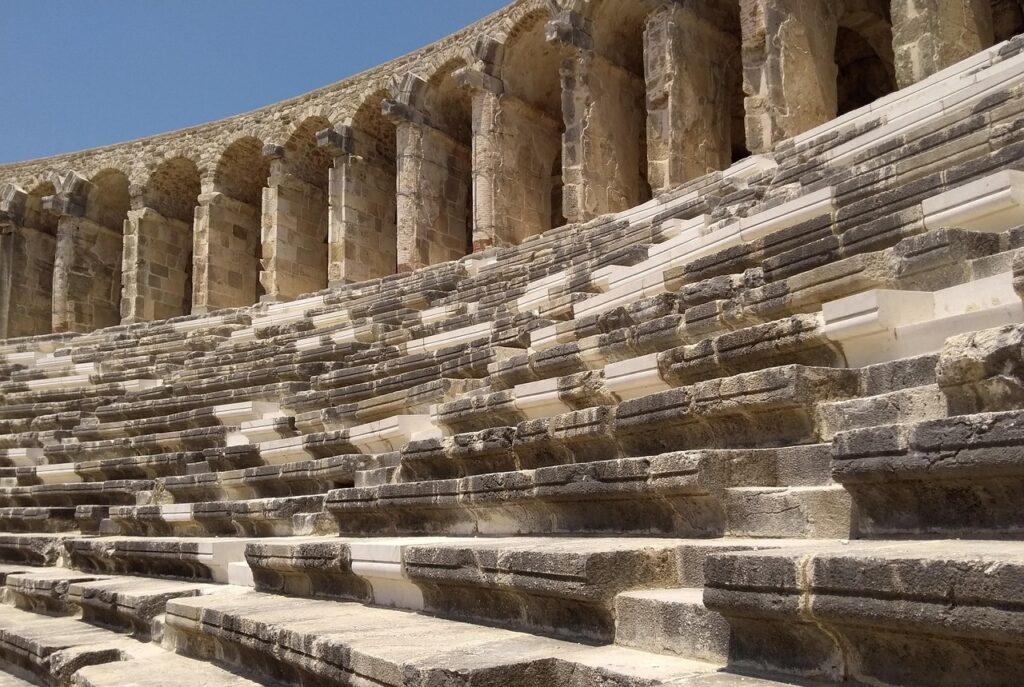
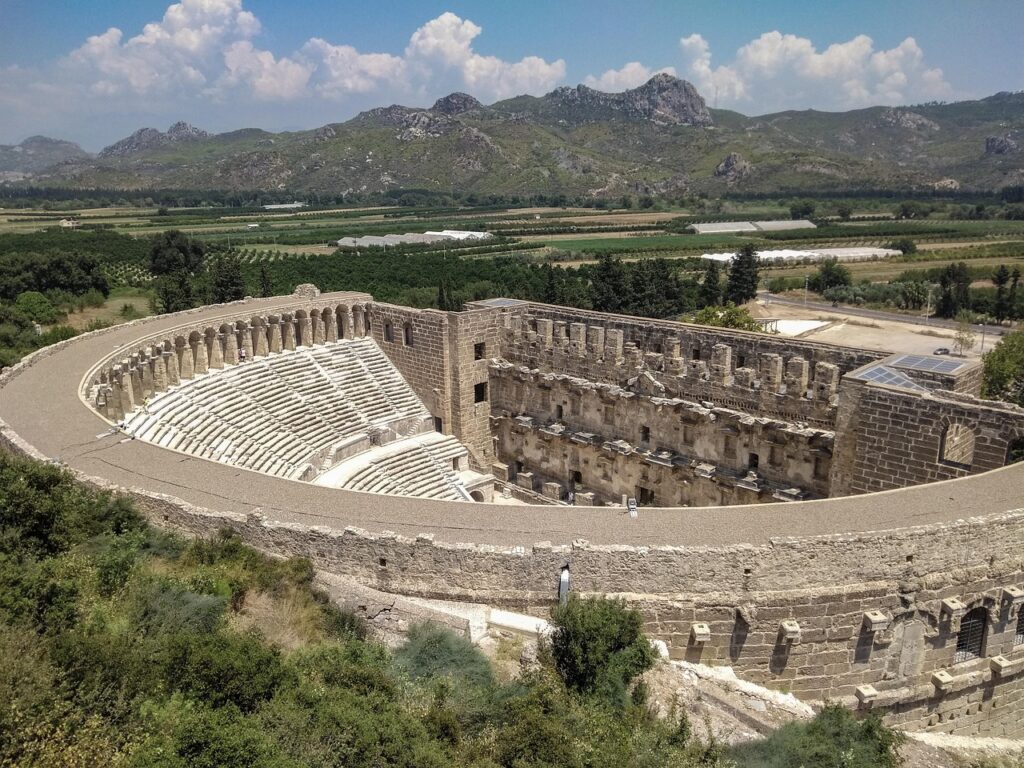
The 2nd century AD was Aspendos’s finest hour. The city was rich, confident and eager to show it, and it poured its wealth into public building. The theatre, built in the middle of the century under the emperor Marcus Aurelius, was the masterpiece: a vast bowl of seating and a towering stage building, designed by the local architect Zenon and financed by a wealthy citizen of Aspendos.
The theatre was joined by other monuments: a stadium, a basilica, baths and an agora, the full apparatus of a Roman city. And across the plain strode the great aqueduct, carrying water to the city’s fountains and baths. In the 2nd century, Aspendos looked the way the empire’s best cities looked, and the theatre, then as now, was the jewel in its crown.

Late Antiquity and the Long Decline
From the 4th century onward, Aspendos shared the slow decline of the classical world. Christianity replaced the old gods, the city’s population shrank and its great public buildings outlived their uses. The theatre, stripped of its marble and its statues, stood as a vast shell, and the river trade that had made the city rich gradually moved elsewhere.
By the early Middle Ages, Aspendos was a shadow of itself. The city had not disappeared, but its grandeur had, and the great theatre survived mostly because it was too solid to fall easily. The centuries of abandonment were hard on the building, but they were not fatal, and the theatre waited through them for the intervention that would save it.
The Seljuk Rescue
That intervention came in the 13th century, in an unexpected form. The Seljuk Turks, who then ruled the region, found the old theatre and recognised its value. They repaired the structure, rebuilt parts of the stage building and put the great hall to new uses, as a caravanserai for travelling merchants and as a palace. An inscription on the building records their work.
The Seljuk restoration is one of the most important chapters in Aspendos’s story, because it is the reason the theatre survives today. The medieval builders maintained the Roman structure with skill and care, and their repairs carried the building through the centuries that followed. Aspendos was saved not by a museum but by a civilisation that put the old theatre back to work.
The Ottoman Century and the Quiet Years
Under the Ottoman empire, Aspendos returned to obscurity. The region was ruled from elsewhere, the ancient city was no more than a village among ruins, and the theatre stood as a curiosity for shepherds and travellers. The great building was known locally, but the wider world had forgotten it, and its perfection went uncelebrated for centuries.
The quiet years were, in a sense, good for the theatre. Abandoned but not demolished, intact but not rebuilt, the building simply stood, slowly gathering the soil and the vegetation of neglect. When the first Western travellers of the 19th century reached Aspendos and recognised what they were seeing, they found a Roman theatre that had survived the Middle Ages almost by the power of its own construction.
Rediscovery and the Festival Age
The 19th century put Aspendos back on the map. Travellers and antiquarians marvelled at the theatre and published its praises, and the building’s fame grew across Europe. In the 20th century, as modern Turkey developed its heritage, Aspendos was restored, protected and, in the 1930s, given a new life: the stage was used again for performances, and the tradition of theatre at Aspendos was reborn.
Today the theatre hosts an international opera and ballet festival, and it has become one of the most visited sites in Turkey. The city that bargained with Alexander and fought alongside pirates now entertains the world, and its theatre, saved by Seljuk craftsmen and celebrated by modern audiences, has completed the most remarkable journey of any ancient building in the region.
Aspendos in Your Century
For the modern visitor, Aspendos offers an unusually complete arc of history. You can stand in a theatre where Romans sat, trace the Seljuk repairs that saved it, admire the aqueduct that fed the Roman city and listen to performances that continue a tradition two thousand years old. The centuries are not buried at Aspendos; they are stacked visibly in the stone.
The city’s story is also a lesson in survival. Aspendos endured Persia, Alexander, Rome, the Arab raids and the centuries of neglect, and it is still standing. When you visit, you are not just seeing the best-preserved ancient theatre in the world; you are seeing the endpoint of a story that began with legendary Argive founders and is still being written, one performance at a time.
Frequently asked questions
What is the oldest part of Aspendos’s history?
The city claimed foundation by Greek colonists from Argos in the generations after the Trojan War, and it was certainly an established city by the 5th century BC, when it minted its own coins under Persian rule and the battle of the Eurymedon was fought nearby.
When was the theatre of Aspendos built?
The theatre was built in the middle of the 2nd century AD, during the reign of the emperor Marcus Aurelius, by the local architect Zenon. It was restored in the 13th century by the Seljuk Turks, whose work is recorded in an inscription on the building.
What happened to Aspendos after the Roman period?
The city declined through late antiquity and the Middle Ages, its trade fading and its population shrinking. The theatre survived thanks to Seljuk restoration and later careful modern conservation, and today it hosts an international opera and ballet festival.

All Over Information
The All Over Information editorial team researches and writes practical English-language guides to Turkey. Facts are checked against official and local sources before publication, prices are published as dated ranges rather than quotes, and guides are revised when things change. We accept no sponsored posts, paid placements or paid links.
More guides like this

The Architecture of Aphrodisias Explained
Aphrodisias is the rare ancient city you can read like a textbook, because almost all of it was built from the same…

Best Time to Visit Xanthos to Avoid Crowds
Xanthos is one of the quietest of Turkey's great ancient sites, a hilltop of ruins on the Lycian coast that most travelers…
The Architecture of Sardis Explained
Sardis was built on a site of extraordinary natural strength and beauty: a steep acropolis rock, a broad fertile valley, and a…

Best Time to Visit Hierapolis to Avoid Crowds
Hierapolis shares its gates with the travertine terraces of Pamukkale, and together they form one of the most visited attractions in Turkey.

Best Time to Visit Troy to Avoid Crowds
Troy is one of the quieter great sites of Turkey, and for most of the year the crowds are modest, but they…
Best Time to Visit Zeugma Mosaic Museum to Avoid Crowds
The Zeugma Mosaic Museum is an indoor museum, and that changes the rules of crowd avoidance entirely.