The history of Derinkuyu Underground City is measured not in years but in centuries, and even in millennia. Beneath a modest village in Cappadocia lies a city that was carved, expanded, sealed, forgotten, and rediscovered over the course of thousands of years. It witnessed the rise and fall of Hittite kings, Roman legions, Byzantine bishops, and Ottoman governors, adapting to each new age. Tracing Derinkuyu through the centuries is like reading a history of Anatolia in stone, from the volcanic dawn of the landscape to the tourist trails of today. This article follows the city’s journey, era by era, from geology to UNESCO.
The Volcanic Foundation
The story of Derinkuyu begins long before humans. Millions of years ago, the volcanoes of central Anatolia, among them the great peaks of Erciyes and Hasan, erupted repeatedly, blanketing the plateau in ash. Over time, that ash compacted into tuff, a soft stone that would one day prove ideal for underground building.
The same eruptions shaped the entire landscape of Cappadocia, creating the valleys, fairy chimneys, and hidden canyons that make the region so distinctive. For early humans, the tuff offered shelter of a different kind: caves that could be lived in, and rock soft enough to be carved into something more permanent. The geology of the region set the stage for everything that followed.
The First Excavators
No written record tells us who first cut chambers beneath Derinkuyu, but archaeology offers strong clues. The Hittites, whose empire dominated central Anatolia more than three thousand years ago, are known to have used underground refuges in times of trouble. Some scholars believe the deepest, simplest chambers at Derinkuyu are Hittite work.
Others point to the Phrygians, a people who arrived around the eighth century BC and were masters of rock-cut architecture, carving entire cities and shrines from the cliffs of central Anatolia. Whatever the truth, the earliest levels of Derinkuyu were almost certainly begun more than two and a half thousand years ago, and the tradition of underground building in Cappadocia is far older than the city itself.
The early builders worked with simple tools, but their ambitions were anything but simple. The deepest chambers show an understanding of geology, drainage, and airflow that must have been learned through generations of trial and error. Every level added was a lesson passed down, and the city grew wiser with the centuries.
The Persian and Hellenistic Centuries
In the sixth century BC, the region fell under Persian rule, and Cappadocia became a satrapy of the great empire. For the people of the plateau, the underground cities may have served as refuges in troubled times, though the great expansion was still centuries away.
When Alexander the Great swept through Anatolia in the fourth century BC, the old Persian order collapsed, and the region passed through a succession of Hellenistic kingdoms. Greek culture, language, and religion spread across Cappadocia, and the first churches carved into the region’s rocks began to appear. The underground world continued to grow, shaped now by the customs and beliefs of the Hellenistic age.
Roman Expansion and the Early Underground City
Under the Roman Empire, Cappadocia prospered. The region became a province, roads were built, trade flourished, and Christianity began to spread through its cities and villages. It was in this era that Derinkuyu began to take on the form we recognize today.
The Roman centuries were also centuries of persecution for the new faith, and the underground cities offered Christians a place to worship and hide. The early rock-cut churches of Cappadocia date from this period, and it is likely that the underground settlement was already substantial. The city was no longer a simple refuge; it was becoming a community, a place where people could live in safety and faith.
The Byzantine Golden Age
The great age of Derinkuyu came in the Byzantine era. From the seventh century, the region faced a new and terrible threat: raids by Arab armies pushing north from the Mediterranean coast. The people of Cappadocia responded by expanding their underground cities into the vast, sophisticated networks that survive today.
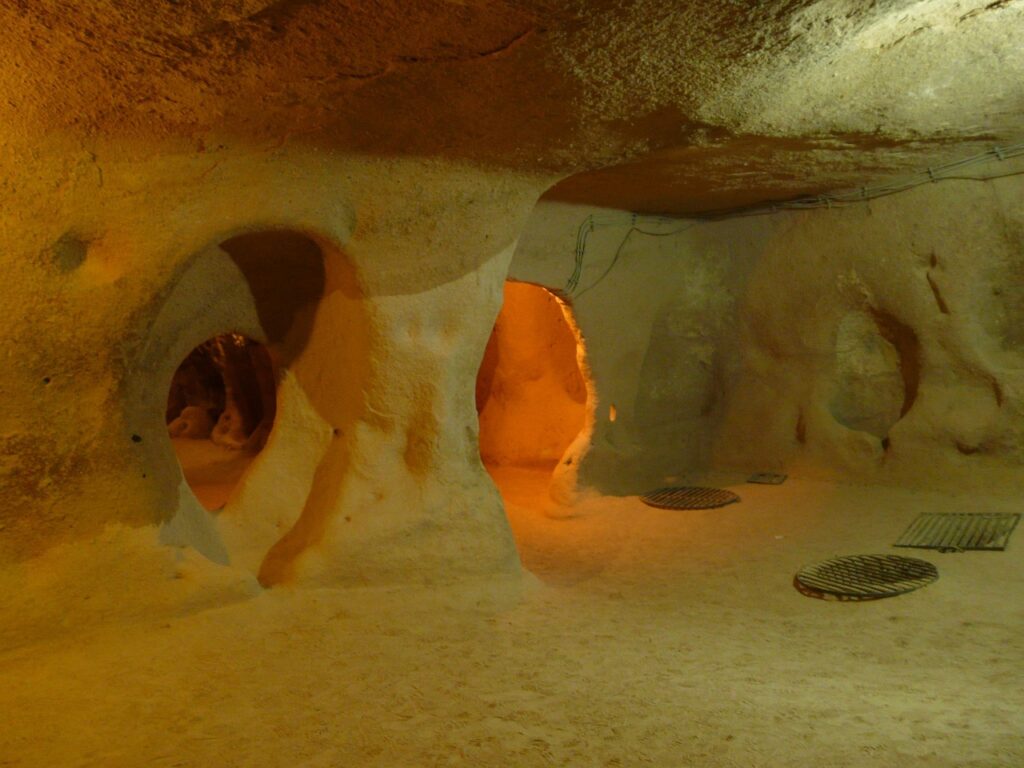
Level after level was added, rolling stone doors were installed, ventilation shafts were driven deeper, and the city grew large enough to shelter tens of thousands of people. Chapels, baptismal rooms, and meeting halls were carved for the community’s spiritual life. For centuries, Derinkuyu functioned as a complete underground city, the product of a civilization under constant threat and of the remarkable engineering that threat inspired.
Historians have also noted how the city mirrored the surface world. When the region prospered, the underground city grew; when peace returned, its rooms were given over to storage and wine. The city was not a static monument but a living part of the community, breathing with the rhythms of its history.
The Age of Refuge
The centuries of Arab raids, from the seventh to the ninth, were the underground cities’ finest hours. When the warning came, the population of the surrounding district would descend into Derinkuyu, sealing the entrances behind them. The city was stocked with grain, wine, oil, and water, and it could hold out for months.
The raids came and went, and each time the city proved its worth. Written sources and archaeology confirm that these refuges saved countless lives over the centuries. The experience left a deep mark on the region: even after the raids ended, the people of Cappadocia continued to maintain their underground cities, ready for whatever danger the next century might bring.

The Seljuk and Ottoman Centuries
By the eleventh century, new powers had risen in Anatolia. The Seljuks arrived from the east, followed later by the Ottomans, and the region’s political life was transformed. The great raids that had shaped the underground cities faded, and Derinkuyu’s role changed with them.
The city was not abandoned. In the Ottoman centuries, it served as a place of storage, a cool cellar for the village’s wine and grain, and a refuge in times of local unrest. The upper levels were kept in use, while the deepest chambers were gradually abandoned and forgotten. For many centuries, the people of the village above lived their lives knowing, vaguely, that something lay beneath their feet, though its full extent had passed from memory.
The Long Obscurity
As the centuries passed, knowledge of the city faded. The entrances were blocked or built over, and the underground chambers were swallowed by silence. The village of Derinkuyu went about its business, and the great city beneath it became a local legend, a rumor of hidden rooms and secret passages.
In the early twentieth century, the region experienced dramatic change, including population movements that reshaped its villages. Yet through it all, the city below remained undisturbed. The tuff that had preserved the city for thousands of years continued its work, holding the chambers, the carvings, and the rolling doors in a state of remarkable preservation, waiting for a century that would finally pay attention.
The legends of the village played their part in keeping the memory alive. Stories of hidden tunnels running beneath the fields, of rooms that no living person had seen, passed from generation to generation. When the 1963 discovery finally came, it seemed to many villagers less like a surprise and more like a confirmation of what they had always suspected.

1963: The Rediscovery
The modern story of Derinkuyu began, as such stories often do, by accident. In 1963, a resident of the village knocked through a wall during a renovation and discovered a mysterious chamber behind it. Curious, he kept digging, and the chamber led to a passage, and the passage led to the underground city.
The discovery spread quickly through the village and then to the wider world. Archaeologists arrived, initial surveys were made, and the scale of the find became clear. Within a few years, the site had been cleared, reinforced, and opened to visitors. A village that had unknowingly lived on top of one of the wonders of the ancient world had found its place in history.
From Village to World Heritage
Since its rediscovery, Derinkuyu has become one of the great attractions of Cappadocia. The open levels were stabilized and lit, and visitors from around the world now descend into the city each day. In 1985, the rock sites of Cappadocia, including the underground cities, were inscribed on the UNESCO World Heritage List.
The centuries have brought the city full circle. Built as a refuge, it is now a place of welcome; hidden for so long, it is now one of the most visited sites in Turkey. Yet the deepest levels remain unexplored, and the oldest stories may still lie sealed in the rock. After thousands of years, Derinkuyu is still writing its history.
For travelers, the centuries of Derinkuyu offer a rare perspective. Standing in a room carved before the pyramids were finished, you are touching a history that spans almost all of recorded time. The city is a reminder that the past is never as far away as it seems, and that the ground beneath our feet holds more history than any museum.
Frequently asked questions
How old is Derinkuyu Underground City?
The earliest chambers may date back more than three thousand years, to the Hittite or Phrygian periods. The major expansion came in the Byzantine era, between the seventh and ninth centuries, when the city was enlarged as a refuge from Arab raids. The city was continuously used for centuries after that.
When was Derinkuyu rediscovered?
Derinkuyu was rediscovered in 1963, when a villager knocked through a wall during a renovation and found a hidden chamber. Further digging revealed the underground city, and archaeologists soon confirmed its scale. It was opened to visitors within a few years of the discovery.
Why was Derinkuyu built underground?
The city was primarily a refuge. During periods of invasion, particularly the Arab raids of the Byzantine era, the population of the region sheltered in Derinkuyu, sealing the entrances with rolling stone doors. The city was equipped to sustain thousands of people, with food stores, water, and ventilation.

All Over Information
The All Over Information editorial team researches and writes practical English-language guides to Turkey. Facts are checked against official and local sources before publication, prices are published as dated ranges rather than quotes, and guides are revised when things change. We accept no sponsored posts, paid placements or paid links.
More guides like this

The Complete History of Aspendos
Aspendos is known to the world for one thing: its theatre, the best-preserved ancient theatre anywhere, a two-thousand-year-old building so intact that…

Why Kaymakli Underground City Should Be on Your Turkey Bucket List
Every traveler to Cappadocia hears about the underground cities, and most of them rush straight to Derinkuyu, the largest and deepest of…

Sardis Through the Centuries
Sardis is one of the oldest and most storied cities of Anatolia, and for a few centuries in the first millennium BC…
The Architecture of Kaymakli Underground City Explained
Kaymakli Underground City is one of the great works of ancient engineering, a city carved into the living rock of Cappadocia and…

Best Time to Visit Perge to Avoid Crowds
Perge is one of the quieter great sites in Turkey, but quiet is relative, and there are clearly better and worse times…

Visiting Miletus: Tickets, Hours, and Tips
Miletus is one of the most rewarding ancient sites on the Aegean coast of Turkey, and also one of the easiest to…