The Zeugma Mosaic Museum is the end point of a story two thousand years long. It began with a Greek city founded on the banks of the Euphrates, continued through the centuries of Roman rule that made the city rich in art, and was rescued in our own time from the rising waters of a dam. The museum is the latest chapter in the history of Zeugma, and the whole story is told within its walls. This is that story, century by century.
The Hellenistic Foundation
The story begins around 300 BC, when Seleucus I Nicator, one of Alexander the Great’s generals, founded a city at one of the great crossing points of the Euphrates. He settled the site with his veterans and colonists, and the new city, first called Seleucia, joined the network of Greek foundations that stretched across his eastern empire.
The city’s position made it valuable from the start. The Euphrates was the barrier between the Mediterranean world and the East, and whoever controlled the crossing controlled the trade. The city grew as a frontier settlement, part Greek, part Syrian, part Persian, a meeting place of peoples.
For three centuries the city lived under the successors of Alexander. It passed from the Seleucids to the kingdom of Commagene and back again, and it developed the mixed culture that would later make it famous. Its greatest age, however, belonged to Rome.
The Roman Century of Wealth
In 64 BC, the Roman general Pompey reorganised the East, and the city, now called Zeugma, entered the Roman world. Under Roman rule the crossing point became a proper frontier city, and the traffic of legions, merchants, and officials made it one of the most important towns of the province of Syria.
The Roman centuries brought the city its wealth. The legion based in the region brought soldiers and money, the trade routes brought goods from both directions, and the city grew into a substantial urban centre with temples, baths, a theatre, and grand houses climbing the terraces above the river.
It was this prosperity that created the collection the museum holds today. The wealthy families of Roman Zeugma built themselves villas and decorated them with the finest mosaics money could buy, and the second and third centuries AD produced the art that would survive the city itself.

The Villas and Their Owners
The villas of Zeugma are the key to its art. The city’s elite built their houses on the hillsides above the Euphrates, with rooms arranged around courtyards and floors paved with mosaics. Each villa was a statement of wealth, taste, and status.
The owners were the city’s merchants, officials, and military families, and their tastes are written in their floors. They chose scenes of mythology and heroes, of gods and sea creatures, and they commissioned portraits of their families, all worked by professional mosaic workshops.
The villas were filled with more than mosaics. The excavations found statues, fountains, wall paintings, and the everyday objects of Roman life, and together they show the complete domestic world of a wealthy frontier city. The villas were miniature palaces, and their art has survived.
The Mosaicists at Work
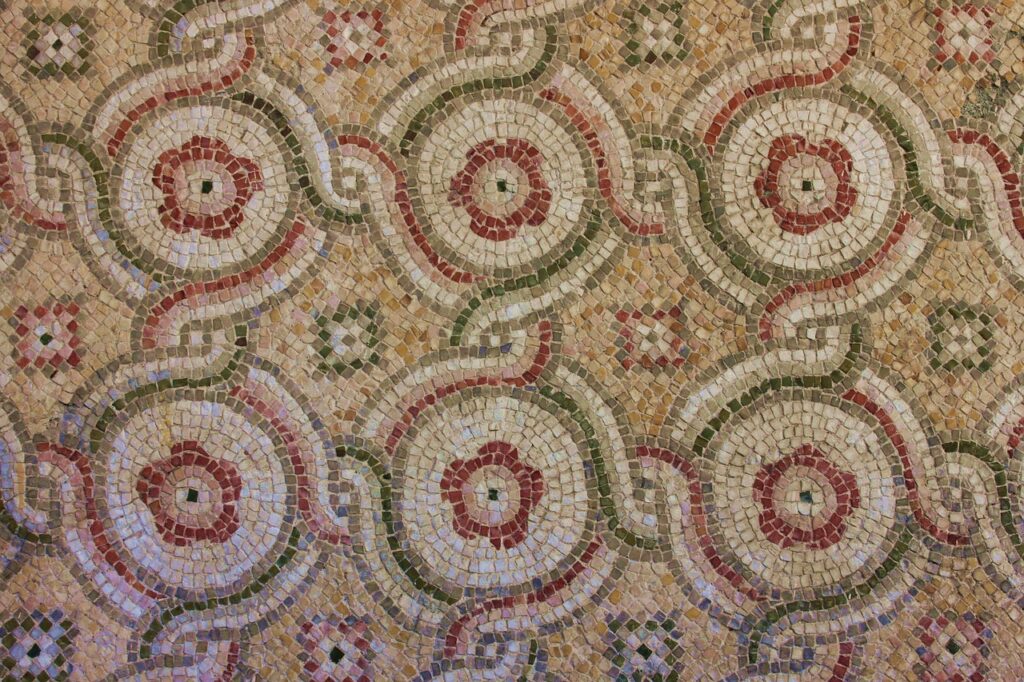
The mosaicists of Zeugma were professionals at the top of their craft. They worked in the Roman technique of opus tessellatum, laying thousands of small stone cubes into beds of mortar, and their finest works used tesserae only a few millimetres across to achieve almost painterly detail.
The workshops were organised and skilled. Designs were planned, tesserae were cut, and teams laid the floors in sections, working from the patterns of the borders toward the central panels. The best of their work, the portraits and the great figural scenes, ranks with the finest mosaics of the Roman world.
The craft flourished in the second and third centuries, when the city was at its richest, and the competition among villa owners pushed the workshops to ever higher standards. The mosaics of Zeugma are the legacy of those workshops, preserved against the odds.

The City’s Decline
From the third century, Zeugma’s fortunes turned. The Roman Empire entered its long crisis, the frontier came under pressure from the Persian Sassanids, and the city, so dependent on peace and trade, began to shrink. The grand villas were abandoned one by one.
By late antiquity, the city was a shadow of itself. The buildings decayed, the population fell, and the great houses crumbled into the earth. In the centuries that followed, the site was gradually abandoned, and the Euphrates and its silt buried the ruins, the villas, and the mosaics under meters of soil.
The burial, again, was the art’s salvation. Sealed beneath the fields, the floors escaped the plough and the weather, and they survived in extraordinary condition, waiting for the moment when the modern world would find them. The city died, but its art slept.
The Site at Belkis
The ruins slept by the river under a village called Belkis, whose name preserved a local legend of a queen. Archaeologists knew from the nineteenth century that a great ancient city lay in the fields, and scattered finds hinted at its riches, but excavation was slow and the site vast.
Through the twentieth century, the site attracted growing interest. Surveys mapped the ruins, and rescue digs revealed houses, streets, and the first of the mosaics, and it became clear that Zeugma was one of the most important Roman cities of the East. The discoveries only increased the urgency of study.
Then the modern world intervened. In the 1990s, Turkey built the Birecik Dam on the Euphrates, and its reservoir was planned to flood the site. With the waters rising, the quiet archaeology of Belkis became a desperate race to save the city’s treasures.
The Twentieth-Century Excavations
The modern excavations at Zeugma began in earnest in the 1990s, driven by the threat of the dam. Turkish archaeologists, joined by international teams, worked to map and excavate the site, and their finds exceeded all expectations: villa after villa with their mosaics still in place.
The quality of the art stunned the archaeological world. The floors of Zeugma were not provincial work but the output of the finest workshops, and the portraits, the mythological scenes, and the great figural panels took their place among the masterpieces of Roman art. The site became world news.
The excavations were also a logistical challenge. The site was huge, the time was short, and the methods had to be developed as they went, from the lifting of the mosaics to the recording of the villas. The teams were writing the manual of rescue archaeology as they used it.
The Race Against the Dam
The year 2000 saw the climax of the rescue. As the Birecik Dam filled and the waters closed in, an international campaign worked around the clock to save the most important remains. The mosaics were cut from their floors, rolled and mounted, and carried to safety as the reservoir rose behind them.
The rescue captured the world’s imagination. The Gypsy Girl, discovered in 1998, became the symbol of the campaign, her face appearing in newspapers and broadcasts around the globe, and the drama of the race gave the mosaics a modern fame their ancient makers could never have imagined.
When the waters finally covered the lower parts of the city, the greatest treasures were already safe. The rescued floors were transported to Gaziantep, and the city began planning the museum that would give them a permanent home.

The Museum Project
The museum project turned the rescue into a collection. Gaziantep, which already possessed a respected archaeological museum, commissioned a new building worthy of the Zeugma finds, and the rescued mosaics were conserved, restored, and prepared for display through the 2000s.
The work of preparation was immense. Thousands of mosaic sections had to be cleaned, repaired, and reassembled into complete floors, and the conservation laboratories developed methods for treating the ancient tesserae. The project was a museum-building and an archaeological project at once.
The new museum took shape in the centre of the city, a purpose-built complex designed around the floors. When it opened in September 2011, it was one of the largest mosaic museums in the world, and the rescue of Zeugma had found its permanent monument.
The Museum Today
Today the Zeugma Mosaic Museum is one of the great cultural institutions of Turkey. It welcomes visitors from around the world, displays the rescued floors in galleries built for them, and tells the full story of the city, from its foundation to the race against the dam.
The museum continues to grow. Research on the collection continues, conservation work goes on in the laboratories, and the site of Zeugma itself remains a focus of archaeological study, with parts of the city still being explored above the waters of the reservoir.
After two thousand years, the city by the Euphrates has found its voice again. The museum is the latest chapter in the long history of Zeugma, and the story it tells, of a city, its art, and its rescue, is one of the great tales of the modern archaeological age.
Frequently asked questions
When was Zeugma founded?
Zeugma was founded around 300 BC by Seleucus I Nicator, one of Alexander the Great’s generals, at a major crossing point of the Euphrates. The city was originally called Seleucia and later took the name Zeugma, meaning bridge or junction, as it became a key Roman frontier city.
How was the museum’s collection saved?
The mosaics were saved in a rescue excavation that climaxed in 2000, when the Birecik Dam was flooding the site. Archaeologists cut the floors into sections and transported them to safety, and the rescued material was then conserved and prepared for display in the new museum, which opened in 2011.
Is the ancient city of Zeugma still visible?
Parts of Zeugma survive above the waters of the reservoir and remain the subject of archaeological work, but the lower city now lies beneath the lake. The museum in Gaziantep tells the city’s full story and displays the art rescued from the flood.

All Over Information
The All Over Information editorial team researches and writes practical English-language guides to Turkey. Facts are checked against official and local sources before publication, prices are published as dated ranges rather than quotes, and guides are revised when things change. We accept no sponsored posts, paid placements or paid links.
More guides like this

Visiting Cappadocia’s Underground Cities: Tickets, Hours, and Tips
Few experiences in Turkey are stranger or more memorable than descending into a Cappadocian underground city.

Best Time to Visit Gobekli Tepe to Avoid Crowds
Gobekli Tepe has become one of Turkey's most talked-about archaeological sites, and with fame comes crowds.
Why Priene Should Be on Your Turkey Bucket List
Most travelers to Turkey plan their ancient cities around the great names: Ephesus, Pergamon, Hierapolis. Priene rarely makes the first draft of…
Why Miletus Should Be on Your Turkey Bucket List
Every traveler to Turkey knows Ephesus, and every list of ancient cities starts with the same famous names. But Miletus, a short…

The Complete History of Termessos
Termessos is one of the most extraordinary ancient cities in the world: a Pisidian mountain city built high in the Taurus range…

Why Ephesus Should Be on Your Turkey Bucket List
Every country has one site that sums it up, and for Turkey that site is Ephesus.