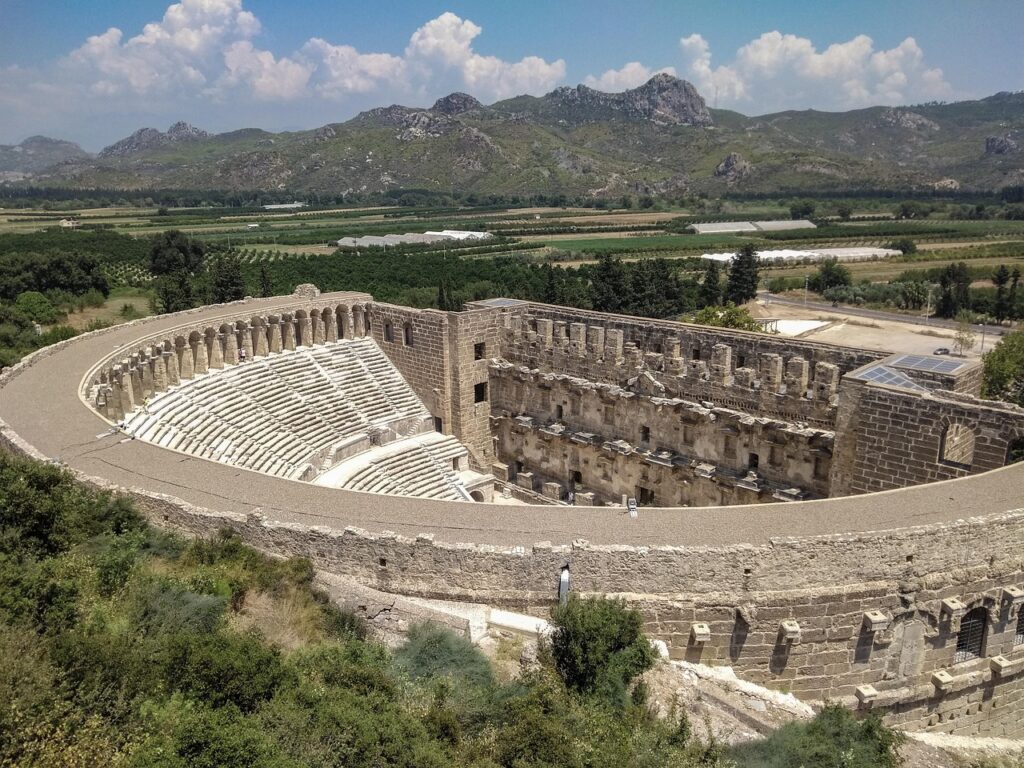
Aspendos is known to the world for one thing: its theatre, the best-preserved ancient theatre anywhere, a two-thousand-year-old building so intact that it still hosts performances today. But the theatre is only the surviving star of a much longer story. Aspendos was a rich and proud city of Pamphylia, famous in antiquity for its horses, its river trade and its stubborn independence, and its history runs from legendary Greek founders to Persian tribute, Alexander the Great, Roman prosperity and beyond. This is the full story of Aspendos.
The Legendary Foundation
Like many cities of the Pamphylian coast, Aspendos claimed a foundation in the age of heroes. Greek tradition said the city was founded by colonists from Argos, led by a figure named Aspendos or by the seer Mopsus, in the confused centuries after the Trojan War. The claim of Argive descent was more than pride; it was a diplomatic tool, used later to argue kinship with other Greek cities and to claim a place in the Greek world.
Whatever the truth of the legend, the site itself was chosen with care. Aspendos stood on the banks of the Eurymedon River, the modern Koprucay, at a point where the river was navigable and the surrounding plain was fertile. A high ridge above the river offered a defensible position, and the sea, about fifteen kilometres away, was reachable by riverboat. It was a location made for trade, and the city grew rich on it.
The Persian Age and the Battle of the Eurymedon
By the 5th century BC, Aspendos lay within the Persian empire, and like its neighbours it paid tribute to the Great King. Yet the city kept its Greek identity, minting its own coins and managing its own affairs. Its wealth came from the river and the land: grain, wine, oil and, above all, horses, for which Aspendos was famous across the ancient world. Its horsemen were said to be among the finest in the region.
The most dramatic moment of the Persian age came around 466 BC, when the Athenian general Cimon defeated the Persian fleet at the mouth of the Eurymedon River, in the waters near Aspendos. The battle broke Persian naval power in the eastern Mediterranean for a generation and made the river’s name famous in Greek history. The city itself, caught between empires, survived by adapting, a skill it would need again and again.

Alexander the Great at Aspendos
In 333 BC, Alexander the Great arrived at Aspendos after his march through Pamphylia. The city first tried to negotiate, agreeing to provide money and horses for his campaign. When Alexander pressed on, however, the citizens of Aspendos refused to ratify the agreement, and Alexander returned with his army and forced the city to submit, demanding a heavier fine and the horses he had been promised.
The episode shows Aspendos’s character: wealthy, proud and willing to test the limits of its rulers. It also shows the practical cost of resistance. Aspendos surrendered, paid and kept its existence, and under Alexander’s successors the city continued its rise. The story of the bargaining at Aspendos is one of the few detailed episodes we have from the city’s early history, and it paints a vivid picture of a rich trading city negotiating with the conqueror of the world.
The Hellenistic City
After Alexander’s death, Aspendos passed through the long power struggles of his successors, falling at times under Ptolemaic and Seleucid influence. Through it all, the city prospered. The Hellenistic period saw Aspendos expand, fortify its position and grow rich on the trade of the Eurymedon valley, and its coins, stamped with the image of its patron deity and symbols of its identity, circulated widely.
The city’s famous independence was a constant theme. Aspendians negotiated with kings, resisted governors and kept their civic life intact through every change of empire. The river was the engine of this prosperity: boats carried the valley’s produce down to the coast, and the city controlled the crossing and the tolls. By the time Rome turned its attention to the east, Aspendos was one of the wealthiest and most stubborn cities of Pamphylia.
The Early Roman Century
Rome’s arrival in Anatolia in the 2nd century BC changed the rules of the game. Aspendos first tried to keep its independence, and in the 1st century BC the city even hired pirates, a desperate act that shows how far it was willing to go to avoid absorption. The pirates were defeated, however, and Aspendos was brought firmly into the Roman orbit, its independence finally ended.
Under Rome, the city found a new stability. The civil wars of the late Republic gave way to the Pax Romana, and Aspendos, like the other cities of the coast, began to grow rich in peace. The old defensive walls and towers, once essential, became ornaments as the threat of war receded. The stage was set for the city’s greatest architectural age, the age that produced the monument for which Aspendos is now known to the whole world.
The Great Theatre and the Roman Golden Age
The 2nd century AD was Aspendos’s golden age, and its crowning achievement was the theatre, built in the middle of the century during the reign of the emperor Marcus Aurelius. According to inscriptions found at the site, the architect was a local man named Zenon, and the theatre was financed by a wealthy citizen of Aspendos. The result was a masterpiece of design, seating on the order of fifteen thousand spectators.
The theatre was not the city’s only monument. Aspendos also built a stadium, a basilica, baths and an agora, and the great aqueduct that still strides across the plain toward the city, one of the most impressive Roman water systems in Turkey. The prosperity behind all this building came from the land and the river, and the city of the horse breeders had become a full Roman metropolis, adorned in marble and proud of its place in the empire.

The Aqueduct: Engineering Across the Plain
Aspendos’s Roman aqueduct deserves a place beside the theatre in any account of the city. Built in the 2nd century AD, it carried water from springs across the plain to the city, and its route included a remarkable section where the water was forced under pressure through pipes to cross a valley. The surviving towers of the aqueduct march across the countryside, monuments to Roman engineering that still impress travellers today.
The aqueduct tells you how much the city invested in its own comfort. Water powered the fountains and fed the baths, the same public luxury that defined Roman urban life. That the citizens of Aspendos built one of the most ambitious aqueducts of the region shows both their wealth and their determination to live like the great cities of the empire. It is the hidden half of Aspendos’s greatness, overshadowed by the theatre but just as remarkable.
Late Antiquity and the Seljuk Interlude
In late antiquity, Aspendos, like its neighbours, declined. Christianity replaced the old cults, the city shrank and the great public buildings fell into disuse. By the early Middle Ages, Aspendos was a shadow of its former self, and the river trade that had made its fortune had moved elsewhere. The city faded from history, and its theatre, stripped of its decorations, survived only as a vast and beautiful shell.
Then came one of the strangest chapters in its story. In the 13th century, the Seljuk Turks, who then ruled the region, restored the theatre and used it as a caravanserai and as a palace, repairing the stage building and adapting the great hall for their own purposes. It is largely thanks to the Seljuk restoration that the theatre survived in such remarkable condition, and an inscription in the building still records their work.

Rediscovery and the Festival Age
Modern interest in Aspendos began when travellers of the 19th century rediscovered the theatre and marvelled at its condition. As Turkey developed tourism in the 20th century, the theatre’s perfection made it famous worldwide, and in the 1930s it was put to a new use: as a stage for performances. The tradition grew, and today Aspendos hosts a major international opera and ballet festival, bringing the theatre’s two thousand years full circle.
The theatre has also been carefully restored and maintained, with the cavea, the stage building and the vaulted passages all preserved. Aspendos’s place in history is now secure: it is one of the most visited sites in Turkey, its theatre is universally acknowledged as the best-preserved ancient theatre in the world, and its aqueduct, its stadium and its river valley complete the picture of a city that never quite disappeared.
What the History Leaves You
For the visitor, Aspendos’s history is unusually legible. The theatre carries you back to the 2nd century AD in an instant, its acoustics and its seats as usable as the day they were built. The Seljuk inscription on the stage building speaks of the medieval restoration. The towers of the aqueduct march across the plain toward the city, and the river below still flows past the site as it did when Cimon’s fleet fought at its mouth.
What remains hidden is the life of the city itself: the agora, the baths and the houses that surrounded the great theatre are largely unexcavated, and the theatre stands somewhat alone. That makes Aspendos a different experience from a site like Perge, but no less powerful. The story of Aspendos is the story of survival, from legendary founders to Persian battles, from Alexander to Rome, from the Seljuks to the festival stage, and the theatre is the monument that carried that whole story into the present.
Frequently asked questions
How old is the theatre of Aspendos?
The theatre was built in the middle of the 2nd century AD, during the reign of the emperor Marcus Aurelius, and was designed by the local architect Zenon. It is therefore around 1,850 years old and remains the best-preserved ancient theatre in the world.
Why does the theatre of Aspendos survive so well?
Two reasons: the quality of its original construction, and the restoration carried out by the Seljuk Turks in the 13th century, who repaired the stage building and used the theatre as a caravanserai and palace. That medieval repair protected the structure through the centuries that followed.
What else is there to see at Aspendos besides the theatre?
The site also includes the remains of a stadium, a basilica, baths and an agora, and the great Roman aqueduct whose towers still march across the plain. The lower city and the river valley, where the ancient Eurymedon flows, are also worth exploring.

All Over Information
The All Over Information editorial team researches and writes practical English-language guides to Turkey. Facts are checked against official and local sources before publication, prices are published as dated ranges rather than quotes, and guides are revised when things change. We accept no sponsored posts, paid placements or paid links.
More guides like this

Visiting Derinkuyu Underground City: Tickets, Hours, and Tips
Derinkuyu Underground City is one of the great experiences of Cappadocia, a descent into a world carved from rock that sheltered thousands…

Ephesus Through the Centuries
No ancient city in Turkey tells a longer or richer story than Ephesus, and the secret of enjoying it fully is to…

Visiting Gobekli Tepe: Tickets, Hours, and Tips
Gobekli Tepe is the oldest monumental site in the world, a hilltop of stone circles and carved pillars built around 9500 BC,…

Why Kaymakli Underground City Should Be on Your Turkey Bucket List
Every traveler to Cappadocia hears about the underground cities, and most of them rush straight to Derinkuyu, the largest and deepest of…

The Architecture of Pamukkale Travertines Explained
The terraces of Pamukkale are a building without an architect, a structure created by water and chemistry over thousands of years.

Why Xanthos Should Be on Your Turkey Bucket List
Turkey's southwest coast is full of ancient wonders, but Xanthos stands apart. It is not the biggest site or the best preserved,…