Nevsehir is the modern name for one of the most storied landscapes on earth. The soft volcanic rock of Cappadocia has been carved, painted, and inhabited for thousands of years, by prehistoric farmers, Byzantine monks, Ottoman administrators, and the Turkish villagers who live there today. The region’s history is written into its cliffs, and its culture is a living thing: pottery, wine, hospitality, and the quiet continuity of village life. This guide traces the history and culture of Nevsehir from the volcanoes to the present.
The Volcanic Landscape
The story of Nevsehir begins with the volcanoes. Millions of years ago, the great peaks of Erciyes and Hasan Dagi erupted repeatedly, covering the region in ash that hardened into a soft stone called tuff. Wind and water then carved that tuff into valleys, chimneys, and ridges of extraordinary shape.
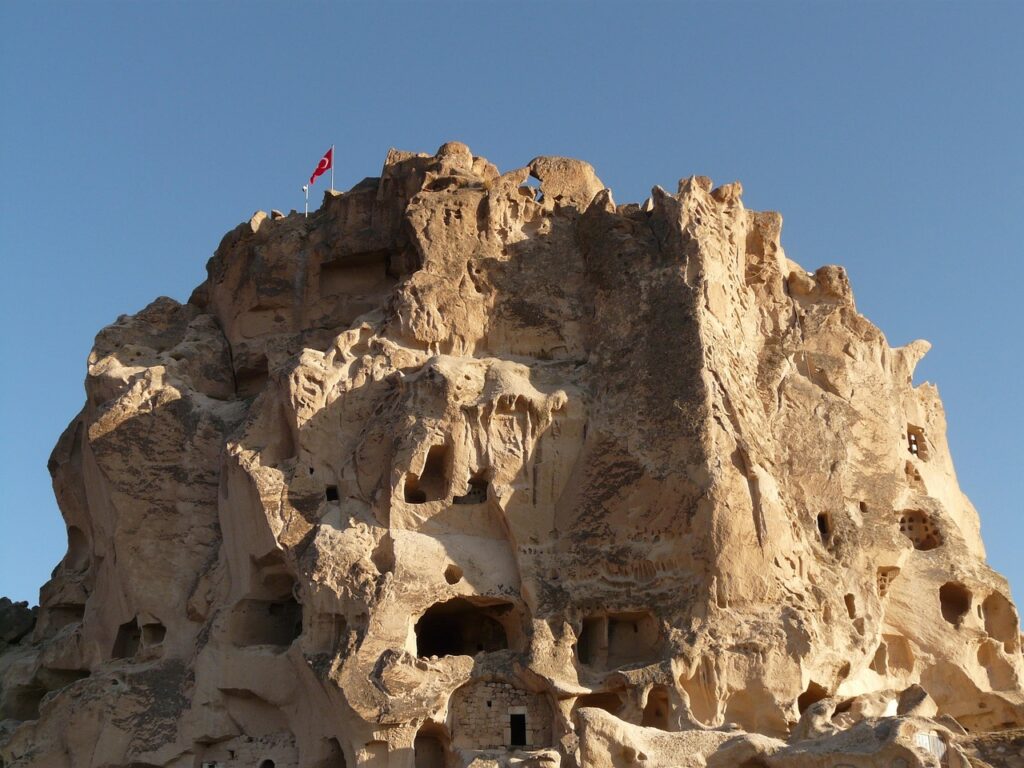
The geology determined everything that followed. Tuff is soft enough to carve with simple tools yet hardens on contact with air, which made it the perfect material for a civilization that built by excavation. The first settlers found ready-made caves, and their descendants turned those caves into homes, churches, and cities.
The landscape also made the region a natural fortress and a natural storehouse. Cliffs that could be carved and defended, rock that stayed cool in summer and warm in winter, and valleys that sheltered settlements from the winds of the plateau: the volcanoes had created a world designed for human habitation.
The First Carvers: Prehistory
Humans have lived in Cappadocia since prehistoric times, drawn by the caves, the water, and the fertile volcanic soils. The region appears in the records of the Hittites and their neighbors, and the trade routes that crossed Anatolia passed through its valleys.
The Hittites, whose heartland lay to the north and east, knew this region well, and their archives mention the towns and cults of the area. Later, the Persians used the great roads through the region, and the name Cappadocia itself comes from this ancient period, when the land was a satrapy of the Persian Empire.
For the visitor, this early history is mostly invisible, buried beneath the later layers. But the very existence of the cave settlements and the region’s role on the ancient roads explains why so much came after: Cappadocia was always a place where people stopped, lived, and built.

The Byzantine Monks
The Christian centuries gave Cappadocia its most famous monuments. From the early centuries of the faith, monks and hermits were drawn to the region’s cliffs, and by the Byzantine period the valleys were filled with monastic communities, churches, and chapels carved into the rock.
The churches of the Goreme area preserve some of the finest Byzantine frescoes in the world. Painted between the ninth and eleventh centuries, they show scenes from the life of Christ, the saints, and the Last Judgment in vivid color, preserved by the dry air and the darkness of the rock chambers.
This was a golden age of religious art and learning, when Cappadocia produced bishops, writers, and saints who shaped the Eastern Church. The rock-cut monasteries were not remote hermitages but organized communities, with refectories, kitchens, and libraries, and their art speaks across a thousand years.
The Underground Cities
The strangest monuments of the region lie beneath its surface. At Derinkuyu, Kaymakli, and other sites, entire communities carved multi-level cities into the rock, with rooms for living, storing grain, stabling animals, and worship, connected by tunnels and sealed by rolling stone doors.
The dating of these cities is debated, but their purpose is clear: they were refuges. When armies or raiders crossed the plateau, the population descended, rolled the stone doors shut, and lived underground for weeks, ventilated by shafts that rose invisibly to the surface.
The underground cities were used through the Byzantine centuries and beyond, and they remained in memory long after their last occupation. For modern visitors, they are the most visceral connection to the region’s history: the dark tunnels and cool chambers make the past physically present in a way no museum can.
The Seljuk and Early Turkish Period
The Turkish conquest of Anatolia in the eleventh century brought new rulers and new faith to Cappadocia. The Seljuks and the principalities that followed built caravanserais along the trade routes, mosques and medreses in the towns, and a network of roads that linked the region to the wider Islamic world.
Under these rulers, the region’s economy flourished. The vineyards that the Byzantines had planted continued to produce, the pottery towns kept throwing their clay, and the markets of the plateau connected the agricultural heartland with the cities of the coast. Cappadocia became a crossroads of trade and culture.
The Seljuk period also saw the arrival of Sufi saints and dervish communities, whose legacy survives in the spiritual life of the region. The great figures of Anatolian mysticism walked these valleys, and their tombs and tekkes became centers of pilgrimage and learning.
The Ottoman Town: Damat Ibrahim Pasa
The modern city of Nevsehir owes its existence to the eighteenth century. The town then known as Muckur caught the eye of Damat Ibrahim Pasa, a grand vizier of the Ottoman Empire born in the region, who persuaded the sultan to rebuild it as a proper provincial center, complete with his own complex of mosque, medrese, library, and fountain.
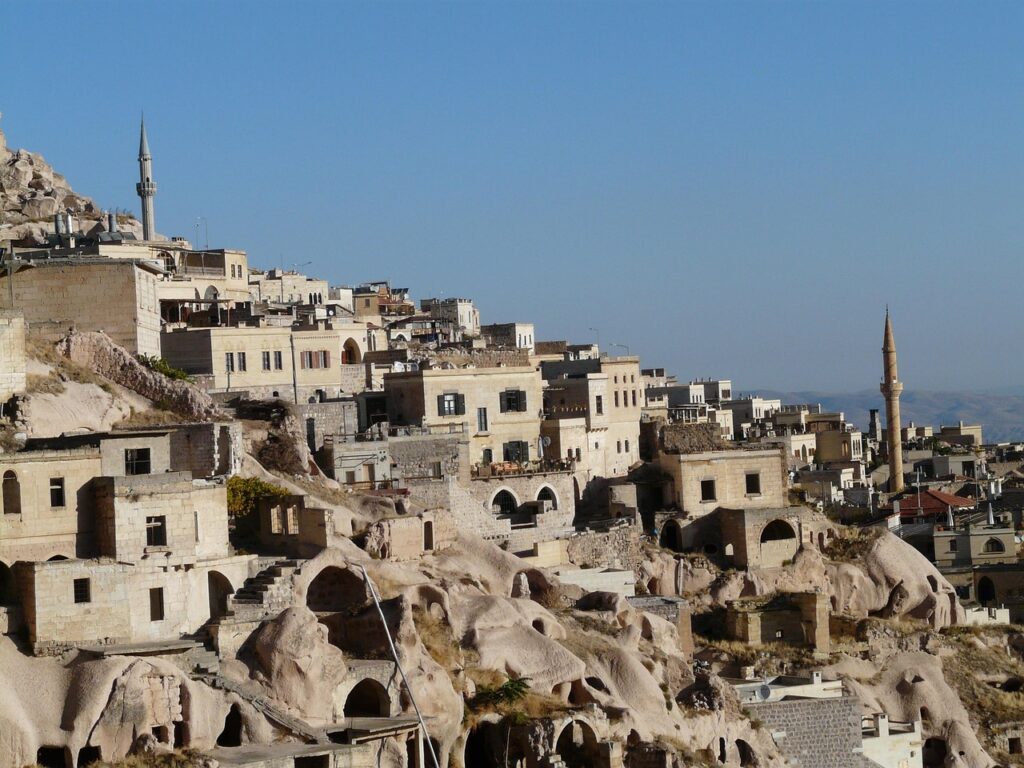
The grand vizier’s building campaign transformed the settlement into a city, and it was given the name Nevsehir, meaning “new city.” The complex that bears his name remains the architectural heart of the town, a graceful example of Ottoman stonework in a landscape of rock.
The Ottoman centuries also deepened the region’s character. The Greek communities of the towns grew wealthy on trade, the vineyards expanded, and the villages settled into the rhythms of farming and craft that continued into the twentieth century. Nevsehir became the quiet provincial capital it remains today.
The Greek Community and the Exchange
One of the most poignant chapters of the region’s history is the story of its Greek communities. Towns such as Mustafapasa, once called Sinasos, were prosperous Greek settlements, with fine stone houses, schools, and churches built by merchants who traded across the empire.
In 1923, the population exchange between Greece and Turkey uprooted these communities. The Greeks of Cappadocia left for Greece, and Turkish families from the Balkans arrived to take their place, and the elegant mansions of Sinasos passed to new hands.
The legacy is still visible: the carved facades of Mustafapasa, the churches that became mosques or museums, and the villages that changed their names. For the traveler, the old Greek towns are among the most atmospheric places in the region, monuments to a shared and complicated past.
The Republic and Modern Nevsehir
The Turkish Republic brought new institutions to the region: schools, hospitals, a university, and the infrastructure of a modern province. Nevsehir grew steadily through the twentieth century, and today it is a provincial capital with a museum, a university, and a confident sense of its own place in the world.
The modern era also brought tourism, and tourism changed everything. The valleys that once sheltered monks and farmers now shelter travelers from every country, and the cave hotels, restaurants, and balloon companies have made Cappadocia one of Turkey’s most visited regions.
The transformation has been managed with unusual skill. The historic sites are protected, the villages retain their character, and the region has avoided the worst excesses of mass tourism. Modern Nevsehir is a working city that has learned to share its wonders without losing them.

Museums and Living Heritage
The region’s museums gather its scattered past. The Nevsehir Museum holds the archaeology of the province, from prehistoric finds to the Byzantine and Ottoman periods, while the museums at the open-air sites interpret the cave monasteries and the underground cities in their settings.
Living heritage is everywhere around the visitor. The potters of Avanos still throw their red clay on the same river that supplied their ancestors, the vineyards of Urgup still produce wine, and the villages still weave, bake, and keep the crafts of the plateau. In Cappadocia, the past is not only displayed; it is practiced.
The cultural calendar adds color: local festivals, harvest celebrations, and the religious ceremonies of the Sufi tradition. For the traveler, the lesson is simple: the history of Nevsehir is not finished. It is being lived in the workshops, the vineyards, and the village kitchens.
Culture Today: Wine, Villages, and Hospitality
The culture of modern Nevsehir is defined by continuity and welcome. The villages keep their rhythms: bread baked in the wood oven, wine pressed in the autumn, and the long conversations over tea that bind the community together. The region’s famous hospitality extends to every visitor.
Wine remains central to the regional identity, as it has been for millennia. The volcanic slopes around Urgup produce wines that carry the landscape in the glass, and the wineries, old and new, are among the most welcoming doors in the region.
And above all, the people. The families who have carved, farmed, and traded in these valleys for generations have made hospitality their culture, and the traveler who accepts the offered tea, the village lunch, and the patient stories will find that the true treasure of Nevsehir is not in the rock at all.
Frequently asked questions
Why does Cappadocia have so many cave dwellings?
The region’s soft volcanic stone, tuff, is easy to carve and hardens on exposure to air. Over thousands of years, people turned this geology into homes, churches, and cities, finding that the rock stayed cool in summer and warm in winter.
Who built the underground cities of Nevsehir?
The underground cities were built and expanded over many centuries, probably beginning in the first millennium BC and continuing through the Byzantine period. They served as refuges for the local population during invasions, with ventilation shafts and rolling stone doors.
What is the connection between Nevsehir and the Ottomans?
The city was rebuilt and renamed in the eighteenth century by Damat Ibrahim Pasa, a grand vizier born in the region, who added a mosque, medrese, and library. The name Nevsehir, meaning new city, dates from this Ottoman transformation.

All Over Information
The All Over Information editorial team researches and writes practical English-language guides to Turkey. Facts are checked against official and local sources before publication, prices are published as dated ranges rather than quotes, and guides are revised when things change. We accept no sponsored posts, paid placements or paid links.
More guides like this

A First-Timer’s Guide to Nevsehir
Nevsehir is the capital of Cappadocia, the surreal landscape of fairy chimneys and cave dwellings that is one of Turkey's most famous…

Day Trip Ideas from Nevsehir
Nevsehir is the perfect base for exploring Cappadocia, with nearly all of the region's wonders within an easy drive.
Top Things to Do in Nevsehir
Nevsehir is the gateway to Cappadocia, but it is far more than a transit point.

Where to Stay in Nevsehir
Nevsehir sits at the center of Cappadocia, which means your choice of accommodation decides the shape of your trip.

Best Local Food in Nevsehir
Cappadocia's food is as distinctive as its landscape, shaped by volcanic soils, long winters, and the storage traditions of a region that…