Making lokum at home is a small adventure in patience, but the reward is a tray of soft, fragrant Turkish delight that bears no resemblance to the boxed versions you may know. The process is simple in ingredients and demanding in technique: sugar, starch, and water, cooked with care until they turn into the silky gel that has delighted sweet lovers for centuries. This guide walks you through every step, from the syrup to the final dusting.
Understanding the Ingredients
Lokum is made from just three foundations: sugar, water, and cornstarch. The proportions and the cooking are everything.
Sugar gives the sweetness and the structure, cornstarch provides the gel, and water brings them together. Each plays a role that the others cannot.
Flavor comes from small additions. Rose water, lemon juice, or orange zest are traditional, and pistachios add the crunch that makes the modern favorite.
Quality matters. Use pure cornstarch, real rose water, and fresh nuts, because lokum has nowhere to hide a cheap ingredient.
One more ingredient deserves mention: time. The cooking, the setting, and the resting all demand patience, and a hurried batch of lokum is a wasted batch. Plan the afternoon, and let the sweet set the pace. The proportions matter, but they are also forgiving. A recipe is a starting point, and the confectioner eye adjusts the sugar, the starch, and the water according to the feel of the mixture, the humidity, and the quality of the ingredients.
The Equipment You Need
A heavy saucepan, ideally copper or stainless steel, is the heart of the operation. The mixture must be stirred constantly, and a heavy pan distributes the heat evenly.
A long-handled wooden spoon is the traditional tool, and it is the right choice for the long stirring ahead. Your arm will get a workout.
You will also need a flat tray, greased or lined, to set the lokum, and a sharp knife for cutting the finished sheet.
Finally, have a candy thermometer if you have one. It helps, though the experienced eye and the texture of the mixture are the real guides.
A damp cloth for the tray and a clean bench for the cutting are small details that make the work easier. Lokum is a sweet of many small steps, and each one is simpler with the right preparation.
Cooking the Sugar Syrup
Begin by dissolving the sugar in water over gentle heat, stirring until every crystal disappears. The syrup must be clear before you proceed.
Bring the syrup to a boil and cook it until it reaches the thread stage, when a drop forms a soft thread between your fingers.
The syrup is the skeleton of the lokum, and getting it right makes the rest easier. Do not rush this stage.
Keep the heat steady and watch the pan carefully. Sugar syrup boils over quickly, and a calm, patient cook always wins.
If you do not have a thermometer, test the syrup the old way: drop a little into cold water, and when it forms a soft ball that flattens between your fingers, it is ready. The hand test has served confectioners for centuries.
Mastering the Cornstarch
The cornstarch is the soul of the texture, and it must be handled with care. Mix it with cold water into a smooth slurry before adding it to the syrup.
Add the slurry to the boiling syrup in a slow, steady stream, stirring constantly. Lumps form instantly and are almost impossible to remove.
The mixture will thicken dramatically, and the stirring becomes more important than ever. Do not stop, even for a moment.
As it cooks, the mixture turns glossy and translucent, and it pulls away from the pan. This transformation is the heart of the craft.
The cooking time is not fixed; it depends on the heat, the pan, and the humidity of the day. Experience teaches the signs, the gloss, the pull, and the smell, and every batch is a small lesson. The starch also needs full cooking to lose its raw taste, so keep the heat honest and the stirring constant until the mixture is clearly transformed.
Flavoring and Coloring
The flavor is added near the end of the cooking, when the mixture is thick and smooth. Rose water, lemon juice, or orange zest go in at this stage.
Color follows the flavor. A drop of natural food color gives rose lokum its pink, though some makers prefer the natural ivory of the sugar.
The flavor should be light. Lokum is a sweet of restraint, and a heavy hand with the essence ruins the balance.
Stir the flavor and color in thoroughly, and taste carefully. The hot mixture is ready when it tastes cleanly of its flavor.
Natural coloring is available in many markets, and a tiny amount goes a long way. If you prefer, leave the lokum uncolored, since the ivory of the sugar and the green of the pistachios are beautiful on their own.
Adding Nuts and Rose Water
If you are making pistachio lokum, the nuts go in near the end of cooking, folded gently into the thick mixture.
Use good pistachios, coarsely chopped, and fold them in just until distributed. Overstirring crushes the nuts and muddies the color.
Rose water, if you use it, should be added with the flavoring, and the amount matters. Too much rose tastes of soap, too little is wasted.
The hot, nut-studded mixture is then poured into the prepared tray, spread level, and left to cool and set completely.
The pouring stage needs a steady hand. The hot mixture is thick and heavy, and it will find its own level, so spread it gently and do not fight it. A level sheet means even cubes later.
The Setting Stage
Setting is a test of patience. The lokum must cool completely, which takes several hours, and it must not be rushed.
Leave the tray undisturbed in a cool place, and do not refrigerate it to speed the process, which can change the texture.
The lokum is ready when it is firm enough to hold a cut edge, yet soft and springy to the touch.
When it is set, turn the sheet out onto a surface dusted generously with powdered sugar and cornstarch.
Setting times vary with the weather, and a humid day can take longer. Be guided by touch, not the clock, and wait until the surface is firm and the corners hold their shape when you press them. Some recipes call for the lokum to rest overnight before cutting, and the patience is rewarded with a firmer, cleaner cut.
Cutting and Dusting
Cut the lokum with a sharp knife, wiped clean between cuts, into small cubes of about two centimeters.
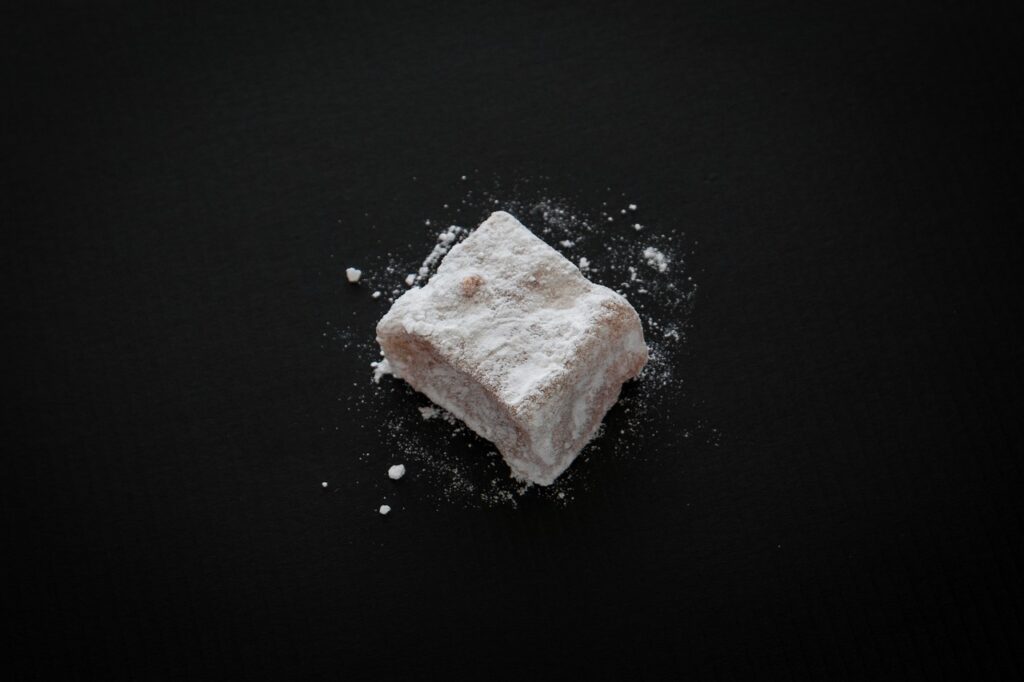
Each cube is then rolled in a mixture of powdered sugar and cornstarch, which keeps the pieces separate and gives them their white coat.
Work quickly but gently, because the cubes are soft and will lose their shape if handled roughly.
The dusting is the finishing touch. It should be even, light, and fragrant with sugar, the classic coat of Turkish delight.
The cut cubes are delicate, and the dusting is what saves them from each other. Roll each cube in the sugar mixture until every face is coated, then shake off the excess in a sieve for a clean finish.

Storing and Serving
Store the finished lokum in an airtight container at room temperature, where it will keep soft for several weeks.
Do not refrigerate lokum; cold hardens the gel and ruins the texture you worked so hard to create.
Serve the lokum at room temperature with Turkish coffee or tea, letting the sweetness do its quiet work.
Lokum also makes a lovely gift. Packed in a small box with a dusting of sugar, it carries your effort and your kindness together.
Lokum also makes a thoughtful homemade gift. A box of hand-cut cubes, packed in paper and tied with string, carries your effort in every piece, and the recipient will taste the difference. Lokum also pairs well with nuts and dried fruit on a festive table, and a tray of mixed sweets with lokum at the center is a common sight at Turkish celebrations of every kind.
Troubleshooting Common Problems
If your lokum is too soft and sticky, it was undercooked. Cook the mixture longer, until it is thick and glossy and pulls away from the pan.
If it is hard and rubbery, it was overcooked or the syrup was too concentrated. Watch the texture and remove it from the heat at the right moment.
If the mixture is lumpy, the starch was added too fast. Always add it as a smooth slurry, in a slow stream, with constant stirring.
If the flavor is weak, add a little more of the essence next time, and remember that the flavor fades slightly as the lokum cools.
Do not be discouraged by an imperfect first batch. The craft of lokum is subtle, and every batch teaches something new. By the third attempt, you will have a tray you are proud to serve.
Frequently asked questions
Why is my homemade lokum too sticky?
The most common cause is undercooking. The mixture must be cooked until it is thick, glossy, and pulls away from the sides of the pan. Once the lokum has set, a generous dusting of powdered sugar and cornstarch also helps keep the cubes from sticking.
Can I use gelatin instead of cornstarch in lokum?
Traditional lokum uses cornstarch, which gives the authentic soft, elastic texture and the dusty finish. Gelatin produces a firmer, more jelly-like sweet that is not the same. For genuine Turkish delight, cornstarch is the ingredient to use.
How long does homemade lokum last?
Stored in an airtight container at room temperature, homemade lokum stays soft and fresh for several weeks. Keep it away from heat and humidity, and do not refrigerate it, because cold hardens the gel and dulls the flavor.

All Over Information
The All Over Information editorial team researches and writes practical English-language guides to Turkey. Facts are checked against official and local sources before publication, prices are published as dated ranges rather than quotes, and guides are revised when things change. We accept no sponsored posts, paid placements or paid links.
More guides like this

How to Make Authentic Turkish Tea (Cay) at Home
Turkish tea, known simply as çay, is the most honest drink in Turkey: nothing but black tea leaves, water, and sugar, yet…

Turkish Pastries: A Taste of Turkish Culture
You can read a great deal about Turkey from its pastries.

Ayran: A Taste of Turkish Culture
Ayran is more than a drink in Turkey; it is a daily ritual, a badge of identity, and one of the oldest…

The Ultimate Guide to Lahmacun
Lahmacun is the thin flatbread of Turkey that carries a topping of spiced minced meat, baked in a fierce oven until the…

How to Make Authentic Menemen at Home
Menemen is the dish that wakes up Turkey: a soft scramble of eggs folded into tomatoes and green peppers that have been…

The History Behind Pide
Pide is a bread with a history as long as the Turkish kitchen itself.