If you have visited a Turkish mosque, museum, or market, you have already seen Ottoman calligraphy: the flowing Arabic letters on walls, ceramics, and documents. For visitors who cannot read Arabic, it can be hard to know what they are looking at. This guide explains the essentials clearly, without assuming any background. You will learn what the art is, why it matters, how it was made, where you will meet it in Turkey, and how to appreciate it as a traveler.
What Calligraphy Is and Why It Matters
Calligraphy is the art of beautiful writing, and in the Islamic world it is the most honored of the visual arts. Because Islam discourages images of living beings in religious settings, the written word carried the burden of decoration. Copying the Quran and other sacred texts in a beautiful hand became a form of worship in itself.
In the Ottoman Empire, calligraphy was more than decoration. It was used for royal decrees, official seals, buildings, coins, and books. A skilled calligrapher ranked among the most respected professionals in society, and the sultans themselves often practiced the art.
The word you will hear is hat, meaning script or writing, and hüsn-i hat, which means beautiful writing. When Turks say that someone writes like a hattat, they are comparing them to a master calligrapher, and the comparison is a high compliment.
The Script You Will See: Arabic Letters in Turkish Hands
The letters you see in Ottoman art are Arabic letters, because the Ottoman Empire used the Arabic alphabet to write the Turkish language. The script was shared across the Islamic world, but the Ottomans developed their own standards of beauty and proportion over six centuries.
You will notice that the script is written right to left and that letters change shape depending on their position in a word. Short vowels are usually omitted, which is why the writing can look dense to foreign eyes. The impression of flowing ribbon is created by connecting the letters within words.
Although modern Turkey uses the Latin alphabet, Arabic script remained in religious use. So a mosque interior may show writing that looks unfamiliar even to Turks who cannot read it themselves. Do not worry: most visitors cannot read it either, and appreciation does not require reading.

The Styles: How to Tell Them Apart
The most common style in grand settings is thuluth, which is large, dramatic, and sweeping. Its tall vertical strokes and generous curves are designed to be seen from a distance, which is why it decorates mosque interiors and public inscriptions. It is also the most difficult style to write well.
For books, the standard was naskh, a smaller, clearer, and more regular script. It was the everyday workhorse of the calligrapher, and it is still one of the most widely used Arabic scripts in the world today. The Quran you see in museums is usually written in naskh.
A third form you will meet constantly is the tughra, the sultan’s monogram, which is discussed below. A useful trick for visitors: if the writing is huge and architectural, it is likely thuluth; if it is small and tidy in a book, it is probably naskh.
The Tughra: The Sultan’s Signature
The tughra is the most distinctive product of Ottoman calligraphy, and once you know it, you will see it everywhere. It is the official monogram of the sultan, combining his name, his father’s name, and the title always victorious in a distinctive arrangement of vertical strokes and sweeping curves.
Think of it as a royal signature plus a royal seal combined. It appeared on imperial decrees, treaties, coins, stamps, and even on some buildings. Each sultan had his own tughra, and the calligraphers who designed them held special status at court.
For the visitor, the tughra is a useful landmark in time: it tells you which sultan ruled when a document was made. Museums display them prominently, and you will also see stylized versions in modern logos and souvenirs. It is the easiest piece of Ottoman calligraphy to recognize.

Where You Will Encounter It in Turkey
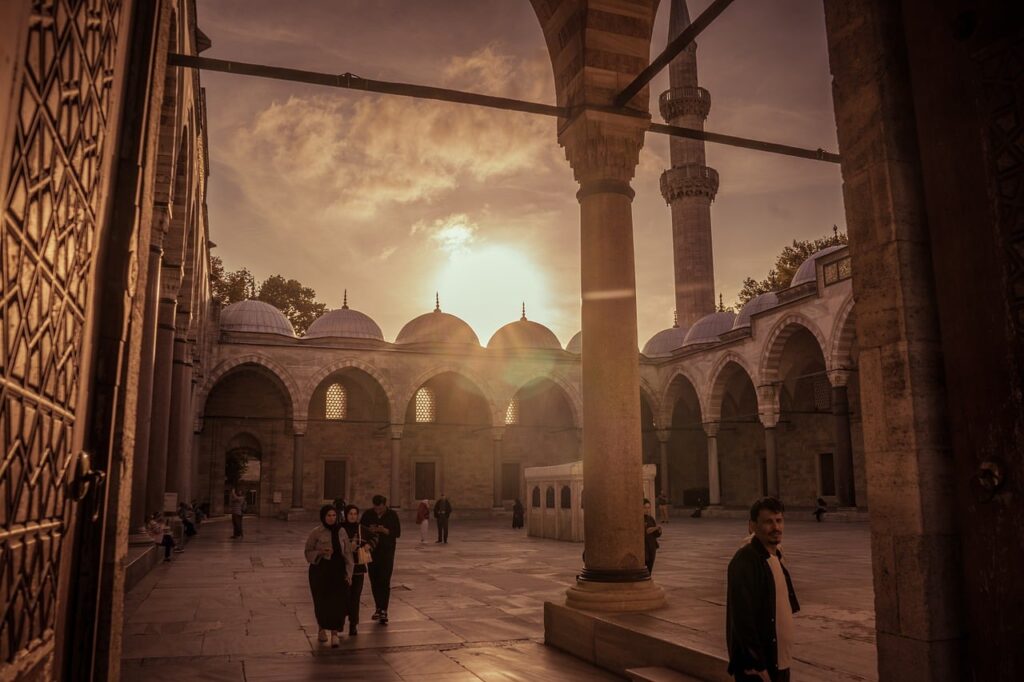
Mosques are the grandest gallery of calligraphy in Turkey. Look up: the bands of writing circling the domes and walls of Istanbul‘s great mosques are thuluth inscriptions, usually naming God, the Prophet, and the first caliphs. The Blue Mosque and the Süleymaniye are outstanding examples.
Museums give the closest view. The Museum of Turkish and Islamic Arts in Istanbul holds Qurans, imperial firmans, and the practice sheets of famous calligraphers. Topkapi Palace displays documents with magnificent tughras, including treaties and maps. Look for the gilding and painted borders that frame the script.
Finally, calligraphy surrounds you in daily life. You will see it on tombstones in old cemeteries, on fountains and gates, on ceramics and textiles, and in shops selling modern works. Once you start looking, you will find it impossible to stop noticing it.
How It Was Made: Pen, Ink, and Paper
The calligrapher’s tool was a reed pen cut to a slanted point, which produced the characteristic thick and thin strokes of the script. The pen was trimmed with a small knife, and the angle of the cut determined the character of the writing. Each master had his own preferred cut.
Ink was made from soot, often mixed with gum arabic and other binders, and good ink had to flow evenly without blotting. Paper was handmade, sized, and often polished to a smooth surface. Many pages were then marbled or tinted, with gold leaf and colored borders added by illuminators.
Writing was slow, deliberate work. A single page could take days, and a complete Quran months or years. The finished piece was often signed and dated, and the signature of a famous master could make a modest page into a treasure.

The Human Chain: Masters and Students
Calligraphy was passed from person to person, not from book to book. A student found a master, presented examples of writing, and, if accepted, spent years copying his work. The master corrected each letter by hand, and the student filled hundreds of practice sheets before mastering a single style.
The end of training was marked by the icazet, a diploma granted when the student produced a finished masterpiece under the master’s eye. The diploma listed the student’s entire line of teachers, reaching back through the centuries to the founders of the art. This chain of transmission gave the tradition its authority.
This system still operates today. Modern calligraphers can name their teachers, and their teachers’ teachers, back many generations. When you see a contemporary work of hüsn-i hat, you are seeing one link in a chain that stretches back over a thousand years.
The Script Revolution of 1928
In 1928, the young Turkish Republic replaced the Arabic alphabet with the Latin alphabet, in a sweeping reform intended to modernize the country. Overnight, the writing system used for centuries disappeared from daily life, and the public lost the ability to read Ottoman documents.
The art did not die. Calligraphy survived in religious contexts, since the Quran is always written in Arabic, and a small circle of masters kept the tradition alive through private teaching. In recent decades, the art has enjoyed a remarkable revival, with exhibitions, courses, and a new generation of hattats.
For visitors, the revolution explains a strange experience: walking through a modern Turkish city where ancient buildings are covered in a script that almost nobody around you can read. The beauty survives even where the reading does not.
What to Look For
Start with proportion. In fine calligraphy, the letters sit in perfect balance, and the spacing feels inevitable, as if the words could not be arranged any other way. Compare the drama of a mosque inscription with the calm of a book page, and you will see the range of the art.
Look at the details. Check whether the page is gilded, marbled, or illuminated, and whether the pen strokes are crisp and even. Look for a signature or date at the edge of the piece. These details separate a masterwork from a student exercise.
Then consider the object itself. A Quran, a royal decree, a wall inscription, and a modern panel each carry different meanings and different histories. Asking what the piece was made for turns a beautiful image into a story, and the story is what you will remember.
Bringing the Art Home
If you want to buy calligraphy, start with the reputable shops near the Grand Bazaar and the museums, where pieces are usually signed and the sellers can explain the work. Handwritten pieces by trained hattats cost more than prints, but they carry the tradition in a way reproductions cannot.
Before spending, ask about the artist, the materials, and the text. A framed piece of hüsn-i hat makes a distinctive souvenir, and a small tughra or a single-word composition such as besmele, the phrase meaning in the name of God, fits easily in luggage. Avoid pieces that seem mass-produced.
Whether you buy or simply admire, the main thing is to look closely. Ottoman calligraphy rewards attention: the longer you study a fine page, the more its rhythm and balance reveal themselves. After this guide, you will see these letters not as decoration, but as a great art.
Frequently asked questions
Is Ottoman calligraphy the same as Arabic calligraphy?
Ottoman calligraphy uses the same Arabic letters and shares its roots with the wider Islamic tradition, but it is a distinct school. Ottoman masters developed their own standards of proportion and their own favored styles, especially thuluth and naskh, and their work is regarded as the most refined branch of the art. Turkish hattats trained under Ottoman masters carried this style through the centuries.
Can I visit workshops or watch calligraphers work?
Yes. Istanbul has calligraphy schools and ateliers, some attached to museums and cultural centers, where visitors can watch demonstrations and attend short courses. The Museum of Turkish and Islamic Arts and various cultural foundations announce events, and many shops employ calligraphers who will show you their tools and technique on request. Practicing a single letter under supervision is a memorable hands-on experience.
What should I look for when buying calligraphy?
Look for a signed, dated piece by a trained hattat, and ask about the text and materials. Fine work uses handmade paper, quality ink, and gold leaf, and the letters will be crisp and perfectly balanced. Prints and mass-produced panels are cheaper but carry none of the tradition. If the price is high, ask for the artist’s name and credentials before you commit.

All Over Information
The All Over Information editorial team researches and writes practical English-language guides to Turkey. Facts are checked against official and local sources before publication, prices are published as dated ranges rather than quotes, and guides are revised when things change. We accept no sponsored posts, paid placements or paid links.
More guides like this

Turkish Folk Dances like Halay and Zeybek Explained for Foreigners
Turkish folk dance can look intimidating to outsiders: circles of people moving in perfect unison, solo dancers with arms spread like eagles,…

Understanding Turkish Dairy Products
Dairy is woven into the fabric of Turkish food. Yogurt accompanies meat, cheese anchors breakfast, ayran cools spicy kebabs, and kaymak crowns…

Understanding Religious Diversity in Turkey
Turkey is often described as a Muslim country, and in many ways it is, but that description hides a far richer reality.
A Deep Dive into the History of Turkish Cinema
The history of Turkish cinema is a century-long story of invention, ambition, collapse, and renewal, and it mirrors the history of modern…
Understanding the Ottoman Tile and Ceramic Tradition: A Beginner’s Guide
If you have ever stood inside a great Ottoman mosque and felt the walls glow around you, you already know the power…

Understanding Modern Turkish Pop Culture
Modern Turkish pop culture is everywhere, even if you do not realize it: television dramas that air on six continents, pop songs…