Ayran is one of the oldest drinks on the Turkish table, and its history reaches back to a time before written records, to the nomadic herders of Central Asia who first discovered that yogurt mixed with water and salt made a refreshing, long-lasting drink. From the steppes to the Ottoman Empire to the modern Republic, ayran has traveled without changing its essential character. This article traces that journey, looking at how the drink was born, how it spread, and how it became the everyday companion of Turkish meals.
The making of the drink was a daily rhythm of the camp: the milk of the herd, the fermentation of the night, and the churning of the morning produced both food for the day and refreshment for the journey. Every herder knew the proportions by hand, and the knowledge passed from mother to daughter without a written recipe.
The Birth in Central Asia
Ayran began with yogurt, and yogurt began with the nomads of Central Asia. Milk carried in animal-skin containers fermented naturally into yogurt, and the herders learned that the thickened milk kept longer than fresh milk.
The discovery that yogurt mixed with water made a drinkable refreshment was a natural next step. Salt was added for flavor and preservation, and the mixture became a staple of the nomadic diet.
The drink had practical genius. It hydrated, it fed, it survived the heat, and it used ingredients available to every herder. The same qualities that made it useful on the steppes made it useful everywhere the Turks went.
Linguists point to the drink as one of the deep links between the Turkic peoples, a word that crossed thousands of kilometers of steppe and mountain without losing its meaning. The drink itself crossed with it, and the two traveled together so closely that one is unthinkable without the other.
The Name and Its Roots
The word ayran is ancient, and its origins reach into the deep history of the Turkic languages. It is related to words for milk and for the milking process, and similar names appear across the Turkic world.
In Azerbaijan, Kazakhstan, and the other Turkic republics, the same drink is known by the same or closely related names, a sign of how old and how widespread the tradition is.
The survival of the word is itself evidence of the drink’s age. Language changes fast, but a word that has stayed in use for this long points to a practice that stayed in use with it.
The migrations that carried ayran into Anatolia were spread over centuries, and each wave brought the drink to new villages and new tables. By the time the first Turkish states were founded in Anatolia, ayran was already as native to the land as the yogurt it was made from.

The Journey West
As the Turkic peoples migrated west, they carried ayran with them. The drink crossed the steppes into Anatolia with the waves of settlement that began more than a thousand years ago.
The Seljuk and Ottoman eras found ayran already established in Anatolian life. It was the drink of the countryside, of the armies, and of the ordinary table, and it crossed every border the empire drew.
The drink also spread into the Balkans and the Caucasus with the Ottoman armies and settlers. Today, versions of the drink exist across the former Ottoman world, each with its own local accent.
The drink also had a place in the palace kitchens, where yogurt-based dishes were refined and celebrated. The imperial cooks took the village drink and dressed it for the court, but the everyday ayran of the people never changed, and the two versions coexisted without conflict.
Ayran in the Ottoman World
In the Ottoman centuries, ayran was above all the drink of the common table. It accompanied the meals of villagers, soldiers, and city workers, and it was made fresh wherever yogurt was made.
The drink was also practical in a military context. The Ottoman armies, like the nomads before them, valued a drink that was nourishing, portable, and safe in the heat.
The coffeehouse culture of the cities belonged to coffee and tea, but the home table and the kebab house belonged to ayran. The division of roles, ceremonial drinks for public life, ayran for the meal, took shape in this era.
Dried yogurt, another invention of the nomadic world, could be reconstituted into ayran on the road, and the two techniques supported each other across the centuries. The ability to carry nutrition in a dry block and turn it into a cold drink on arrival was a genuine technology of its time.

The Yogurt Connection
The history of ayran is inseparable from the history of yogurt, and yogurt itself has a long history on the Anatolian table. The word yogurt is Turkish, and the technique of fermenting milk is ancient in this part of the world.
Yogurt was a cornerstone of the Turkish diet, eaten fresh, dried into blocks for storage, and thinned into drinks. Ayran was one of the many ways the culture used its most precious food.
The connection explains the health reputation of ayran: it is yogurt, with the yogurt’s cultures and proteins, made drinkable. What began as a practical use of surplus milk became a daily source of nourishment.
The churn also gave the drink its social shape: making ayran for a family or a feast was a communal task, and the rhythm of the work set the rhythm of the day. The tools were simple, but the skill in using them was respected, and the best churners were known in every village.
The Village Tradition
For most of its history, ayran was made in the village, by hand, in quantities for the household. The wooden churn, the yayık, was a standard piece of village equipment.
The churning was daily work, and it produced both butter and the rich drink called yayık ayranı. The process connected the household’s dairy to its table in a way that factory products never quite replaced.
The village tradition survives today, and the churned ayran is still the benchmark by which other versions are judged. The old method is slower, but the taste it produces is the original one.
The packaged ayran also traveled beyond Turkey, following the emigrant communities to Europe and beyond, and it became one of the ways Turkish food established itself abroad. The carton in a foreign supermarket is the descendant of the nomad’s skin of thinned yogurt, and the taste is still recognizably the same.
The Modern Transformation
The twentieth century changed how Turkey drinks ayran. The packaged version appeared, first in bottles and cartons, and the drink moved from the village churn to the market shelf.
The industrial version standardized the taste and made ayran available everywhere, in every season, at any hour. The drink that once belonged to the countryside became a national product.
The transformation did not weaken the drink; it widened it. The same ayran is now poured in fast-food restaurants, school canteens, and beach stands, and the tradition has only grown in reach.
The minister’s remark was remembered precisely because ayran is so ordinary: no one argues about the foam on an exotic drink, but everyone has an opinion about the glass on their own table. The joke worked because the drink works, and the debate became a small celebration of that.
The Political Footnote
Ayran even earned a place in modern political history, through a famously odd controversy. In the 2010s, a government minister publicly suggested that the correct way to drink ayran was without foam.
The country disagreed loudly. The remark became a national joke, and the debate over foam versus no foam was argued with complete seriousness, with photographs of frothy glasses shared by the thousands.
The episode is remembered with affection, and it revealed something true: ayran is so woven into daily Turkish life that even its foam is a matter of national identity.
The drink has also found new settings: modern cafés serve it alongside their menus, and chefs use it in marinades and sauces, giving the old drink a place in contemporary cooking. The new uses do not replace the old glass; they add to it, and the tradition grows without changing its roots.

The Drink of the People
Through the twentieth century, ayran remained the drink of the ordinary table, the companion of workers, soldiers, and villagers. It was cheap, nourishing, and everywhere, and it never carried the ceremony of coffee or the ritual of tea.
In the barracks, in the fields, and in the factories, ayran was the refreshment that cost little and restored much. It belonged to the everyday, and that is precisely why it survived every change in Turkish eating.
The drink of the people also became a quiet symbol of the republic’s promise: simple, honest, and available to everyone. The glass on the common table was a small proof that plenty could be ordinary.
Ayran and Identity Today
Today, ayran is a marker of Turkish identity at home and abroad. Turkish communities carry the drink with them, and it appears in Turkish restaurants on every continent.
At home, the drink is a constant: the glass at the kebab table, the cooler at the beach, the carton in every refrigerator. It is ordinary in the best sense, a tradition so established that it needs no defense.
The history of ayran is the history of a simple idea that worked: thin the yogurt, add salt, drink cold. Five centuries ago or five years ago, the glass is the same, and the taste is the taste of a culture.
Frequently asked questions
How old is ayran?
Ayran is one of the oldest drinks of the Turkish world, with roots reaching back to the nomadic herders of Central Asia, well over a thousand years ago. The practice of thinning yogurt with water and salt traveled with the Turkic migrations into Anatolia and has continued without interruption. The ancient name for the drink survives across the Turkic world today.
Where does the word ayran come from?
The word ayran comes from the ancient Turkic vocabulary of milk and dairying, and closely related names appear across the Turkic-speaking world, from Azerbaijan to Kazakhstan. Its survival in the language points to how old the practice is. The word is understood wherever Turks live, even outside Turkey, and it is one of the strongest proofs of the drink’s ancient roots.
Why did people start drinking ayran?
Ayran began as a practical solution: nomads who carried yogurt found that mixing it with water and salt made a refreshing, hydrating drink that lasted in the heat. It also used ingredients that every herder had on hand. The same practicality kept the drink on the table through the Ottoman era and into the present day.

All Over Information
The All Over Information editorial team researches and writes practical English-language guides to Turkey. Facts are checked against official and local sources before publication, prices are published as dated ranges rather than quotes, and guides are revised when things change. We accept no sponsored posts, paid placements or paid links.
More guides like this

The Ultimate Guide to Baklava
Baklava is the jewel of the Turkish dessert table, a symphony of paper-thin pastry, sweet nuts, and golden syrup that has delighted…

The History Behind Turkish Coffee
The history of Turkish coffee is the history of coffee itself, because the method that conquered Europe began in Istanbul.
Turkish Tea Farms in Rize: A Behind-the-Scenes Look
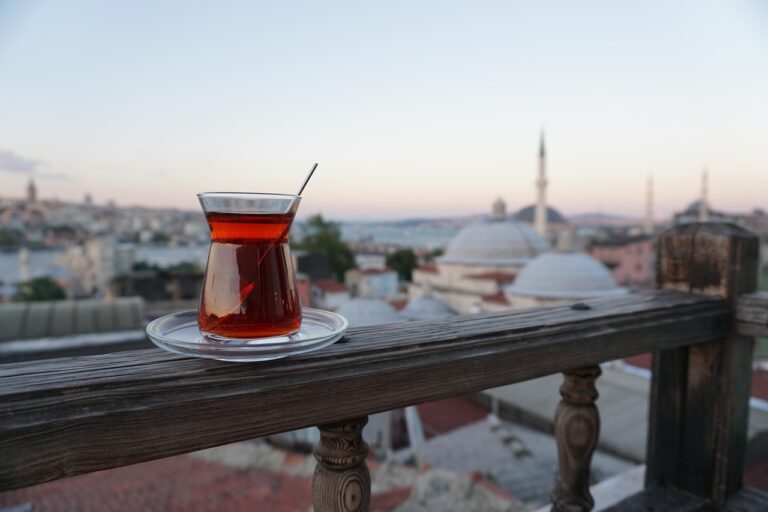
The tea that fills tulip-shaped glasses across Turkey comes from one place above all: the steep, rainy hills of Rize on the…
Kumpir (Stuffed Baked Potato) Vs. International Variations: What Makes It Turkish
Every culture that grows potatoes has invented its own way of loading them with toppings, from the American loaded baked potato to…

The History Behind Cig Kofte
Every famous dish has a history, and cig kofte has one of the deepest in Turkish cooking.

Testi Kebab (Pottery Kebab) Vs. International Variations: What Makes It Turkish
Every culture with a clay tradition has a slow-cooked pot dish, and the family is enormous: the French have pot-au-feu, the Moroccans…