Beneath the surface of central Turkey lies a hidden world that has fascinated travelers for centuries: vast underground cities, churches carved into rock, and cave systems shaped by both nature and human hands. The most famous examples surround Cappadocia, but caves and underground settlements exist across the country. This guide explains how these extraordinary places formed, who built them, and how you can explore them safely and rewardingly.
How the Rock Formed
The story begins millions of years ago, when volcanic eruptions covered the region of Cappadocia in thick layers of ash. Over time, the ash hardened into a soft rock called tuff, which is easy to carve yet firm enough to support large openings. Rain, wind, and frost then sculpted the landscape into valleys, pinnacles, and the famous fairy chimneys.
Later eruptions added harder layers of basalt on top of the soft tuff. Where the basalt protected the softer rock beneath, tall cones remained, their caps of dark stone balanced above columns of pale tuff. These are the fairy chimneys, and their formation explains both the beauty and the usefulness of the region.
The same geology made the caves possible. Because the tuff is soft, ancient people could dig into it with simple tools, creating rooms, corridors, and entire cities with a speed and ease that stone-built construction could never match. The landscape itself was the building material.
Who Carved the First Caves
The earliest cave dwellers in the region were probably farmers and monks, attracted by the shelter, the security, and the cool interiors. By the Byzantine period, the valleys of Cappadocia were dotted with monastic communities, and thousands of churches, chapels, and monasteries were carved into the rock.
The rock-cut monasteries were not crude shelters. They included churches with domes and columns carved from the living rock, refectories with long stone tables, kitchens, storerooms, and cells for the monks. Frescoes decorated the churches, and entire communities lived out their lives underground and inside the cliffs.
The caves also served practical purposes. The rock keeps a constant temperature, cool in summer and warm in winter, and it offered protection from raids. When danger threatened, the inhabitants could retreat into the deeper chambers and close the entrances behind them with large round stone doors.

The Underground Cities: How They Work
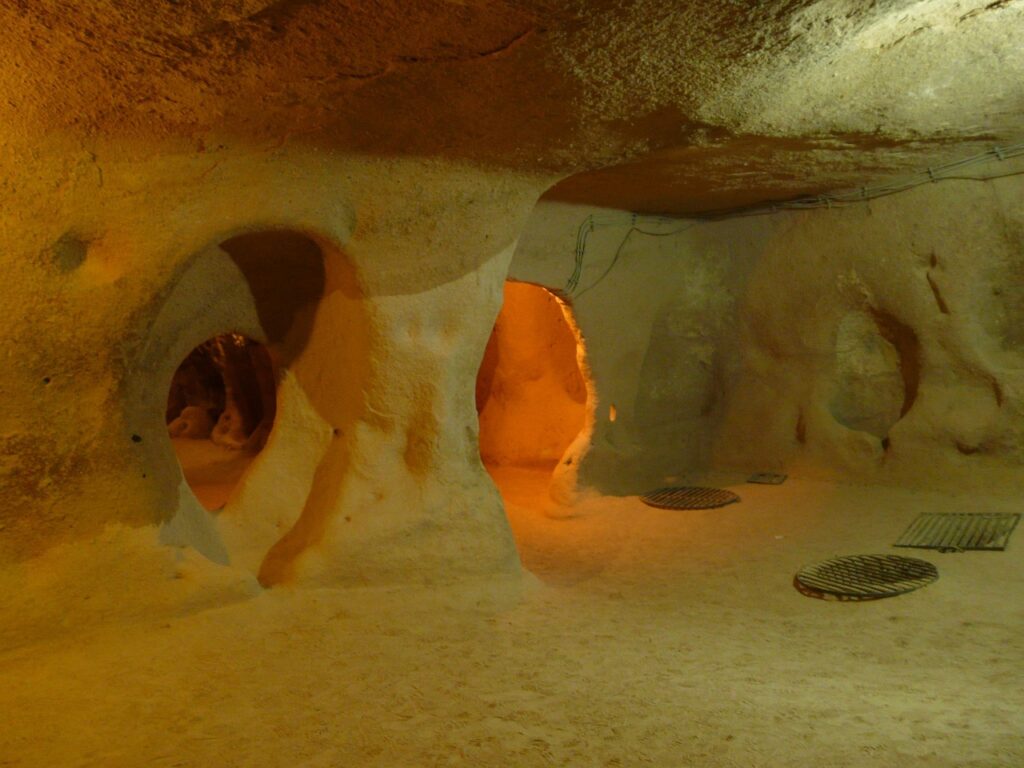
The most extraordinary creations are the underground cities, of which the region holds dozens. The most famous are Derinkuyu and Kaymaklı, but new chambers and entire cities are still being discovered. These are not simple caves but planned settlements with streets, plazas, and ventilation shafts.
Derinkuyu descends many levels beneath the surface, and its chambers include stables, kitchens, wine cellars, chapels, and even a missionary school. Ventilation shafts carry fresh air to the deepest levels, and rolling stone doors could seal each section from attackers. Water came from wells that tapped the water table below.
The cities were places of refuge rather than permanent homes. Estimates of their population vary, and they were probably used in times of threat, housing thousands of people for weeks at a time. Their scale is staggering: Derinkuyu alone could shelter a significant community, complete with its animals and stores.
How to Visit Derinkuyu and Kaymaklı
Derinkuyu is the deepest and most spectacular of the underground cities, and it is the essential visit. You will descend through a series of levels, past the stables, the cellars, and the chapel, and you will see the rolling stone doors still in place. The experience is fascinating and slightly claustrophobic in equal measure.
Kaymaklı is less deep but broader, and its corridors are slightly wider and easier to walk. It is a good choice for those who find Derinkuyu’s narrow passages challenging. Both sites are well lit and maintained, and both give a vivid sense of life beneath the earth.
Plan your visit with a few practical points in mind. The cities are cool, so a light layer is useful even in summer. The passages are narrow, and the stairs are many. Arrive early, especially in high season, and allow at least an hour for each city. A guided tour brings the history vividly to life.

The Valley Churches of Göreme
The open-air museum at Göreme is the most famous of the rock-cut sites, and it contains some of the finest churches in the region. The churches cluster in a valley of fairy chimneys, and their carved interiors are decorated with frescoes that survive in remarkable condition.
The Dark Church is the masterpiece, its frescoes preserved by the lack of natural light that gives the church its name. The Apple Church, the Snake Church, and the Buckle Church each have their own cycles of biblical scenes, and the museum’s walking route takes you through the monastic life of the valley.
The museum is busy, especially in summer, so arrive at opening time and give it the better part of a morning. The valley itself is beautiful, and the walk between the churches passes through a landscape that looks like the set of a fantasy film.
The Ihlara Valley: A Gorge of Churches
South of Göreme, the Ihlara valley is a deep green gorge cut by the Melendiz river, and its cliffs are pierced by more than a hundred rock-cut churches. The valley is a hiking paradise, with a path that follows the river past the churches, the springs, and the old village houses.
The churches of Ihlara are simpler than those of Göreme, but their frescoes are vivid and their settings are spectacular. The climb down into the gorge from the village of Ihlara is dramatic, and the walk along the river is one of the most beautiful in Turkey.
Allow a full day for Ihlara. The valley is long, and the best route is to descend at one point and walk downstream, visiting the churches on the way. The setting is peaceful, the greenery is a contrast to the bare plateau above, and the river adds a sound of running water to the silence of the cliffs.
The Valley of the Monks and the Surrounding Valleys
Beyond the famous sites, the valleys around Göreme hold a wealth of quieter rock-cut wonders. The valley of Zelve was a monastic settlement and a village, with dwellings and churches carved into its three branches. The valley of Paşabağ is famous for its triple-headed fairy chimneys, one of them a hermit’s chapel.
The valley of Görkündere and the rose and red valleys of the region offer walking routes past hermit cells, pigeon houses, and abandoned churches. The pigeon houses are a feature of the region: their facades, carved with geometric patterns, once sheltered the birds whose guano fertilized the vineyards.
These valleys are the place to go when you want to escape the crowds. The paths are marked, the landscapes are extraordinary, and the sense of discovery is constant. A sunset walk through the rose valley, with the light turning the rock pink, is one of the great experiences of Cappadocia.
Caves Beyond Cappadocia
The cave tradition is not confined to Cappadocia. Across Turkey, caves have served as homes, fortresses, and monasteries for thousands of years. The ancient city of Mardin is built into the hillside, and the region around it contains monasteries and villages that extend into the rock.
The western Black Sea region holds caves of spectacular natural beauty, like the great cave systems of the area, and the limestone landscape of the southwest is riddled with underground rivers and chambers. The traveler with an interest in caves will find them all over the country.
The most accessible of these is the tradition of cave hotels. In Cappadocia, many hotels and restaurants have been carved into the rock, and staying in a cave room is one of the most memorable experiences Turkey offers. The caves are modernized, but the rock walls and the constant temperature remain.

The Underground City of Özkonak and Others
The region’s underground cities extend beyond the famous pair. The city of Özkonak, north of Avanos, is smaller than Derinkuyu but includes a system of communication holes that allowed the defenders to pass messages between levels. The city of Mazıköy, near Kaymaklı, is partly flooded and atmospheric.
The city of Tatlarin, near Acıgöl, is being excavated and includes a large church with frescoes. Each city has its own character: some are deeper, some wider, some still partially collapsed or flooded. For the enthusiast, visiting two or three cities reveals how varied the underground architecture could be.
A word of caution: not all sites are suitable for everyone. The narrow passages, the stairs, and the enclosed spaces can be difficult for those with mobility issues or claustrophobia. Choose the site that suits your comfort level, and do not feel you must see them all.
Practical Advice for Exploring Underground
Exploring the caves and underground cities is straightforward if you prepare sensibly. Wear comfortable shoes with good grip, because the stairs and corridors are worn smooth. Carry a light layer, because the temperature underground is cool and constant. And bring a small torch: the sites are lit, but the corners and niches repay a closer look.
Respect the sites themselves. The frescoes are fragile, and touching them damages them. The stone is soft, and graffiti scars it permanently. Follow the marked routes, keep your voice down in the churches, and take nothing but photographs.
Finally, pace yourself. A visit to an underground city is physically demanding, and a full day of cave sites will tire you more than a day above ground. Alternate the underground days with valley walks, and let the region’s extraordinary landscape fill the rest of your time.
Frequently asked questions
Which underground city should I visit first?
Derinkuyu is the deepest and most impressive, and it is the essential first choice for most visitors. If you are claustrophobic or prefer wider corridors, Kaymaklı is a gentler introduction. The two are only a short drive apart, and visiting both in one day is easy and rewarding.
How old are the underground cities?
The exact dates are debated, but the region’s rock-cut history spans millennia. The earliest occupation may date to the Hittite era, thousands of years before Christ, and the Byzantine period saw the great expansion of the churches and the underground settlements. New chambers continue to be discovered, and the full story is still emerging.
Is it cold inside the caves?
The rock keeps a constant temperature of roughly 13 to 15 degrees Celsius year-round, so the caves feel cool in summer and mild in winter. A light jacket or long-sleeved layer is comfortable even on the hottest day, and the contrast with the summer heat outside is one of the pleasures of going underground.

All Over Information
The All Over Information editorial team researches and writes practical English-language guides to Turkey. Facts are checked against official and local sources before publication, prices are published as dated ranges rather than quotes, and guides are revised when things change. We accept no sponsored posts, paid placements or paid links.
More guides like this

Best Hiking Trails Around the Kure Mountains National Park
The Kure Mountains National Park offers some of the wildest walking in Turkey, through a forest that feels like nowhere else in…

Best Hiking Trails Around Lake Van
Lake Van's shoreline and the mountains that surround it offer some of the most rewarding hiking in eastern Turkey.
Best Hiking Trails Around Salt Lake (Tuz Golu)
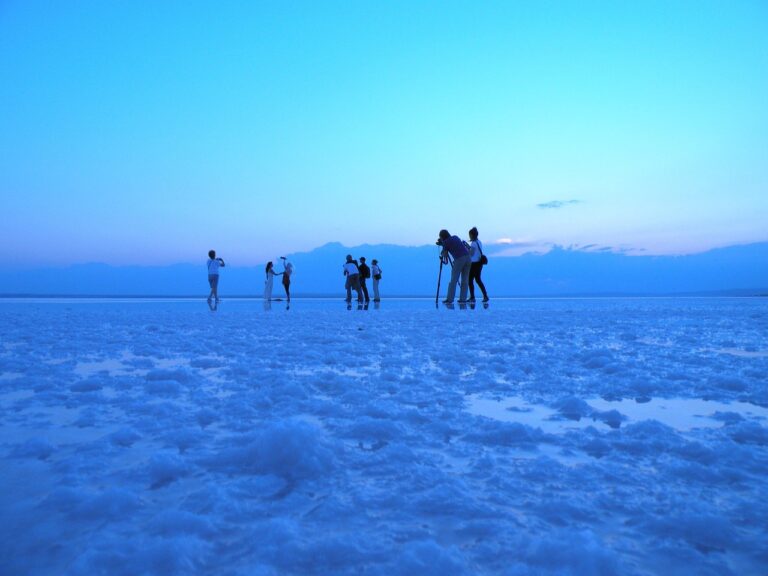
Tuz Golu, Turkey's great Salt Lake, may not look like a hiker's destination at first glance, but its vast white flats and…
The Kaz Mountains (Mount Ida): Turkey’s Natural Wonder
Stand among the dark pines of the Kaz Mountains and you understand why the ancients set their gods here.

Beysehir Lake: Turkey’s Natural Wonder
Beysehir Lake is a natural wonder in the truest sense: a vast inland freshwater sea that most visitors to Turkey never even…

Turkey’s Best Farmers Markets
The market, the pazar, is the beating heart of Turkish life, and no traveler should miss it.