Breakfast is the most personal meal of the day, and every culture defends its own version fiercely. The English fry their plate, the French dip their croissant, the Americans build their stacks, and the Turks cover the entire table. Comparing kahvalti with its international rivals is the fastest way to see what makes it Turkish: not a single dish, but a structure, a rhythm, and a philosophy of the morning. This comparison walks through the world’s great breakfasts and shows where kahvalti stands among them.
The Breakfast Spectrum
Breakfasts across the world fall into a rough spectrum. At one end sit the minimal tables: a pastry, a coffee, a small bite designed to be quick. At the other end sit the grand spreads, built to be shared and lingered over.
The grand spreads divide into two families. One family is built around a single hot centerpiece, like the English fry-up or the American egg plate. The other family, the Turkish one, is built around abundance and variety: many small dishes with no single star.
Kahvalti belongs firmly to the second family. Its genius is that the table itself is the dish, and the meal is the act of moving across it.
The Full English: Heavy and Structured
The full English breakfast is kahvalti’s most famous rival: eggs, bacon, sausages, beans, tomatoes, mushrooms, toast, and tea, all on one plate. It is hearty, structured, and fiercely loved.
The English plate is a fixed sequence, the same components in the same combination, while the Turkish table is a system of choices. Where the English breakfast is a performance of completeness, kahvalti is a performance of variety.
Both breakfasts share a working-class heritage and a serious relationship with tea, but the English version centers the plate while the Turkish version centers the table. The difference is architectural.
The Continental: Minimal and Sweet
The continental breakfast, the pastry-and-coffee standard of European hotels, sits at the far end of the spectrum from kahvalti. It is small, sweet, and quick by design, a meal built to be efficient.
Kahvalti is its opposite in every dimension: savory as much as sweet, abundant, and unhurried. Where the continental breakfast assumes you are leaving, the Turkish table assumes you are staying.
The continental model influenced the world through hotels, while kahvalti spread through homes and neighborhoods. One is a convenience; the other is a ritual.
The American: Sweet and Protein-Rich
The American breakfast combines sweet and savory in its own way: eggs and bacon with pancakes, syrup, and coffee, often built around a single main plate. It is generous, energetic, and fast by Turkish standards.
The American table is sweet-forward in a way kahvalti is not. Turkish breakfast sweetness is a corner of the table, honey and jam beside the cheese, while the American morning often makes sweetness the center.
Both breakfasts share a love of abundance, but the American version is oriented to the individual plate while kahvalti is oriented to the shared spread. The same generosity, different geometry.
The Middle Eastern Breakfast: Shared and Savory
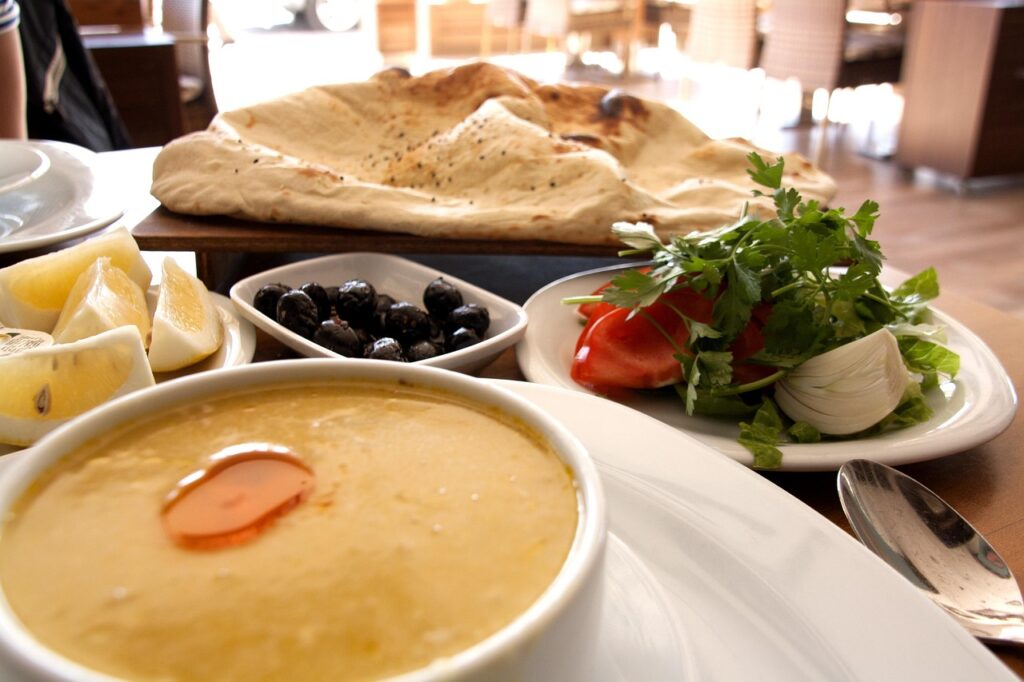
The Middle Eastern breakfast is kahvalti’s closest relative: shared plates of cheese, olives, breads, eggs, and dips, eaten together over a long morning. The family resemblance is unmistakable.
The differences are regional accents. The Levantine table adds its own dips and breads, the Iranian table adds its jams and eggs, and each country claims its own classics. Kahvalti is the Anatolian branch of this shared eastern morning.
The comparison is a reminder that breakfast traditions do not respect modern borders. The shared eastern breakfast is one culture with many tables, and kahvalti is one of its most elaborate versions.
The comparison also reveals how much the eastern tables borrow from each other. The stuffed vine leaves, the white cheeses, and the flatbreads of the Levantine morning appear in Turkish homes under slightly different names, and the shared heritage is a source of quiet pride on both sides.
The Mediterranean: Light and Local
The Mediterranean breakfast, from Italy to Spain to Greece, is usually light: bread, olive oil, cheese, fruit, and coffee. It is local, seasonal, and quick, more fuel than ceremony.
Kahvalti shares the Mediterranean’s ingredients, the bread, the cheese, the olives, but not its restraint. The Turkish table multiplies those ingredients into a spread, while the Mediterranean keeps them few and proud.
The comparison shows the Turkish speciality: taking the modest Mediterranean pantry and building an architecture of abundance from it. The ingredients are cousins; the scale is the difference.

The Turkish Table: Many Small Dishes
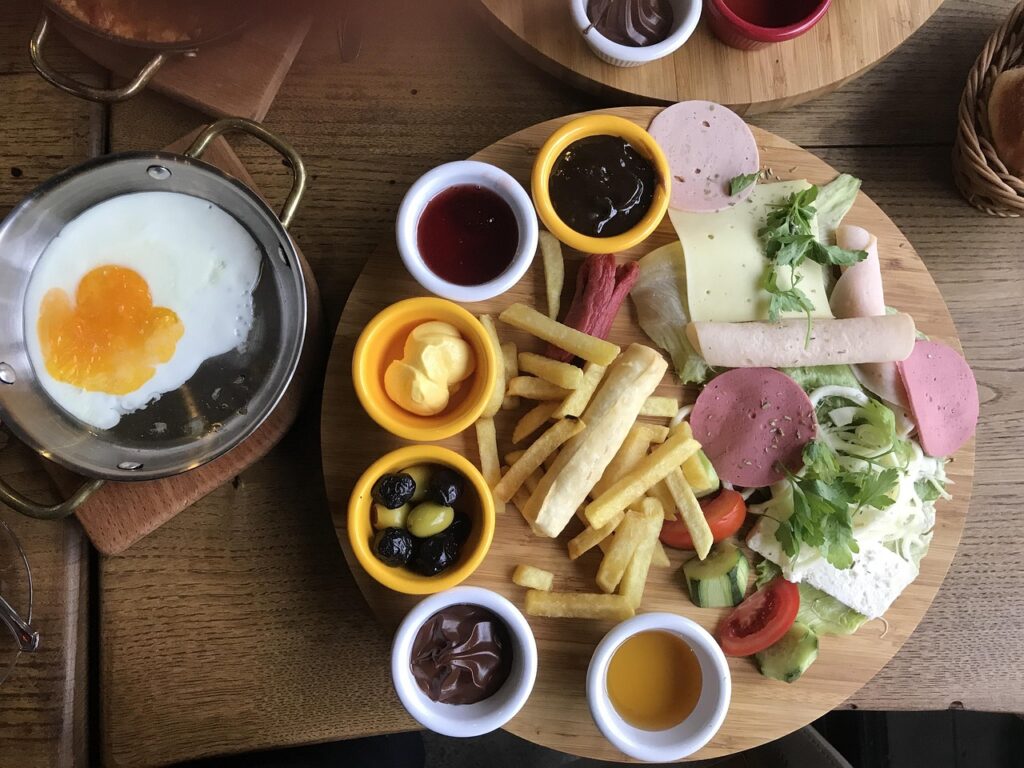
Kahvalti’s structure is its signature. Dozens of small plates cover the table: cheeses, olives, vegetables, eggs, breads, jams, honey, and kaymak, with tea as the constant companion. No single dish defines the meal; the collection does.
The structure produces a particular eating rhythm: small bites, constant movement, endless combinations. Every slice of bread is a new decision, and the meal unfolds as a series of small discoveries.
This structure also makes kahvalti the most social breakfast in the world. Because the food is shared and the table is abundant, the meal naturally runs long and the conversation runs with it.
This structure also makes kahvalti the most forgiving breakfast in the world for the home cook. Nothing on the table demands a chef: the cheese is sliced, the olives are poured, the jam is spooned, and the eggs are the only cooked act. International breakfasts built around a single hot plate require timing and skill; kahvalti requires a well-stocked pantry and a willingness to share.
Tea and Coffee: The Great Divider
The hot drink divides the breakfast world. The English, the Americans, and the continental Europeans build their mornings around coffee or a different tea culture, while the Turks built theirs around the double-pot black tea ritual.
Turkish tea is not a side drink but the meal’s engine: strong, endlessly refilled, and adjusted to each drinker’s strength. No other breakfast integrates its drink so completely into the meal’s structure.
The tea also explains the breakfast’s length. A coffee is finished; a tea service continues, and the kahvalti table is built for a drink that never ends.

What Kahvalti Shares With Its Neighbors
For all the differences, kahvalti shares real ground with its rivals. With the English it shares the serious morning meal and the devotion to tea. With the Americans it shares generosity and abundance.
With the Middle Eastern and Mediterranean tables it shares the pantry: bread, cheese, olives, and eggs, the same ancient morning ingredients prepared with the same respect. The shared DNA is visible on every table.
These connections matter because they show that kahvalti is not an oddity but a summit. It stands at the meeting point of several breakfast traditions and elevates their common elements into something more.
What Makes It Turkish
Bring the comparison home and the Turkish identity is clear. First, the structure: many small shared dishes with no centerpiece, the table itself as the main course. Second, the balance: savory and sweet in constant dialogue, salt and honey on the same slice of bread.
Third, the tea: the double-pot ritual that paces the whole meal. Fourth, the pace: a breakfast measured in hours, not minutes, defended against every pressure of modern life.
Finally, the social shape: kahvalti is eaten with others, refilled by the host, and designed for company. That is what makes it Turkish, and it is why no other breakfast quite replaces it.
The comparison with international breakfasts is complicated by the fact that Turkey itself has two kahvaltis. The village breakfast is the old root: bread, cheese, olives, eggs, and tea, seasonal and modest, built from the household’s own production.
The city breakfast is the famous spread: the serpme table with its dozens of dishes, served in breakfast houses from morning to afternoon. It is the village table enlarged, ornamented, and given a menu.
Both versions share the same identity: the shared table, the torn bread, the endless tea, the unhurried pace. Whatever form it takes, the kahvalti is recognizable at a glance, and no international breakfast reproduces that family resemblance.
Modern life has tested the kahvalti and found it surprisingly durable. The weekday version compresses into ten minutes without losing its structure, and the weekend version expands into the long ceremony that the tradition demands.
The modern breakfast house has also carried kahvalti into new settings: brunch menus, delivery boxes, and single-serving plates for the solo diner. Each adaptation keeps the core intact, small dishes, strong tea, shared atmosphere.
The comparison with other breakfasts suggests why kahvalti survives modernization so well: it is not a fixed recipe that can go stale but a structure that can hold any ingredients. The structure is the tradition, and the structure is still standing.
For the visitor, the practical lesson of the comparison is simple: order the spread, not the single plate. The international breakfasts you know will still be waiting at the hotel; the kahvalti table is the one you can only get here, and it is worth every minute of the morning.
Frequently asked questions
How is Turkish breakfast different from the English breakfast?
The English breakfast is a fixed plate with eggs, bacon, sausages, beans, and toast as the centerpiece. Kahvalti is a spread of many small shared dishes, cheeses, olives, vegetables, eggs, jams, and breads, with no single star and endless tea as the engine of the meal.
Why is Turkish breakfast mostly cold?
The Turkish table centers on the pantry items that keep well and travel to the table: cheeses, olives, bread, vegetables, honey, and jams. One hot dish, usually eggs, completes it. This cold structure is practical and lets the meal run long without the food suffering.
What makes Turkish breakfast unique?
The combination is unique: a shared spread of dozens of small dishes, a strong savory-sweet balance, and a tea ritual that paces the meal. No other breakfast builds its entire identity around abundance, sharing, and the unhurried morning.

All Over Information
The All Over Information editorial team researches and writes practical English-language guides to Turkey. Facts are checked against official and local sources before publication, prices are published as dated ranges rather than quotes, and guides are revised when things change. We accept no sponsored posts, paid placements or paid links.
More guides like this
Where to Find the Best Turkish Soups (Corba) in Turkey
Turkey is a country of soups, and every region serves its own version with local pride.

Hunkar Begendi: A Taste of Turkish Culture
Hunkar begendi is more than a recipe; it is a story that Turkey has told itself for centuries, a dish named for…

How to Make Authentic Turkish Flatbread (Bazlama) at Home
Bazlama is one of the most rewarding breads a home cook can make.
Turkish Tea Farms in Rize: A Behind-the-Scenes Look
The tea that fills tulip-shaped glasses across Turkey comes from one place above all: the steep, rainy hills of Rize on the…
Baklava Vs. International Variations: What Makes It Turkish
Baklava is one of the most traveled desserts in the world, and every country it has touched has made it its own.
Kebab: A Taste of Turkish Culture
Few foods say more about Turkey than kebab. It is the smoke that rises from a hundred thousand grills, the warmth of…