The Mevlevi tradition, known to the world through the whirling dervishes, is one of the great spiritual currents of Islam and one of the most beautiful cultural inheritances of Turkey. Founded in the wake of the poet Rumi’s death in the thirteenth century, it grew into a sophisticated order that shaped Ottoman music, poetry, and manners for six hundred years. Understanding the Mevlevi tradition means understanding its origins, its rituals, its arts, and the remarkable story of its survival into the present.
What Is the Mevlevi Tradition?
The Mevlevi tradition is a Sufi order, a brotherhood of Muslims devoted to the inner, mystical dimension of their faith. It is named after its inspiration, Mevlana, the title given to the poet Rumi, meaning our master.
Like other Sufi orders, the Mevlevis are organized around a master-disciple relationship and a disciplined path of spiritual development. What distinguishes them is their celebration of music, poetry, and the ritual whirling known as the sema as vehicles of prayer.
The tradition is both a way of life and a body of culture, and the two can never be separated. It produced master musicians, poets, and calligraphers, and its lodges were centers of refinement and learning as well as devotion. Understanding it requires attention to both dimensions, the inner path and its outward expressions.
Origins in the Life of Rumi
The tradition begins with Rumi, born in 1207, whose family fled the Mongol invasions and settled in Konya. He became a renowned scholar, but his life was transformed by his meeting with the wandering mystic Shams of Tabriz, whose companionship released Rumi’s great flood of poetry.
After Shams disappeared, Rumi expressed his longing and love in verse that became the spiritual foundation of the order. He died in 1273, and his followers, led by his son, organized themselves around his tomb and his teaching into what became the Mevlevi order.
The early community was shaped by grief and love, and these emotions remained at the heart of the tradition for centuries. The whirling, the music, and the poetry all grew from Rumi’s own practice of ecstatic remembrance, and they preserved the intensity of that first generation of followers.

The Order, the Lodge, and the Master
The Mevlevi order was built around institutions that gave its spirituality concrete form. The lodge, known as a tekke, was the center of community life, containing the prayer hall, the sema hall, and rooms for the dervishes.
At the head of the order stood the sheikh, the spiritual master who guided disciples along the path. The relationship between master and disciple was the heart of Sufi practice, and the discipline was demanding, involving fasting, prayer, and long periods of service.
The dervishes lived a structured life of poverty, obedience, and remembrance, and the lodges functioned as schools where music, calligraphy, and the inner sciences were taught. The institution and the spiritual path were inseparable.
The Sema: Ritual and Symbolism
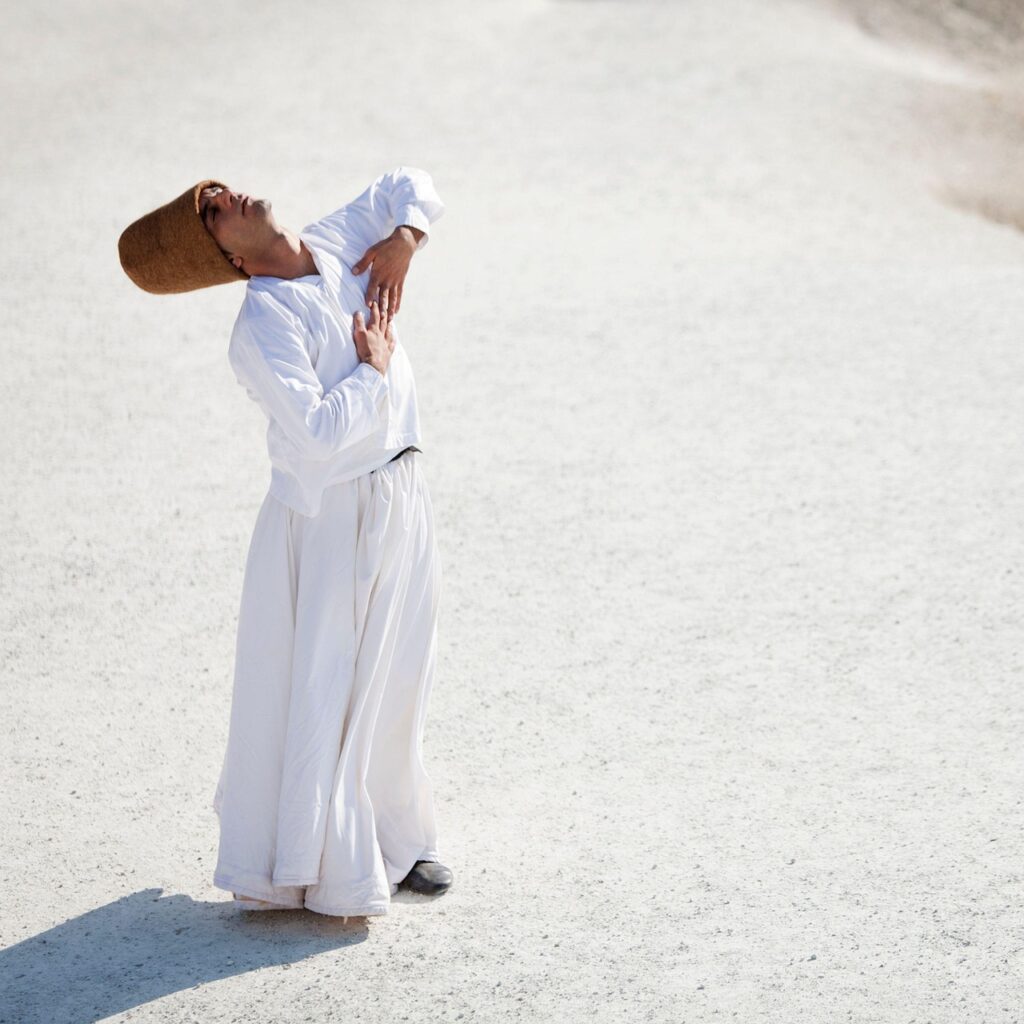
The sema is the most famous ritual of the Mevlevi tradition. In it, the dervishes whirl in a ceremony lasting about an hour, accompanied by the ney flute, the drum, and the choral music of the ayin.
Every element is symbolic. The dervish’s tall camel-hair hat represents the tombstone of the ego, and the black cloak its shroud; the casting off of the cloak at the beginning of the ceremony signifies the abandonment of the self before God.
The whirling itself is the soul’s journey: the right hand, raised, receives divine grace, and the left hand, lowered, pours it upon the world. The four movements of the sema trace the stages of spiritual ascent, and the ceremony ends with a recitation from the Qur’an.

Music of the Whirling Dervishes
Music is the lifeblood of the Mevlevi tradition. The ney, the reed flute whose opening wail begins the Masnavi, is its emblem, and its sound is inseparable from the ceremony of the sema.
The ceremonial repertoire, known as the ayin, is among the greatest achievements of Turkish classical music. Composed over centuries by Mevlevi musicians, these long works combine instrumental and vocal passages in a structure that mirrors the spiritual journey.
The order’s musical tradition influenced the whole of Ottoman classical music, and its compositions are still performed and recorded today. The music is not accompaniment but prayer, and it is understood as an essential part of the spiritual work.
Poetry as Spiritual Practice
Poetry occupies a central place in the Mevlevi tradition. Rumi’s own verse, above all the Masnavi and the lyric poems of the Divan, is the spiritual literature of the order, recited, studied, and sung.
The tradition cultivated poets for centuries, and the lodges produced a rich literature in Persian and Turkish. Poetry was not ornament but practice, a way of training the heart and expressing the inexpressible.
The recitation of poetry remains part of Mevlevi life, and the tradition’s literary heritage is among its greatest gifts to world culture. For the dervishes, the verses of Rumi are a living presence, not a museum exhibit.
The Mevlevi Way of Life
The Mevlevi path demands a total transformation of life. Disciples follow a long curriculum, beginning with service in the lodge and progressing through stages of spiritual development under the sheikh’s guidance.
The daily round was structured by prayer, remembrance, study, and work. The famous thousand days of service, when the novice served the community before beginning formal training, became the tradition’s most famous discipline.
The goal of the path is the polishing of the soul until it reflects the divine, like a mirror cleaned of rust, and the fruits of the path are understood to be humility, generosity, and inner peace. The outward forms of the tradition, its rituals, its music, and its etiquette, all exist to serve this inner transformation.
The Tradition in the Ottoman Centuries
Under the Ottomans, the Mevlevi order became one of the most honored institutions of the empire. Sultans visited the lodge in Konya, patronized its arts, and consulted its sheikhs, and the order flourished for six centuries.
Mevlevi lodges were established in the empire’s major cities, and the order became known for its refinement and its cultivation of the arts. It produced leading musicians, poets, and calligraphers, and its influence reached deep into Ottoman high culture.
This long establishment shaped the order’s character, making it the most aristocratic of the Sufi brotherhoods. Its closeness to the state would later make its fate in the modern era particularly dramatic.

The Mevlevi Tradition Today
The twentieth century brought catastrophe and revival. In 1925, the Turkish Republic closed all Sufi lodges and banned the ceremonies, and the public life of the order ended. Its survival through the following decades was private and precarious.
The revival began in the 1950s, when the state permitted the sema as a cultural performance, and the annual commemoration of Rumi in Konya became a major event. Today the ceremony is performed publicly, and the tradition is recognized as world heritage.
The contemporary Mevlevi tradition exists in several forms: a small community of committed practitioners, a rich cultural heritage performed on stage, and a global spiritual brand. All three are heirs of the same centuries-old path.
Experiencing the Tradition Respectfully
For visitors, the most common encounter with the Mevlevi tradition is the public sema, performed in cultural centers and at festivals. The experience can be profoundly moving if approached with the right attitude.
Attend with respect: arrive early, remain silent during the ceremony, and do not applaud until the very end. Dress modestly, turn off your phone, and avoid walking through the space while the whirling is taking place. The dervishes are performing an act of worship, and the audience’s demeanor is understood as part of the ceremony itself.
Beyond the sema, the tradition can be experienced through its music, its poetry, and its sites, from the Mevlana Museum in Konya to the historic lodges and concert halls of Istanbul. Each offers a doorway into a living spiritual tradition.
Sacred Sites and the Geography of the Tradition
The Mevlevi tradition is anchored in a geography of sacred places, and the most important of these is Konya, where Rumi’s tomb lies within the former lodge that is now the Mevlana Museum. The green dome of the tomb is one of the most recognizable monuments in Turkey.
The old lodges of the empire, from Istanbul to the Balkans and beyond, survive in various states, some as museums, some as concert halls, and some as active cultural centers. Each carries the memory of the order that once flourished there.
For travelers, visiting these sites with knowledge of the tradition transforms the experience. The architecture, the gardens, and the artifacts of the lodges all speak of a way of life that combined devotion with beauty, and the places themselves are part of the tradition’s continuing story.
Frequently asked questions
What is a sema ceremony?
The sema is the whirling ceremony of the Mevlevi order, in which dervishes spin to the music of the ney, drum, and choir. It is a ritual of prayer symbolizing the soul’s journey toward God, with the right hand raised to receive grace and the left lowered to give it to the world. It lasts about an hour.
Is the Mevlevi tradition still active in Turkey?
Yes. The order was suppressed in 1925, but the tradition survived privately and was revived from the 1950s onward. Today the sema is performed publicly in cultural programs, the annual Konya commemoration draws large audiences, and a small community of practitioners continues the spiritual path within the tradition.
What is the role of music in Mevlevi practice?
Music is essential to the Mevlevi path. The ney flute symbolizes the soul’s longing, and the ceremonial compositions called ayin structure the sema. The order produced many of the greatest musicians of Ottoman classical music, and its compositions are still performed today as acts of devotion and works of art.

All Over Information
The All Over Information editorial team researches and writes practical English-language guides to Turkey. Facts are checked against official and local sources before publication, prices are published as dated ranges rather than quotes, and guides are revised when things change. We accept no sponsored posts, paid placements or paid links.
More guides like this

Understanding Modern Turkish Pop Culture
Modern Turkish pop culture is everywhere, even if you do not realize it: television dramas that air on six continents, pop songs…
Understanding the Concept of Misafirperverlik (hospitality)
You will hear the word misafirperverlik within days of arriving in Turkey, usually from a Turkish person explaining their own culture.

A Visit to a Traditional Turkish Barber Shop: What to Expect
A visit to a traditional Turkish barber shop, known as a berber, is often described as one of the more memorable everyday…

A Deep Dive into Turkish Youth and Social Media Trends
The social media culture of Turkish youth is one of the most dynamic in the world, and it is not an accident…

Turkish Wedding Traditions Explained
A Turkish wedding is a festival that can last for days, drawing in families, neighbors, and whole neighborhoods.

Understanding How Turkish Extended Families Function
The extended family is the true center of Turkish society, a web of grandparents, parents, children, aunts, uncles, and cousins who share…