Rumi’s legacy in Turkey is one of the most remarkable survival stories in the history of religion and culture. A thirteenth-century poet and mystic, he became the inspiration for an entire spiritual order, a pillar of Ottoman high culture, a casualty of modern secularization, and finally a global phenomenon. Each of these chapters left its mark, and the legacy that visitors encounter in Konya today is the layered result. This deep dive traces the historical Rumi, the making of the Mevlevi tradition, and the complex afterlife of both in modern Turkey.
The Historical Rumi and the Legendary Rumi
The historical Rumi was born in 1207 in the region of present-day Afghanistan, the son of a respected preacher and scholar. Fleeing the Mongol invasions, his family traveled through the Islamic world and settled in Konya, capital of the Seljuk state, where the young man inherited his father’s position.
The legendary Rumi grew after his death. The accounts of his meetings with Shams of Tabriz, his ecstatic poetry, and his funeral, attended according to tradition by Muslims, Christians, and Jews, were elaborated by his followers into a story of universal love that transcends the historical record.
Separating the two is less important than understanding both, and the best scholarship tries to hold them together. The historical Rumi gives the tradition its grounding in thirteenth-century Anatolia, a world of Seljuk courts, Mongol wars, and vibrant religious debate, while the legendary Rumi explains why the tradition has been able to speak to every later age.
The Formation of the Mevlevi Order
Rumi did not found an order. The Mevlevi order took shape in the decades after his death, when his followers, led by his son Sultan Walad, organized the community around his tomb and his teachings into a structured institution.
The order developed a distinctive identity centered on the sema, the whirling ceremony, and on the veneration of the poet as a saint. The first lodge grew around the tomb in Konya, and from there the order spread across the Islamic world, establishing lodges, schools, and cultural institutions in the great cities of the empire.
The Mevlevi path, like other Sufi orders, was built on the relationship between master and disciple, the discipline of the soul, and the practice of remembrance of God. But it was distinguished by its emphasis on music, poetry, and the beautiful forms of the sema.

The Masnavi as Spiritual Encyclopedia
The Masnavi, Rumi’s masterwork, is the foundation of the Mevlevi tradition’s intellectual life. Composed in Persian, it runs to more than twenty-five thousand verses, organized into six books of stories, parables, and commentary.
The work calls itself the roots of the roots of religion, and for centuries it was studied as a guide to the spiritual path. Commentators wrote voluminous explanations, and the reading of the Masnavi became a discipline in its own right within the order.
The Masnavi’s method is storytelling. Rumi tells a tale, interrupts it to draw a lesson, tells another tale within the first, and gradually builds a web of meaning. The effect is encyclopedic, absorbing the wisdom of the Qur’an, the hadith, and the wider Islamic tradition.
The Sema and Its Symbolism
The sema, the whirling ceremony, is the most distinctive creation of the Mevlevi tradition and its most famous export. Its form was refined over centuries into the ceremony performed today, with its music, its choreography, and its prescribed etiquette.
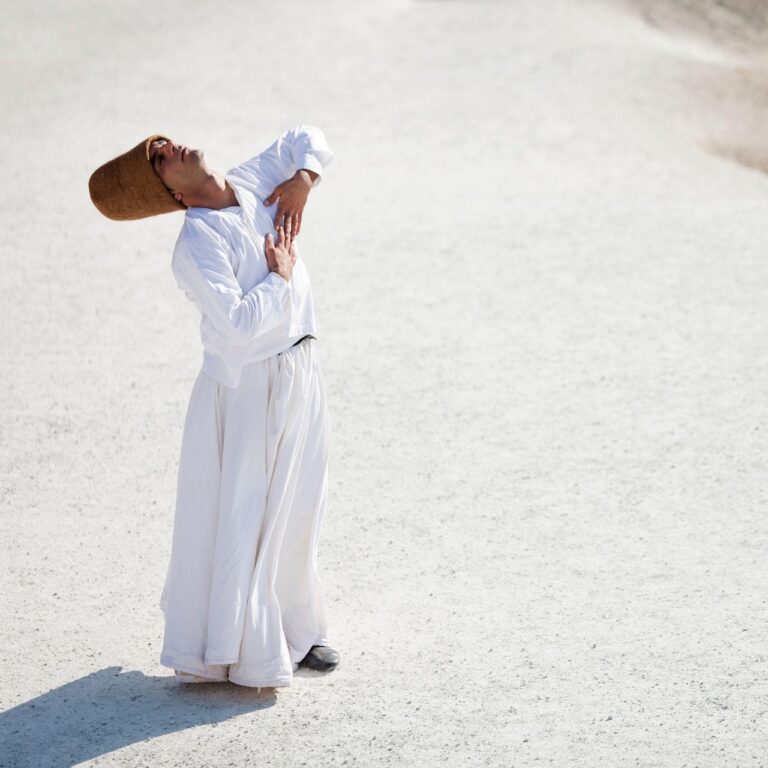
Every element of the sema carries meaning. The dervish’s tall hat represents the tombstone of the ego, the black cloak its shroud, and the casting off of the cloak the abandonment of the self. The whirling itself, with one hand raised and one lowered, receives from heaven and gives to the earth.
The ceremony is understood as a spiritual journey: the four parts of the sema correspond to stages of ascent toward union with God. Its beauty has made it famous, but its purpose is devotional, and that purpose must be understood to see the ceremony rightly.
Music, Poetry, and the Mevlevi Arts
The Mevlevi tradition produced one of the great musical cultures of the Islamic world. The ney, the reed flute whose opening notes open the Masnavi, became the emblem of the order, and the ceremonial repertoire grew into a refined art.
Mevlevi music influenced Ottoman classical music profoundly, and the order trained many of the empire’s finest musicians. The ayin, the long musical compositions for the sema, remain among the most admired works of Turkish classical music.
Poetry was equally central. The order cultivated poets, and Rumi’s own verses, along with those of his successors, were recited, sung, and copied in illuminated manuscripts. The arts of calligraphy and manuscript illumination flourished in the lodges.
Rumi in Ottoman Court Culture
The Ottoman state embraced the Mevlevi order and made it an honored institution. Sultans visited the lodge in Konya, endowed its buildings, and treated the sheikhs of the order with respect, and the order in turn lent its prestige to the dynasty.
Mevlevi lodges were established in the major cities of the empire, and the order’s members served as judges, poets, and officials. The sema became a ceremonial form performed at courtly occasions, and Mevlevi sheikhs were consulted on matters of state.
This long patronage shaped the character of the order. It became the most aristocratic of the Sufi brotherhoods, cultivated, refined, and closely tied to the Ottoman establishment, which made its later fate all the more dramatic.

The Republican Era and the Closing of the Lodges
The founding of the Turkish Republic in 1923 inaugurated a radical transformation of religious life. In 1925, the new state closed all the Sufi lodges, banned their ceremonies, and outlawed the orders, including the Mevlevis, as part of its program of secular modernization.
The ban was a shock to a tradition six centuries old. Lodges were sealed, property was confiscated, and the public practice of the sema became impossible. Some Mevlevis emigrated, while others carried the tradition quietly in private.
The suppression was never complete, and the ban was never total. Music, manuscripts, and esoteric knowledge survived among former dervishes and their families, and the commemoration of Rumi’s death continued quietly in private gatherings. The tradition entered a kind of exile, waiting for the circumstances that would allow its public revival.
The Revival of the Mevlevi Tradition
The revival began gradually after the middle of the twentieth century. The state, recognizing the cultural and touristic value of the tradition, permitted the performance of the sema as a cultural presentation, stripped of its strictly religious framing.
The turning point came in the 1950s, when the government began organizing an annual commemoration of Rumi in Konya. The December ceremony, known as Sheb-i Arus, grew into a major event, and the sema was performed publicly before large audiences once more.
Today the tradition exists in multiple registers: as living religious practice for a small community of Mevlevis, as cultural heritage performed on stage, and as a global brand of Turkish spirituality. The revival has been real, but it has also raised questions about authenticity.

Konya as a Site of Pilgrimage
Konya, the city Rumi made his home, has become the focal point of his legacy. The Mevlana Museum, built around the lodge and tomb, receives millions of visitors every year, making it one of the most visited sites in Turkey.
The city’s identity is inseparable from the poet. Streets, institutions, and festivals carry his name, and the annual December commemoration transforms the city into a gathering place for pilgrims and scholars from around the world.
For the faithful, the visit to the tomb is a pilgrimage in the full sense, an act of devotion with a history stretching back to the poet’s own century. For secular visitors and tourists, the same place offers beauty, history, and a window into a tradition that has shaped the city for seven centuries.
Rumi’s Universal Appeal and Its Limits
The final chapter of Rumi’s legacy is his transformation into a global phenomenon. His poetry has been translated into dozens of languages, and he has become one of the best-selling poets in the world, admired for messages of love, tolerance, and unity.
This global reception has often simplified him, separating the poetry from its Islamic and Mevlevi context. Scholars and believers have sometimes objected to the flattening, and the debates about authenticity continue in Turkey and abroad.
Yet the universal appeal is also grounded in something real. Rumi’s poetry does speak across boundaries, and the tradition itself was always open to people of every faith. The tension between the local Rumi and the global Rumi is likely to remain part of his legacy.
Frequently asked questions
How did the Mevlevi order come into existence?
The order was formed after Rumi’s death in 1273, when his followers, led by his son Sultan Walad, organized the community around his tomb and teachings. It grew into an influential institution with lodges across the Ottoman Empire, known for the sema ceremony and its cultivation of music and poetry. It was suppressed in 1925 and later revived.
What happened to the Mevlevi tradition in the twentieth century?
The Turkish Republic closed all Sufi lodges in 1925 as part of secular modernization, and public ceremonies were banned. The tradition survived privately and abroad. Beginning in the 1950s, the state permitted the sema as a cultural presentation, and the annual Konya commemoration grew into a major event, reviving the public presence of the tradition.
Why is Rumi’s poetry so popular worldwide?
Rumi’s poetry expresses universal themes of love, longing, and the search for meaning with extraordinary beauty, and it speaks to readers of every background. His message of tolerance and unity has resonated widely in the modern world. The poetry is also deeply rooted in Islamic mysticism, and both the universal appeal and the religious context are part of his legacy.

All Over Information
The All Over Information editorial team researches and writes practical English-language guides to Turkey. Facts are checked against official and local sources before publication, prices are published as dated ranges rather than quotes, and guides are revised when things change. We accept no sponsored posts, paid placements or paid links.
More guides like this

How Turkish Teenagers Spend Their Free Time
If you travel to Turkey and find yourself in a park, a shopping street, or a seaside promenade on a weekend afternoon,…

Ramadan Iftar Traditions in Turkey
If you visit Turkey during the month of Ramadan, you will witness a transformation.

Basketball Culture in Turkey
Turkey is famous for football, but basketball runs it a close second in passion and success.

Understanding the Roman Anatolia: A Beginner’s Guide
Anatolia, the peninsula that is now Turkey, was one of the most important regions of the Roman Empire, and its Roman centuries…

The Street Cats of Istanbul Explained for Foreigners
If you have heard anything about Istanbul before visiting, you have probably heard about the cats. They are everywhere: on tram seats,…
The Sufi Mevlevi Tradition Explained for Foreigners
Among all the treasures of Turkish culture, few fascinate visitors as much as the whirling dervishes of the Mevlevi tradition.