Most people arrive in Konya with one thing in mind: the Whirling Dervishes and the tomb of Rumi, the 13th-century mystic known in Turkey as Mevlana. But Konya is far more than that. It was the capital of the Seljuk Empire, and it still wears that identity proudly in its mosques, museums, and monuments. It is also a modern city of more than two million people, with a flat, orderly center that is easy to explore on foot. This guide covers everything a first-time visitor needs to know, from the must-see sights to the local dishes you should not miss.
First Impressions: The City and Its People
Konya sits on the edge of the vast Central Anatolian plain, a flat expanse of wheat fields stretching to the horizon. The city is a study in contrasts: broad boulevards run alongside Seljuk-era stonework that has stood for eight centuries.
Konyans are famously welcoming, and the city is one of the most conservative in Turkey. You will notice more covered women and more mosques per capita than in Istanbul, and bars are rare. That is part of the city’s character. Dress modestly, particularly around religious sites, and you will be treated with genuine warmth.
The pace is slower than Istanbul. Shops close for Friday prayers . Adjust your expectations and the city rewards you with a calm rhythm that few Turkish cities still have.
Getting to Konya
Konya Airport sits about 18 kilometers northeast of the center, with regular domestic flights from Istanbul taking just over an hour. The city is also one of the best-connected in Turkey by rail: the high-speed YHT train links Konya to Ankara in under two hours and to Istanbul in about four and a half hours.
From the airport, a shuttle bus or taxi gets you downtown in about half an hour. From the train station, the tram runs directly into the center, passing within minutes of the Mevlana Museum. The tram network is small but useful, and the center is walkable, so most first-timers rarely use transport. Book train tickets in advance during holidays and the Mevlana Festival in December.
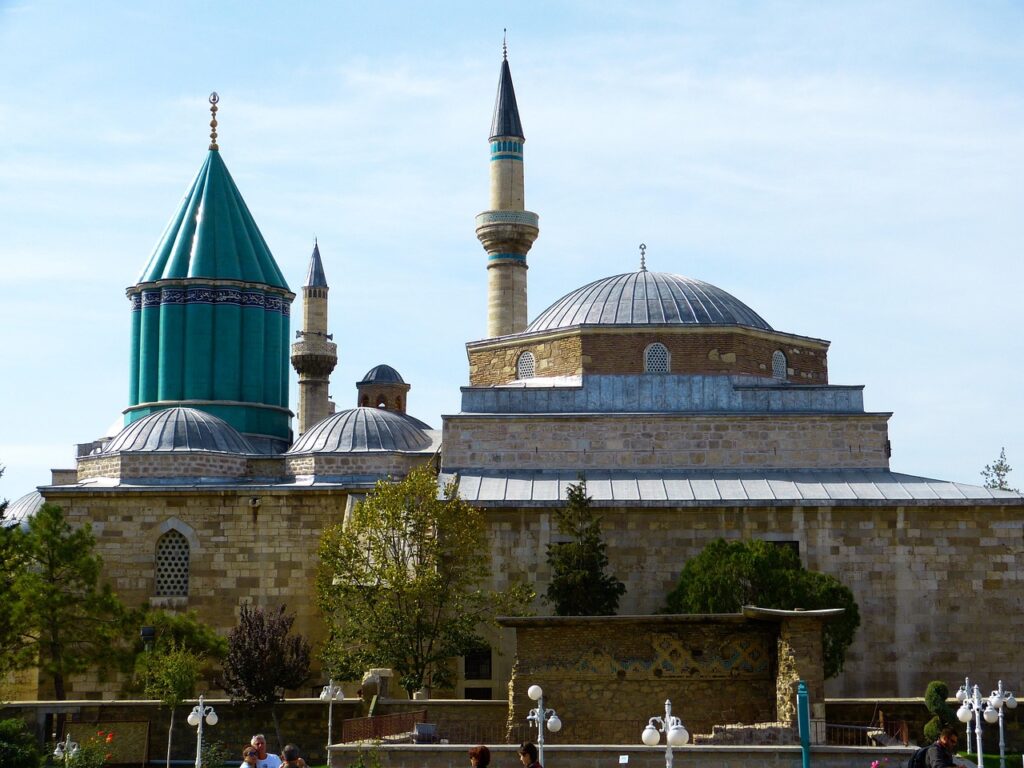
The Mevlana Museum: The Heart of the City
The Mevlana Museum is the reason most people come to Konya, and it does not disappoint. It contains the tomb of Mevlana Celaleddin Rumi, the 13th-century poet and Sufi master whose message of love and tolerance has made him one of the most quoted writers in the world. The turquoise tiled dome and slender minaret dominate the old city, and the tomb chamber, is the emotional center of the visit.
Inside, the museum displays a remarkable collection of Sufi objects: illuminated manuscripts, musical instruments used in the whirling ceremony, and rows of small cells where dervishes once lived and prayed. The atmosphere is contemplative and surprisingly moving.
The museum is the busiest site in Konya, so go early to avoid the crowds, and allow at least two hours. Photography is restricted inside the tomb chamber, so keep your camera for the courtyards and rose garden outside.
The Whirling Dervishes and the Sema Ceremony
The whirling dervishes are followers of Mevlana’s Sufi order, and the sema is their meditation in motion: a slow, hypnotic rotation performed in white robes and tall conical hats. The right hand turns upward to receive divine grace, the left downward to pass it to the world. Watching a sema is the most memorable thing you can do in Konya.
Today a cultural center in the city keeps the tradition alive, with regular performances through the year. During the Mevlana Festival in December the schedule expands dramatically as dervishes gather from around the world.
The sema is a religious ceremony, not a show, so arrive early, sit quietly, and do not applaud until the music finishes. Photography is usually forbidden during the performance, .
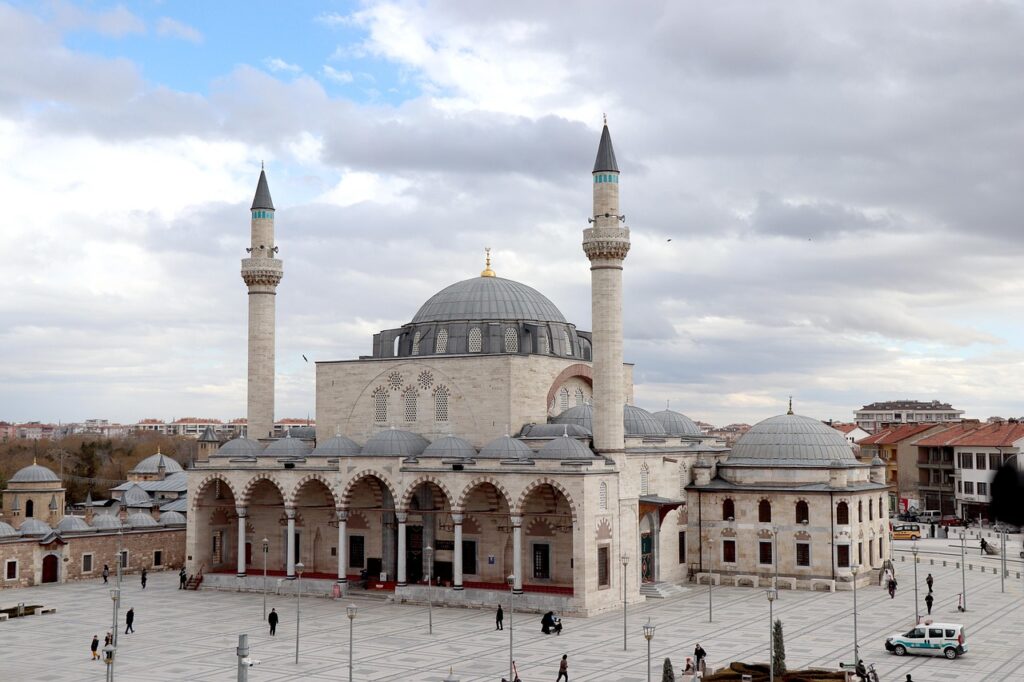
Alaeddin Hill and the Seljuk Capital
Konya was the capital of the Seljuk Sultanate of Rum from the late 11th century until 1243, and no place tells that story better than Alaeddin Hill. This low mound was the site of the Seljuk palace and holds the city’s oldest surviving mosque, the Alaeddin Mosque, built in the 12th and 13th centuries under Sultan Alaeddin Keykubad.
The mosque is austere compared to the ornate Ottoman mosques of Istanbul, with a wooden ceiling supported by a forest of antique columns. The Seljuk sultans are buried in a courtyard tomb here, and the hilltop offers the best open views over the city.
The hill is also home to the archaeological museum and a small tearoom where locals sit in the afternoon sun. It is the perfect place to begin a walking tour of the old city.
More Seljuk Monuments: Ince Minare and Karatay
Two museum-mosques from the Seljuk era sit within a few minutes’ walk of Alaeddin Hill. The Ince Minare Museum occupies a former medrese, a theological school built in the 1260s, named for its pencil-thin minaret, which survives only truncated after lightning struck in 1901. The stone portal is one of the masterpieces of Seljuk ornament, carved with dense geometric patterns.
Inside, the museum displays fine Seljuk stonework and architectural fragments. The Karatay Museum, a short walk away, is the opposite experience: a former medrese built in 1251 whose entire interior is covered in brilliant turquoise and cobalt tiles, the signature art of the Seljuks.
Both museums are compact; an hour in each is plenty. Between them they show why the Seljuks are remembered as the great tile-makers of the medieval Islamic world.

Aziziye Mosque and the Old Bazaar
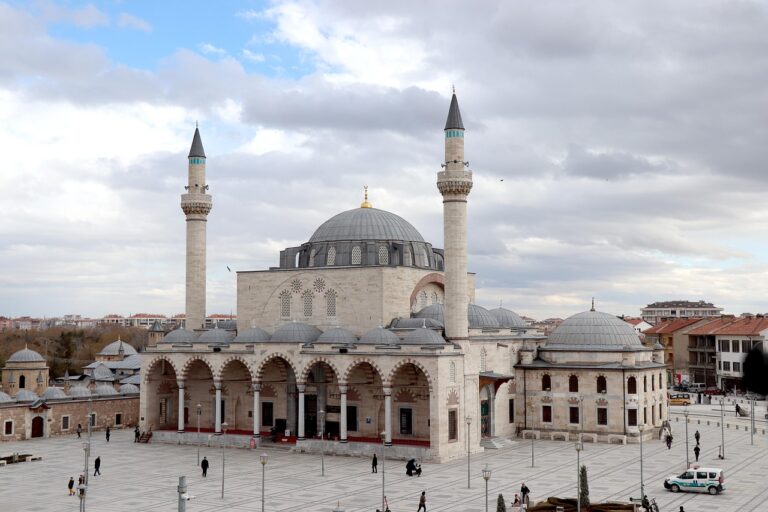
If the Seljuk monuments show Konya’s medieval face, the Aziziye Mosque shows its Ottoman one. Rebuilt in the 19th century after a fire, it is an unusual hybrid: a classical Ottoman plan wrapped in a flamboyant baroque facade of carved stone. The contrast with the austere Seljuk buildings nearby could not be greater.
The mosque fronts the main shopping street, and behind it spreads the traditional bazaar district: covered lanes selling textiles, gold, spices, and Mevlana-themed souvenirs. The atmosphere is much more local than Istanbul’s Grand Bazaar.
The bazaar is also the best place for the essential Konya souvenir: a small replica of Mevlana’s tomb or the flared hats of the dervishes. For something edible, buy a packet of lokum, the Turkish delight made here in dozens of flavors.
What to Eat: Etli Ekmek and Beyond
Konya’s food is hearty, wheat-based, and meat-forward, on the grain-fed Central Anatolian plain. The signature dish is etli ekmek, a long, thin flatbread topped with minced meat and baked in a wood-fired oven until crisp. It looks like a pizza and tastes like nothing else. Eat it with your hands, often with a side of cacik, the cold yogurt and cucumber soup.
The other essential dish is firik pilavı, a fragrant rice pilaf cooked with green wheat roasted over the fire, often served alongside a slow-cooked lamb dish called tirit. For breakfast, the local spread always includes the region’s sweet, creamy butter.
For dessert, Konya claims some of the best Turkish delight in the country, plus a local specialty called bici bici, a shaved ice dessert with rose syrup. For a drink, the city is famous for its sour cherry juice, sold at any market.

Beyond the City: Çatalhöyük and the Konya Plain
Konya’s most extraordinary attraction lies just outside town. Çatalhöyük, a Neolithic settlement occupied between roughly 7400 and 6000 BC, is one of the most important archaeological sites in the world. Its mud-brick houses were built packed together like a honeycomb, entered through roof holes, and its inhabitants painted bulls and goddesses on the walls. UNESCO lists it as a World Heritage Site.
The site consists of a visitor center with a museum and a partial reconstruction, plus the excavated mounds themselves. A visit takes half a day and combines well with a drive across the Konya Plain, beautiful in spring when the wheat is green and gold at harvest.
Çatalhöyük is reachable by taxi or a short drive from the city, and it makes a genuinely mind-expanding day trip.
Practical Tips for First-Timers
The center of Konya is compact and walkable, but the city sprawls at the edges, so plan your hotel near the Mevlana Museum or Alaeddin Hill. The tram is the only transit you will likely need, connecting the train station, airport shuttle stop, and main sights.
Dress code matters here more than in coastal Turkey. Covered shoulders and knees are the standard for entering mosques and dress modestly in the old city. Women may be asked to cover their hair at religious sites; a scarf in your bag solves the problem.
Learn a few words of Turkish. A “Merhaba” (hello) and “Tesekkurler” (thank you) go a long way in a city where fewer people speak English than in Istanbul. Konyans are famously hospitable, and a little effort is repaid with generosity.
When to Visit
Spring and autumn are the sweet spots for Konya. April, May, September, and October bring mild days and the least extreme weather . Summers are hot and dry, with daytime temperatures regularly passing 30 degrees Celsius. Winters are cold and often snowy, with nights below freezing.
The one date that changes everything is the Mevlana Festival in December, around the anniversary of Rumi’s death on December 17. Known as Seb-i Arus, the “night of union,” it draws visitors from around the world for sema ceremonies, concerts, and exhibitions. Hotels fill up and prices rise, but for many the festival is the reason to come.
If you want the city at its most atmospheric, come for the festival. If you want mild weather and few crowds, come in May or September.
Frequently asked questions
How many days do you need in Konya?
Two full days is the right amount for a first visit. One day covers the Mevlana Museum, Alaeddin Hill, and the Seljuk museums; a second allows time for the bazaars, a sema performance, and a half-day trip to Çatalhöyük. If you are visiting during the Mevlana Festival in December, add a third day .
Is Konya safe for tourists?
Yes. Konya is one of the safest large cities in Turkey. The main nuisances are the usual ones: pickpockets in crowded bazaars and touts near tourist sites. Dress modestly and behave respectfully, and you will find the city genuinely welcoming.
Can you visit Konya as a day trip from Istanbul?
You can, thanks to the high-speed train and frequent flights, but it is a long day. The train takes about four and a half hours each way, leaving little time on the ground. A single overnight stay lets you see the main sights, and two nights is better.

All Over Information
The All Over Information editorial team researches and writes practical English-language guides to Turkey. Facts are checked against official and local sources before publication, prices are published as dated ranges rather than quotes, and guides are revised when things change. We accept no sponsored posts, paid placements or paid links.
More guides like this

Shopping Guide: What to Buy in Konya
Shopping in Konya is a journey into the city's identity.
History and Culture of Konya
Konya is a city where history is not a museum exhibit but a living presence.
A Solo Traveler’s Guide to Konya
Konya is an excellent destination for solo travelers, and in some ways it is better alone than in company.

Best Time of Year to Visit Konya
Choosing when to visit Konya means balancing three things: weather, crowds, and the Mevlana Festival.
Konya in Summer: A Complete Travel Guide
Summer is the season of the open sky in Konya: long days, hot sun, and evenings that linger in the parks and…

How to Get to Konya from Istanbul
Getting from Istanbul to Konya is easier than most travelers expect, and the journey itself can be a highlight.