Ani is the ghost city that haunts every traveller who visits. Hidden on the highland border of northeast Turkey, it was once the dazzling capital of the medieval Armenian kingdom, a Silk Road metropolis of churches and palaces, and today it stands empty, its roofless cathedrals looking out over the river toward Armenia. It is a UNESCO World Heritage Site, an architectural treasure, and one of the least crowded wonders of the country. Here is why Ani belongs on your Turkey bucket list.
The City of a Thousand and One Churches
Ani earned its nickname honestly. Within its walls stood dozens of churches, chapels, and monasteries, an extraordinary density of religious buildings for a medieval city, and their domes and conical roofs crowded the skyline. Even in ruin, the remains of more than twenty churches survive, enough to give the plateau the look of a holy city.
The churches are not all alike. They range from the soaring cathedral to tiny chapels tucked into the grass, and each one shows the inventiveness of Armenian builders, who developed their own style of vaulted stone architecture centuries before the Gothic cathedrals of Europe. Walking from church to church across the plateau is like touring a museum of medieval engineering.
Nowhere else in Turkey can you see such a complete medieval Christian city. The density of monuments, the state of their survival, and the silence around them combine into an experience that is part archaeology, part pilgrimage, and entirely unforgettable.
A Capital Lost to History
Ani’s story is stranger than fiction. A minor kingdom’s capital grew into a city of a hundred thousand people, one of the great urban centres of the medieval world, and then collapsed so completely that it was almost forgotten. No city in Turkey has such a dramatic arc from glory to ghost town.
The reasons for the fall are written across the ruins: conquest by the Seljuks, the disruptions of the Mongol age, and the great earthquake of 1319 that shattered the churches. The city’s trade died, its people drifted away, and Ani shrank into a village on the edge of an empire, its history preserved only in its stones.
For the traveller, that history is the reward. You are not visiting a sanitized monument but a real city in its deathbed state, and the melancholy of the place is part of its power. Ani asks you to imagine, and imagining is what makes it unforgettable.
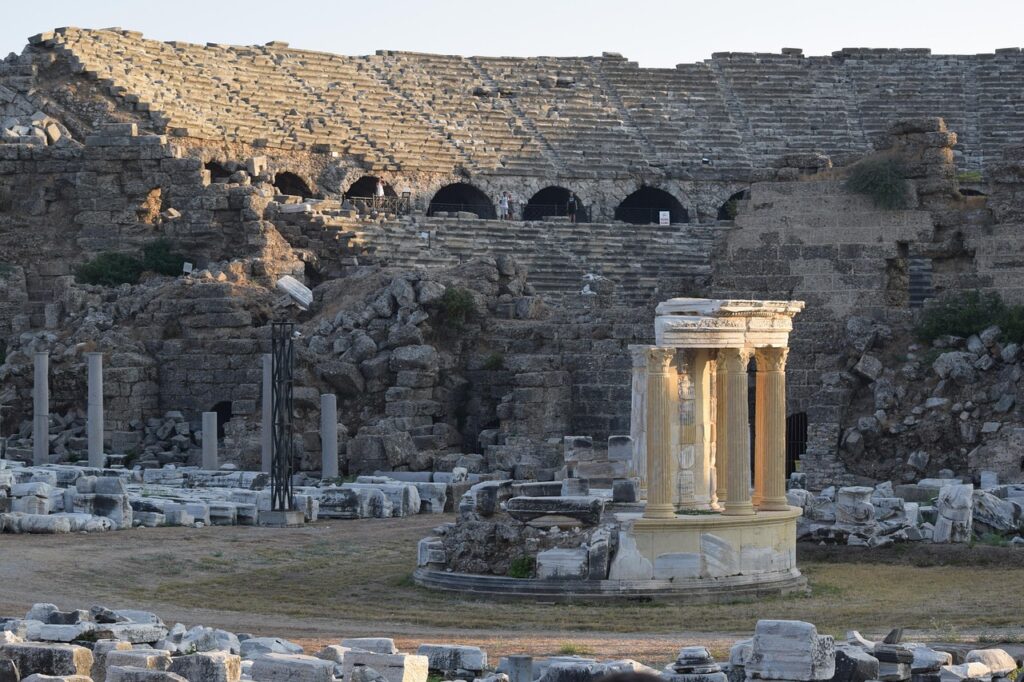
The Cathedral: A Masterwork in Stone
The cathedral of Ani is one of the most important medieval buildings in the world, and it stands almost forgotten at the edge of Europe. Begun in 989 by the architect Trdat, it was the largest church of the Armenian kingdom, and its pointed arches and clustered columns anticipated the Gothic style by two centuries.
Today the cathedral is a roofless shell, its great vault collapsed, and the sky pours through the broken arches. Yet the structure remains so strong that visitors can stand inside the vast interior and feel its original grandeur. It is architecture that speaks across a thousand years.
For anyone interested in buildings, the cathedral alone justifies the journey to Ani. It is a missing link in the story of European architecture, and to stand in its silent nave, with only the wind for company, is an experience few other sites in the world can match.
A Frontier Between Empires
Ani’s position made it great and doomed it in turn. The city stood where the routes of the Caucasus, Persia, and Anatolia met, on a plateau above the Arpacay river, and its merchants grew rich moving goods between worlds. But that crossroads was also a battlefield.
The frontier shifted again and again: Byzantines, Seljuks, Georgians, Mongols, and Ottomans all passed through or ruled here. The walls that still encircle the plateau bear the marks of centuries of siege, and the city’s history is a chronicle of empires colliding on the highland border.
Today the border is still there, a few hundred meters away across the river, and standing on Ani’s cliffs you look directly into Armenia. Few places on earth let you stand at the meeting point of so many histories, and that frontier feeling is one of Ani’s greatest gifts.

The Frescoes of Tigran Honents
The church of St Gregory of Tigran Honents holds one of the rarest treasures in Anatolia: its medieval frescoes. Built in 1215 during the city’s final revival, the church is covered inside with paintings of Christ, the saints, and the donors, executed in rich colour and preserved by the building’s survival.
Frescoes are almost unknown in Armenian churches, which normally favoured carved decoration, and these are among the most important medieval paintings in the region. They have faded and cracked over eight centuries, but the faces still gaze out from the dim interior with remarkable presence.
The contrast is striking: outside, the intricately carved stone of the church, inside, the painted world of the gospels. For the visitor who stops and looks, Tigran Honents is the emotional heart of Ani, the place where the medieval city becomes personal.
The Wild Borderland Setting
Ani’s setting is as memorable as its monuments. The city stands on a triangular plateau between two deep river gorges, ringed by sheer drops, and the empty highland around it stretches to the horizon. It is a landscape of grass, wind, and sky, with the ruins scattered across it like the bones of a city.
The isolation is part of the magic. There are no shops, no crowds, no coach parties; there is only the site, the light, and the wind in the grass. You can walk for an hour among the ruins and meet nobody, something almost impossible at Turkey’s better-known sites.
Photographers find Ani irresistible. The late light turns the dark stone golden, the gorges throw long shadows, and the silhouettes of the churches against the highland sky are images you will keep for a lifetime. The setting makes the site, and the site makes the setting.
UNESCO Recognition
In 2016, the archaeological site of Ani was inscribed on the UNESCO World Heritage List. The listing recognized the city as an exceptional testimony to medieval urbanism and architecture, and it brought international attention and conservation support to a site that had been neglected for too long.
The UNESCO status is a promise as much as a prize. The stone is fragile, the frescoes are delicate, and the wind and frost of the highland winter are merciless; the listing means the world is now watching, and the ruins have a future as well as a past.
For you, the inscription is a guarantee of significance. Ani is not a local curiosity but one of the most important archaeological sites in the world, and the journey to see it is a journey to the heart of medieval civilization.
Escape From the Tourist Trail
Ani is gloriously off the beaten path. It sits far from the classic Turkey itinerary of Istanbul, Cappadocia, and the Aegean, and reaching it means a journey to Kars in the far northeast. Fewer travellers make that journey, and even fewer stay overnight, which means the site is rarely crowded.
On a good day you may share the ruins with a handful of other visitors. The absence of crowds changes the experience completely: the silence returns, the imagination works better, and the ghost city can cast its spell without interference. It is travel as travel used to be.
The distance is also the point. Ani rewards the traveller who goes the extra kilometer, and the effort of getting there becomes part of the story you bring home. In an age of crowded wonders, Ani offers the rarest luxury of all: a great site almost to yourself.

The Layers of the City
Ani is not a single monument but a whole city waiting to be read. The walls, the cathedral, the churches, the mosque, the bazaar quarter, the baths, and the houses all survive in some form, and together they paint a complete picture of medieval urban life.
The layers tell the story. The Armenian churches of the tenth and eleventh centuries, the Seljuk mosque of the late eleventh, the Zakarid church of the thirteenth: each wave of rulers added its own buildings, and the plateau became a palimpsest of civilizations. Walking it is like turning the pages of history.
Few sites in Turkey offer such a complete cross-section of a medieval city. Ani was a capital, a fortress, a market, and a shrine, and all four faces are still visible in the grass. For the curious traveller, it is a city that rewards every step.
The City That Still Astonishes
The final reason to visit Ani is the simplest: it astonishes. Nothing prepares you for the first view of the cathedral against the highland sky, or the moment you stand at the cliff edge with Armenia across the river, or the way the wind sounds through the empty church of a thousand years.
Ani changes the way you see Turkey. It reveals a country far richer and stranger than the postcard version, with histories that go beyond the familiar Roman and Ottoman stories. It is an education, a pilgrimage, and an adventure in one.
Put Ani on your bucket list. Go early, walk slowly, and give the ghost city time to speak. Of all the wonders of Turkey, it is the one that stays with you longest.
Frequently asked questions
Is Ani worth the long journey?
Absolutely. Ani is one of the most important and atmospheric archaeological sites in the world, a complete medieval city of churches, mosque, and walls in a spectacular border setting. The journey from Kars takes about an hour, and the site rewards the effort with an experience no other place in Turkey can match.
How many churches survive at Ani?
More than twenty churches and chapels survive in some form within the walls, from the great cathedral to small chapels in the grass. Together with the mosque, the palaces, and the fortifications, they make Ani the most complete medieval Christian city visible in the region.
Why was Ani abandoned?
Ani declined through a combination of conquest, trade disruption, and earthquake. The Mongol invasions of the thirteenth century broke its prosperity, and the great earthquake of 1319 destroyed many of its buildings. The survivors drifted away, and by the Ottoman period the city was largely empty.

All Over Information
The All Over Information editorial team researches and writes practical English-language guides to Turkey. Facts are checked against official and local sources before publication, prices are published as dated ranges rather than quotes, and guides are revised when things change. We accept no sponsored posts, paid placements or paid links.
More guides like this

Why Xanthos Should Be on Your Turkey Bucket List
Turkey's southwest coast is full of ancient wonders, but Xanthos stands apart. It is not the biggest site or the best preserved,…

The Complete History of Troy
Troy is the most famous name in Western literature, the city of Helen, Achilles, and the wooden horse, and it is also…

Visiting Hierapolis: Tickets, Hours, and Tips
Hierapolis is usually visited together with the white travertine terraces of Pamukkale, and the two are managed as a single destination.

The Architecture of Miletus Explained
Miletus is a textbook of ancient architecture, a site where you can see the development of Greek and Roman building over nearly…


Best Time to Visit Kaymakli Underground City to Avoid Crowds
Kaymakli Underground City is one of Cappadocia's most atmospheric experiences, and one of its great advantages is that it rarely feels as…