Edirne is the great surprise of Turkish travel: a city that was the capital of the Ottoman Empire, holds one of the finest mosques ever built, and still lives at the pace of a border town on the Meric River. It sits in the far northwest of Turkey, close to the borders with Greece and Bulgaria, and it is an easy three-hour journey from Istanbul. For first-timers, it is a compact, walkable and deeply atmospheric introduction to the Ottoman world, and this guide covers everything you need to plan the trip.
Why Edirne Is Worth Your Time
Most travelers skip Edirne, and that is exactly why you should not. The city was the Ottoman capital from 1369 until the conquest of Constantinople in 1453, and it holds the Selimiye Mosque, the masterpiece of the architect Mimar Sinan, which is a UNESCO World Heritage site.
Beyond the famous mosque, Edirne has three more great Ottoman mosques, a restored synagogue, the ruins of the old palace on the rivers, and a bazaar quarter that has barely changed in centuries. It is a city of museums you do not need to enter to enjoy, because the streets themselves are the exhibit.
The rivers give the city its character: the Tunca and the Meric, with their bridges and meadows, surround the old town like a green moat. Edirne feels older and more relaxed than any city of its size in Turkey, and it is remarkably cheap.
Getting There from Istanbul
Edirne lies about 230 kilometers west of Istanbul, close to the Greek and Bulgarian borders, and the journey is straightforward. Buses from the Istanbul otogar run frequently and take about three hours; they arrive at the Edirne bus station on the edge of town.
By car, the highway runs almost all the way, and the drive takes about two and a half hours. Many travelers combine Edirne with the border, since the Kapikule crossing into Bulgaria is nearby, and the city is a natural first or last stop on a land route through the Balkans.
Within Edirne you will not need a car. The old town is compact and walkable, the mosques are all within twenty minutes of each other on foot, and a taxi across the rivers is cheap.

When to Visit
Edirne has a continental climate with hot summers and cold, sometimes snowy winters. The best seasons are spring and autumn, when the weather is mild and the riverside meadows are at their most beautiful, and the light on the old buildings is soft.
Summer is hot but lively, and it brings the city’s great event: the Kırkpinar oil wrestling festival, held each year at the end of June or in early July, which is the oldest continuously running sporting event in the world. If you can time your visit to the festival, do it.
Winter is quiet and cold, but the city is atmospheric under snow, and the mosques are never crowded. For most travelers, May, June, September and October are the sweet spot.
Getting Oriented: Rivers and Squares
Edirne’s geography is simple once you understand it. The old town stands on a ridge between two rivers, the Tunca to the north and the Meric to the west, and the historic center clusters around the square of the Selimiye and the bazaar streets that radiate from it.
The three great mosques form a triangle around the center: the Selimiye to the east, the Old Mosque and the Uc Serefeli to the west, with the covered bazaar between them. Everything a first-timer wants to see is within this triangle.
The rivers are the edges of the city rather than the center, and the bridges across them lead to the meadows, the palace ruins and the modern neighborhoods. The train station across the Meric, at Karaagac, is a pleasant walk or a short taxi ride.
The Selimiye: The City’s Masterpiece
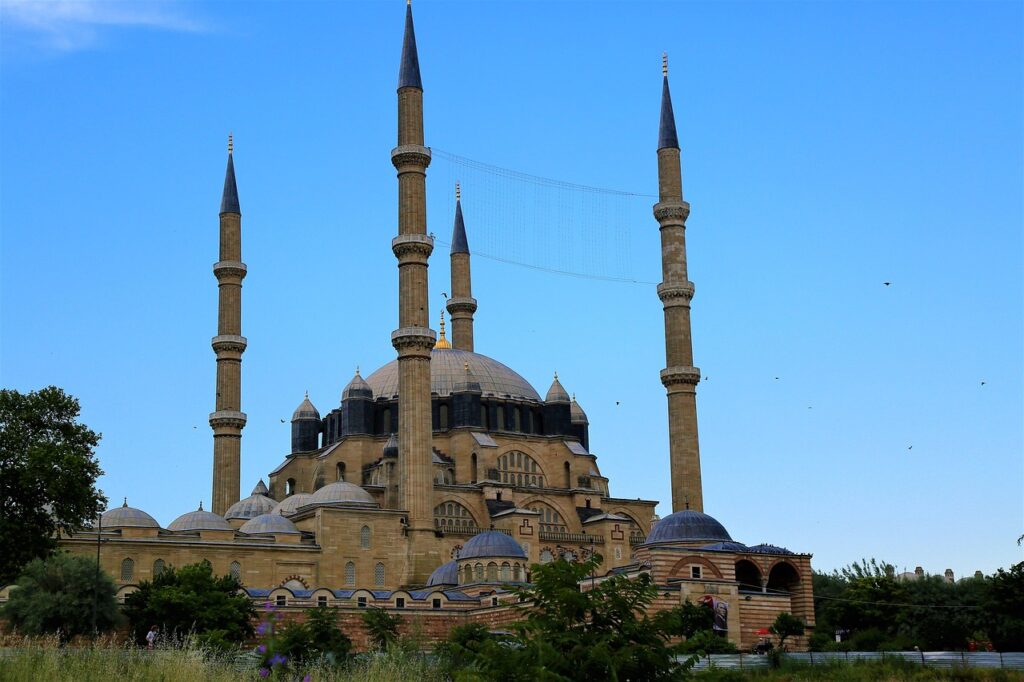
The Selimiye Mosque, completed in 1575 for Sultan Selim II, is the reason Edirne is on the world heritage map, and it is the first thing to see. Mimar Sinan considered it his masterpiece, and its dome, higher and wider than the dome of Hagia Sophia, crowns the city.
The interior is flooded with light, and the stonework, the calligraphy and the painted decoration are of a quality that rewards slow looking. The four slim minarets are the tallest in Turkey, and the courtyard, with its marble fountain, is one of the great public spaces of the Ottoman world.
The mosque is a working place of worship, so visitors are welcome outside prayer times, and modest dress is expected. Allow an hour, and return at sunset, when the light on the stone is unforgettable.
The Other Great Mosques
Edirne’s other mosques are far from second-rate. The Old Mosque, the Eski Cami, was built in the early fifteenth century and has a magnificent painted interior and a minaret carved with calligraphy; it is the city’s spiritual heart.
The Uc Serefeli Mosque, built in the 1440s, was the largest mosque of its day and introduced the asymmetrical courtyard that later Ottoman mosques perfected. Its name comes from the three balconies of its main minaret, a novelty when it was built.
The Muradiye Mosque, smaller and tiled, holds the finest set of early Ottoman tiles outside Bursa, in deep blues and greens. Together with the Selimiye, these four buildings make Edirne one of the great mosque cities of the world.

The Bazaar Quarter
Between the Selimiye and the Old Mosque stretches the bazaar quarter, where Edirne’s daily life happens. The covered bazaar, the bedesten, dates from the early Ottoman period, and the streets around it are lined with shops selling everything from spices to hardware.
The most famous product of the quarter is the liver, the tava cigeri, fried calf liver, which draws people from all over Turkey and beyond. The liver restaurants cluster around the bedesten, and a plate of liver with the local salad is the essential Edirne lunch.
The bazaar is also the place for the local cheese, the beyaz peynir of Edirne, for the almond sweets called badem ezmesi, and for the traditional handcrafts. The quarter rewards an unhurried wander.
The Rivers: Bridges and Meadows
The Tunca and the Meric give Edirne its romantic setting. The Tunca, to the north, is crossed by Ottoman stone bridges, and on its banks stand the ruins of the old Edirne Palace, the Saray, where the sultans lived before the conquest of Constantinople.
The Meric, the wider river, forms the border with Greece, and its meadow, the Sarici, is where the Kırkpinar festival takes place. On a quiet day the meadows are given to grazing horses, and the riverbanks are a popular walk.
Cross to Karaagac, the old railway quarter across the Meric, where the grand station, built for the Orient Express era, now houses a university. The Lausanne Monument nearby marks the 1923 treaty that fixed Turkey’s borders.

Food Essentials: Liver and Cheese
Edirne’s food is dominated by one dish: the tava cigeri, calf liver sliced thin, floured and fried, served with a sharp onion salad and spicy peppers. The liver restaurants of the bazaar quarter are the city’s culinary temples, and the dish is eaten at all hours.
The second pillar is the cheese. Edirne is famous for its beyaz peynir, the white cheese made from the milk of the region’s herds, and the cheese shops of the old town are worth a visit on their own.
The sweets of the city include the badem ezmesi, a dense almond paste, and the pastries of the local bakeries. The food of Edirne is simple, direct and excellent, and it is one of the reasons the city rewards a two-day visit.
A First-Timer’s Mini-Itinerary
With one day, walk the triangle of the three great mosques, lunch on liver, and cross to Karaagac in the afternoon for the river views. With two days, add the palace ruins, the Muradiye tiles, the bazaar at leisure, and a full afternoon on the riverside.
The order matters less than the pace. Start early at the Selimiye, when the light is best, save the bazaar for the middle of the day, and finish each day by the river, where the city shows its softest face.
If you are in town for the Kırkpinar festival, the program is given: wrestling all day in the meadow, music in the evenings, and the whole city in a festive mood. Either way, two days is the honest minimum for Edirne.
Practical Tips for First-Timers
Edirne is an easy city to visit. The old town is walkable, the Turkish lira is the currency, and most of the major sites have clear signage. The mosque entrances are free, though donations are welcome, and modest dress is expected at prayer times.
English is limited, so a few words of Turkish help, and cash is useful for the small shops. The border crossings to Greece and Bulgaria are nearby, which means you may meet travelers passing through, and the city has a genuinely international feel.
Finally, come hungry. The liver, the cheese and the sweets of Edirne are not optional, and the bazaar quarter will take care of you at any hour of the day.
Frequently asked questions
How much time should I spend in Edirne?
One day covers the three great mosques, the bazaar and a lunch of liver, but two days is better, adding the palace ruins, the Muradiye tiles and a relaxed afternoon by the rivers. The city is compact, so the extra day costs little and rewards a great deal.
Is Edirne easy to visit from Istanbul as a day trip?
Yes, though it is a long one. Buses take about three hours each way, so most travelers spend a night or two rather than rushing back. If you are pressed, the early bus and the late return leave about six hours in the city, which is enough for the essentials.
When is the Kırkpinar oil wrestling festival?
Kırkpinar is held every year at the end of June or in early July, following a tradition that claims more than six hundred years of continuity. The festival runs for several days in the Sarici meadow by the Tunca, and it is the best time of the year to experience Edirne at full festival pitch.

All Over Information
The All Over Information editorial team researches and writes practical English-language guides to Turkey. Facts are checked against official and local sources before publication, prices are published as dated ranges rather than quotes, and guides are revised when things change. We accept no sponsored posts, paid placements or paid links.
More guides like this

History and Culture of Edirne
Edirne is a city built on layers of history that most travelers only glimpse.

Best Local Food in Edirne
Edirne is one of the few Turkish cities whose food has a national reputation, and the reason is a single dish: tava…

Day Trip Ideas from Edirne
Edirne sits in the far northwest of Turkey, where the borders of Greece and Bulgaria meet the Meric River, and its position…

Top Things to Do in Edirne
Edirne is one of the most rewarding cities in Turkey precisely because it is so overlooked.
Where to Stay in Edirne
Edirne is a compact city, and nearly every stay puts the great mosques within a short walk, which makes choosing a base…