Edirne is one of the most rewarding cities in Turkey precisely because it is so overlooked. It was the Ottoman capital for nearly a century, it holds the greatest work of the empire’s greatest architect, and it still lives around a bazaar quarter and two rivers that have hardly changed in centuries. Everything is walkable, most of it is free, and the food is famous across the country. These are the top things to do in Edirne, from the world heritage mosque to the plate of liver.
The Selimiye Mosque
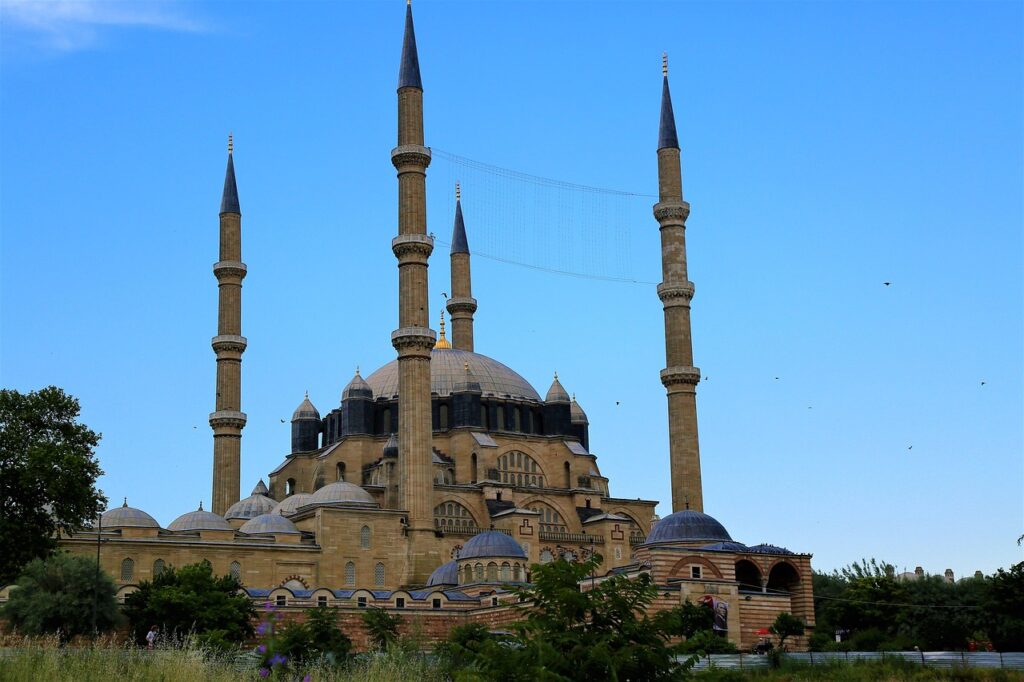
The Selimiye Mosque, completed in 1575, is Mimar Sinan’s declared masterpiece and the reason the city is on the UNESCO World Heritage list. Its dome, higher and wider than that of Hagia Sophia, sits over a single great space flooded with light.
The interior rewards slow looking: the carved marble, the calligraphy, the painted decoration and the acoustics, which make even a whisper carry. The marble used for the mihrab and the pulpit was brought from the island of Marmara, and the workmanship is flawless. The four minarets are the tallest in Turkey, and the courtyard, with its marble fountain, is one of the great public spaces of the Islamic world.
The mosque is in active use, so visitors come outside prayer times and dress modestly. Go early for the light, and come back at sunset, when the stone glows.
The Old Mosque: Eski Cami
Just west of the bedesten stands the Eski Cami, the Old Mosque, built in the early fifteenth century when Edirne was still the Ottoman capital in the making. It is the oldest of the great mosques and the city’s spiritual heart.
The exterior is plain, but the interior is a surprise: the walls and the arches are covered with painted decoration, and one of the minarets is carved with calligraphy in stone, a rarity anywhere in the Islamic world.
The mosque is small and intimate compared with the Selimiye, and it sees more local worshipers than tourists. Sit in the courtyard for a while, and you will understand why the city loves it so. The painted decoration of the interior, renewed over the centuries, gives the building a warmth that the grander mosques lack, and the calligraphy above the entrance announces the building’s ancient foundation date.

The Uc Serefeli Mosque
The Uc Serefeli Mosque, completed in the 1440s, was the largest mosque in the Ottoman world when it was built, and it marked the moment Ottoman architecture turned monumental. Its name, meaning “three balconies,” refers to its main minaret, a novelty at the time.
The courtyard is the glory of the building, with its elegant arcades and its asymmetrical plan, which later Ottoman mosques, including the Selimiye, would echo. The mosque stands near the Old Mosque, completing the western pair of the great triangle.
Its dome, ribbed and broad, shows the Ottoman builders learning the lessons that Sinan would later perfect. A visit here makes the leap to the Selimiye even more striking.
The Muradiye Mosque and the Tiles
The Muradiye, built by Sultan Murad II in the 1430s, is the quietest of Edirne’s great mosques and the one with the finest interior decoration. Its prayer hall is lined with some of the earliest Ottoman tiles, in deep blues, greens and turquoises.
The tiles, made in the workshops of the period, cover the lower walls and the niche of the prayer hall, and their color and glaze are astonishing for their age. The mosque is small, so the effect is intimate rather than overwhelming. The building is sometimes closed for restoration, so check the opening times, and be prepared for the walk up the hill, which rewards the effort with views over the rooftops.
The Muradiye stands on the slope above the river, away from the tourist triangle, and the walk up to it passes the old streets of the city. It is the favorite mosque of many travelers, and the tiles are the reason.
The Covered Bazaar and the Bedesten
The market heart of Edirne lies between the Selimiye and the Old Mosque, a warren of streets where the city has traded for centuries. The bedesten, the covered market, dates from the early Ottoman period, and its stone halls now house shops and workshops.
Around it, the streets sell spices, textiles, copper, sweets and the local specialties: the white cheese of Edirne, the badem ezmesi almond paste, and the pickles and peppers that accompany the city’s famous liver. The bazaar keeps early hours, with the shops opening soon after sunrise and closing in the late afternoon, so plan your wandering accordingly.
The bazaar is a working market rather than a tourist product, which is its charm. Wander without a plan, taste freely, and let the quarter take as long as it needs.
Tava Cigeri: The Liver Lunch
No visit to Edirne is complete without the plate of tava cigeri, calf liver sliced thin, dusted with flour and fried in the local style. The dish is the city’s gastronomic signature, and it draws visitors from all over Turkey.
The liver restaurants cluster around the bedesten, and the ritual is always the same: a plate of liver, an onion and parsley salad, hot peppers, and bread, with the local yogurt drink or ayran alongside. The liver is eaten fast and fresh, and the quality is the point.
The shops are busy at lunch, so arrive early or accept a short queue. It is a dish that has made Edirne famous, and it lives up to the reputation. For the full experience, order the liver sarma as well, liver wrapped and fried, which the local restaurants serve alongside the classic plate.

The Edirne Palace Ruins
On the banks of the Tunca, north of the old town, the ruins of the Edirne Palace, the Saray, stretch across the meadow. The palace was the home of the Ottoman sultans for nearly a century, before the conquest of Constantinople made Istanbul the capital.
Little survives above ground: the kitchen block, a gate, the foundations of the great halls, and the bathhouse, but the scale is still legible, and the setting, with the river and the bridges, is beautiful. The palace grounds have been landscaped as a park, and the paths along the river make the visit a pleasant hour-long walk rather than a mere ruin stop.
The palace grounds are free and open, and they make a fine walk, especially in the late afternoon. Combine them with the bridges and the meadow for the classic Edirne riverside circuit.
The Rivers and the Bridges
The Tunca and the Meric define the city. The Tunca is crossed by Ottoman stone bridges, and the Meric, wider and slower, forms the border with Greece. Both rivers have meadows and paths that invite slow walks.
The most beautiful hour is sunset, when the light falls on the bridges and the minarets. The Sarici meadow by the Tunca hosts the Kırkpinar wrestling festival in summer, and in quieter seasons it belongs to grazing horses.
Cross the Meric to Karaagac, the old railway quarter, where the grand station of the Orient Express era now belongs to a university, and the river views from the far bank frame the whole city.

Karaagac and the Lausanne Monument
Across the Meric from the old town, Karaagac holds one of Edirne’s most moving monuments. Here, in the old railway station district, the Treaty of Lausanne, signed in 1923, was commemorated in the building where the peace negotiations took their final shape.
The monument, a striking sculptural composition, stands in a park, and the old station now houses a university faculty. The story it tells, of borders fixed and the Turkish Republic recognized, is the end of the story that began with the city’s Ottoman founding.
The walk across the Meric bridge to Karaagac takes about half an hour each way, and it is the most scenic approach. The visit completes the picture of Edirne as both an Ottoman capital and a modern border city, and the quiet streets of the quarter, with their turn-of-the-century houses, are a world away from the bazaar.
The Grand Synagogue
Edirne once had a large and thriving Jewish community, and in 1909 the city built one of the largest synagogues in Europe. The building fell into ruin in the twentieth century as the community dwindled, and it was restored and reopened in 2015.
The restored interior is magnificent, with its painted ceiling and its central reading platform, and the building now serves both as a place of worship and as a cultural venue. It stands in the old Jewish quarter, whose streets still carry the memory of the community, and the nearby market square was the heart of the city’s commercial life for centuries.
The synagogue is open to visitors at set hours, and the visit is a moving reminder of the diversity that Edirne’s position on the borders once brought together.
Kırkpinar: The Festival of Oil Wrestling
If your visit falls at the end of June or the beginning of July, the Kırkpinar oil wrestling festival is the city’s great event. Wrestlers from across Turkey, oiled and dressed in leather trousers, compete in the Sarici meadow for the title of chief wrestler.
The festival claims a lineage of more than six hundred years, making it the oldest continuously running sporting event in the world, and the atmosphere is part sport, part carnival, with music, food and crowds.
Even if you cannot visit during the festival, the meadow and the wrestling culture are part of the city’s identity. The oil wrestling tradition is inscribed on UNESCO’s intangible heritage list, and Edirne is its heart.
Frequently asked questions
How long should I spend in Edirne?
Two days is ideal: one for the three great mosques, the bazaar and the liver, and one for the rivers, the palace ruins and Karaagac. The city is compact and walkable, so a single day covers the essentials, but the second day is where the atmosphere really sinks in.
Are the mosques of Edirne free to visit?
Yes. The mosques, including the Selimiye, are open to visitors free of charge outside prayer times, though donations are appreciated. Modest dress is expected, and the best hours are the early morning and the late afternoon, when the light is at its finest.
What is the best time of year to visit Edirne?
Spring and autumn are the ideal seasons, with mild weather and soft light. Summer is hot but brings the Kırkpinar festival at the end of June or in early July, which is the most exciting time to come. Winter is quiet, cold and occasionally snowy, and the mosques are nearly empty.

All Over Information
The All Over Information editorial team researches and writes practical English-language guides to Turkey. Facts are checked against official and local sources before publication, prices are published as dated ranges rather than quotes, and guides are revised when things change. We accept no sponsored posts, paid placements or paid links.
More guides like this

History and Culture of Edirne
Edirne is a city built on layers of history that most travelers only glimpse.
Where to Stay in Edirne
Edirne is a compact city, and nearly every stay puts the great mosques within a short walk, which makes choosing a base…

Day Trip Ideas from Edirne
Edirne sits in the far northwest of Turkey, where the borders of Greece and Bulgaria meet the Meric River, and its position…

Best Local Food in Edirne
Edirne is one of the few Turkish cities whose food has a national reputation, and the reason is a single dish: tava…

A First-Timer’s Guide to Edirne
Edirne is the great surprise of Turkish travel: a city that was the capital of the Ottoman Empire, holds one of the…