Aphrodisias was not a city that flashed briefly and faded. It was occupied for well over a thousand years, surviving the rise and fall of empires, the conversion of the Roman world to Christianity, and a long medieval silence before archaeologists brought it back to light. This is the story of those centuries, told in the order they happened, so you can understand how this marble city in the Aydin hills became what you see today.
Early Settlement: Before the City
People lived on the site of Aphrodisias long before the city had a name. Excavations have found evidence of occupation going back to the Bronze Age, when the fertile valley below the surrounding hills supported small farming communities. The area’s water supply and defensible position made it attractive to early settlers.
The most important early development was religious. A cult of a local mother goddess, later identified with the Greek Aphrodite, took root at the site, and a sanctuary grew up around it. This sacred character would define the settlement’s identity for its entire ancient life.
By the Hellenistic period, after the conquests of Alexander the Great and the wars that followed, the sanctuary settlement had grown into a town. Its fortune was about to change, because its goddess was about to meet the most powerful family in the Mediterranean.
The Sanctuary Takes Shape
In the centuries after Alexander, the region that is now southwestern Turkey was contested by the successors of his empire, and the town around the sanctuary of Aphrodite grew within that turbulent world. The sanctuary itself was developed, with early temples and cult buildings establishing the sacred area at the site’s heart.
The city took the name Aphrodisias, making its devotion to the goddess explicit in its very identity. Local coins carried her image, and the city presented itself to the wider Greek world as the home of a particularly powerful manifestation of Aphrodite.
This was the foundation the city would build on. When Rome’s civil wars ended and a new imperial order began, Aphrodisias was ready to profit from a connection that would transform it from a regional sanctuary town into one of the most privileged cities of the eastern empire.

The Roman Alliance: Augustus and Imperial Favor
The turning point came in the late first century BC. During the civil wars between the heirs of Julius Caesar, the people of Aphrodisias chose the side of Octavian, the man who would become the emperor Augustus. When Octavian won, he remembered his allies.
Augustus granted Aphrodisias special status: freedom, tax privileges, and the right to govern itself, privileges that were inscribed on stone and reaffirmed by later emperors. The city became a point of contact between Rome and the Greek cities of Asia, and its loyalty was rewarded with wealth and imperial attention.
The favor transformed the city’s architecture. With imperial backing, Aphrodisias could build on a grand scale, and the sanctuary of Aphrodite was redeveloped as one of the most magnificent cult centers of the eastern Mediterranean. The goddess of love had gained an empire as her patron.
The Sculpting City: The Height of Prosperity
From the first to the third centuries AD, Aphrodisias enjoyed its golden age. The local marble quarries, combined with generations of skilled carvers, made the city the leading sculpture center of the Roman east. Its workshops exported statues and sarcophagi across the Mediterranean.
The wealth this trade brought is written in the city’s monuments. The stadium, the theatre, the agoras, and the great public buildings of this period were financed by prosperous citizens who competed to adorn their city. Inscriptions record their donations, from colonnades to statues, in their hundreds.
This was also the period of the Sebasteion, the great complex honoring the emperors, built in the first century AD as the city’s grandest architectural statement. Aphrodisias was now not just a sanctuary town but a full imperial city, confident, rich, and deeply connected to the empire’s ruling house.

The Sebasteion and the Imperial Cult
The Sebasteion deserves its own chapter in the city’s story because it defined Aphrodisias’s relationship with Rome. Built in the first century AD under the Julio-Claudian emperors, it combined a temple of the imperial cult with a processional courtyard lined by sculpted facades.
The complex’s reliefs celebrated the emperors and the empire: rulers shown with gods, allegories of peoples brought into the empire, and scenes from Greek mythology that linked Roman power with the Greek past. It was the city’s most public and most political monument.
The Sebasteion also shows how deeply the city invested in its Roman identity. Constructed over decades and maintained for centuries, it stood at the center of civic ceremony until the empire’s religious landscape began to change. Then, like the city around it, it would be transformed.
Christianity and Transformation
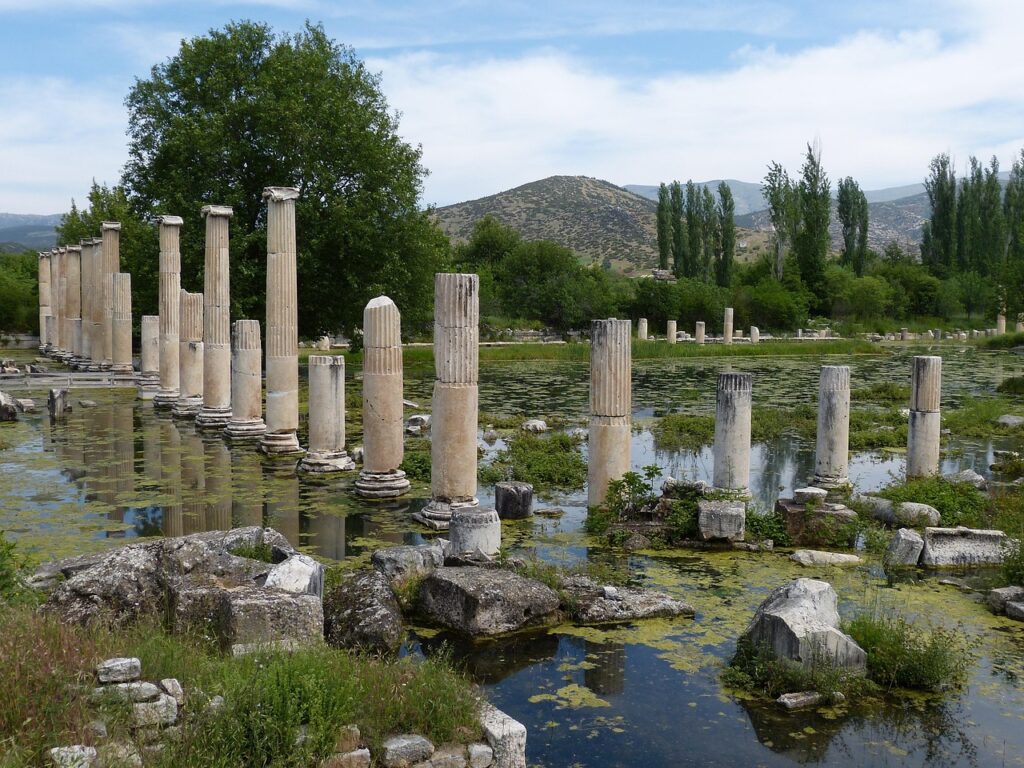
In the fourth century AD, the Roman Empire converted to Christianity, and Aphrodisias, like every city of the Greek east, had to remake itself. The temple of Aphrodite was converted into a church, its columns walled in to create a Christian basilica, and the goddess’s sanctuary became a place of Christian worship.
The city took a new name, Stauropolis, and later Caria, shedding its pagan identity as Christianity became the official religion. Bishops from Aphrodisias attended church councils, and the city remained an important regional center under the early Byzantine emperors.
The transformation was not total. The workshops continued, and the city’s sculptors, adapting their skills, produced Christian carvings alongside the surviving monuments of the pagan past. The old and new worlds existed side by side, until the catastrophes of the seventh century changed everything.
Earthquakes and Decline
Aphrodisias was repeatedly shaken by earthquakes throughout its history, and the evidence is everywhere in the site’s collapsed architecture. Major quakes in the late antique and early Byzantine periods damaged the great public buildings, and each time, the city repaired and rebuilt, though with diminishing resources.
The decisive blow came in the seventh century AD. The region was ravaged by invasions and war, and the urban fabric of the ancient world collapsed across the eastern Mediterranean. Aphrodisias shrank to a small settlement clustered around its defenses, and the great monuments were abandoned to the elements.
The stadium, no longer needed for games, was turned into a fortified enclosure, and the once-mighty city became a modest village among the ruins. The marble that had built an empire of sculpture now lay broken in the fields, waiting out the long centuries.
The Long Silence: Medieval and Ottoman
For over a thousand years, Aphrodisias slept. During the medieval period the region passed through Byzantine, Seljuk, and Ottoman rule, and the ruined city served mainly as a source of building stone. Columns and carved blocks were carried away to be reused in mosques, houses, and fortifications elsewhere.
The village of Geyre grew up over part of the ancient site, its name derived from the old city’s Byzantine name, and daily life continued among the fallen marbles. Travellers who passed through the region occasionally noted the ruins, but no one understood what lay beneath the fields.
The silence was broken only in the late nineteenth century, when western travelers and scholars, following the growing interest in the classical world, began to describe the site. Their reports hinted at what was buried, but the true scale of Aphrodisias’s treasure would only emerge in the twentieth century.

Rediscovery and the First Excavations
Systematic exploration of Aphrodisias began in the early twentieth century, with the first serious surveys identifying the site as ancient Aphrodisias beyond doubt. The early excavators cleared the surface and recognized that the fields concealed one of the best-preserved cities of the Roman east.
The great age of discovery began in 1961, when the archaeologist Kenan Erim started excavations that would continue for three decades. Erim’s teams uncovered the Sebasteion reliefs, the Tetrapylon, the stadium, the theatre, and thousands of sculptures, transforming a quiet site into a world-class archaeological park.
Erim’s passion for the city became legendary. He spent most of his adult life at Aphrodisias, and when he died in 1990 he was buried at the site, beside the city he had revealed to the world. His grave is now part of the site’s story.
Modern Excavation and World Heritage
Since Erim’s death, Aphrodisias has been excavated and studied by successive international teams, working in partnership with Turkish authorities. Their work has refined the dating of the monuments, restored key structures like the Tetrapylon, and published the inscriptions and sculpture that make the site so valuable to historians.
The finds have changed our understanding of Roman art. The Aphrodisian sculptors, once known only from works found elsewhere, are now known from their own city, and the Sebasteion reliefs have become a standard source for studying imperial propaganda in the Greek east.
In 2017, Aphrodisias was inscribed on the UNESCO World Heritage List, recognizing its exceptional preservation and its role in understanding the ancient world. The city that served Aphrodite for a millennium now serves history itself, its centuries of story open for you to walk through.
Frequently asked questions
When was Aphrodisias founded?
The site was occupied from the Bronze Age, but it grew into a proper city in the Hellenistic period, taking the name Aphrodisias. Its greatest period came under the Roman Empire, especially from the first to the third centuries AD, when it became a leading center of sculpture and a privileged imperial ally.
Why did Aphrodisias decline?
Aphrodisias declined because of a combination of earthquakes and the wider collapse of the ancient world in the seventh century AD. Invasions and economic disruption reduced the city to a small settlement, and the great monuments were abandoned and gradually buried, preserving them until modern excavations.
Who excavated Aphrodisias?
The most important excavator was Kenan Erim, an archaeologist who led work at the site from 1961 until his death in 1990. He uncovered the Sebasteion, the Tetrapylon, the stadium, and thousands of sculptures. Work has continued since under successive international teams in partnership with Turkish authorities.

All Over Information
The All Over Information editorial team researches and writes practical English-language guides to Turkey. Facts are checked against official and local sources before publication, prices are published as dated ranges rather than quotes, and guides are revised when things change. We accept no sponsored posts, paid placements or paid links.
More guides like this

Visiting Cappadocia’s Underground Cities: Tickets, Hours, and Tips
Few experiences in Turkey are stranger or more memorable than descending into a Cappadocian underground city.

Miletus Through the Centuries
Few cities in the ancient world lived as long or as fully as Miletus.

Why Perge Should Be on Your Turkey Bucket List
Turkey is so crowded with ancient wonders that building a bucket list feels like choosing favourites among impossible riches. Perge deserves a…
The Architecture of Sardis Explained
Sardis was built on a site of extraordinary natural strength and beauty: a steep acropolis rock, a broad fertile valley, and a…
Why Termessos Should Be on Your Turkey Bucket List
Turkey is full of ancient cities, but there is only one Termessos.

Why Hierapolis Should Be on Your Turkey Bucket List
Most travelers come to Pamukkale for the white terraces and discover the ancient city of Hierapolis almost by accident, standing on the…