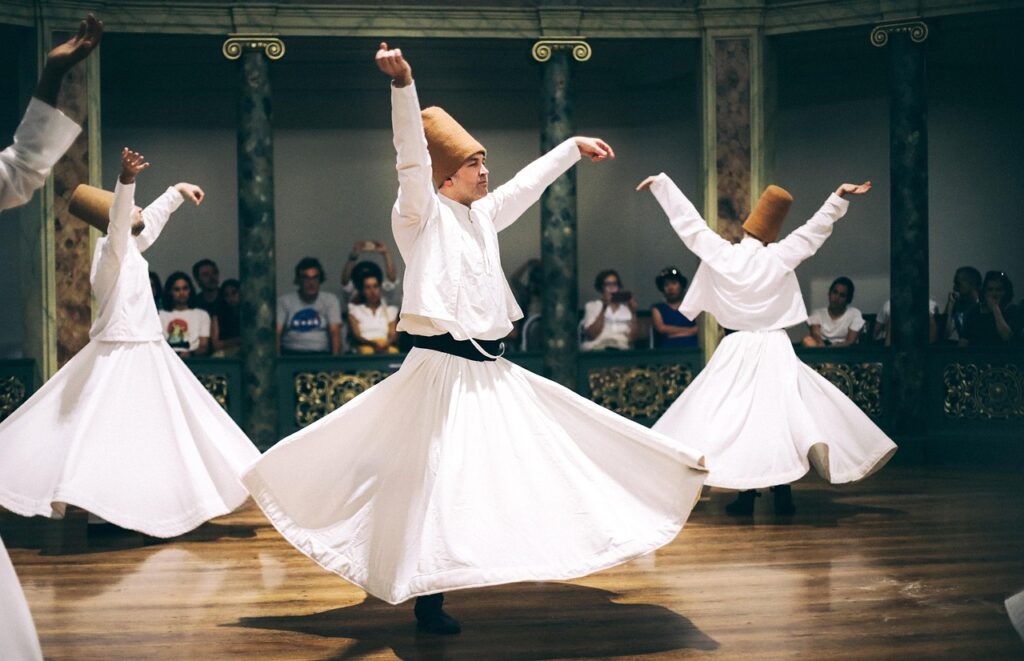
The Whirling Dervishes ceremony, known in Turkish as the sema, is one of the most profound cultural experiences Turkey offers, and for a foreign visitor it can be both mesmerizing and puzzling. Men in tall brown hats and white robes spin in perfect circles to haunting music, their arms outstretched, their faces calm, in a ritual that is far more than a performance. It is a prayer in motion, a centuries-old ceremony of the Mevlevi order of Sufis. This guide tells you what to expect, how to behave, and how to get the most from witnessing it.
What the Sema Is Before You Go
Before you take your seat, it helps to understand what you are about to see. The sema is a religious ceremony, a form of remembrance of God practiced by the Mevlevi Sufi order, founded in the city of Konya after the death of the great poet and mystic Rumi.
The word sema means listening, and at the heart of the ceremony is the act of listening to music and letting it carry the soul toward God. The whirling is the outward form of that inner journey.
This means the ceremony is not a folk dance or a tourist show, though it is performed publicly and visitors are welcome. It is an act of worship, and it deserves the respect you would give any sacred ritual.
Understanding this changes the experience. What looks strange at first, the spinning, the bowing, the costume, becomes meaningful, and the ceremony reveals itself as one of the great spiritual traditions of the world.
Where You Will See It
The ceremony is most closely associated with Konya, the city of Rumi, where it is performed regularly at the cultural center that bears his name. Konya is the heart of the tradition, and its weekly performances draw visitors from around the world.
In the weeks around the anniversary of Rumi’s death, Konya hosts the great gatherings of the year, when the ceremony is performed before large audiences in an atmosphere of deep reverence.
The sema is also performed in other cities, including Istanbul, where the historic Mevlevi lodges host regular ceremonies, and in cultural centers across Turkey and abroad.
Wherever you see it, the setting will be simple and dignified: a hall, an audience in respectful silence, and the dervishes moving through their ritual in the center. The simplicity is part of the power.

The Music and the Instruments
The music of the sema is as essential as the whirling. It begins with the sound of the ney, the reed flute, whose breathy, melancholy voice is the symbol of the human soul seeking its source.
The ney is joined by drums, strings, and voices, building a rich, flowing sound that rises and falls through the ceremony. The music is composed to accompany the stages of the ritual.
The opening solo of the ney is one of the most moving moments of the ceremony. It represents the breath of life and the longing of the soul, and it sets the tone for everything that follows.
The musicians sit to one side of the hall, and their playing is as much a part of the worship as the whirling itself. Listen closely, and the music will carry you into the ceremony as it carries the dervishes.
What Happens During the Ceremony
The sema follows a set structure that has been preserved for centuries. It begins with a solo by the ney, after which the dervishes enter, dressed in their ceremonial costumes, and bow to one another and to the audience.
The heart of the ceremony is the whirling itself, which unfolds in a series of movements known as selams. The dervishes turn slowly at first, then faster, their right hands raised to heaven and their left hands turned down toward the earth.
Between the sections of whirling, the dervishes bow and move through the ritual in patterns that carry symbolic meaning. The whole ceremony builds toward its final part, which is a reading from the Quran and a prayer.
The ceremony ends quietly, with the dervishes bowing and withdrawing. The silence that follows is part of the experience, and the audience is invited to leave in the same quiet spirit.

What the Whirling Means
The whirling is the heart of the ceremony, and its meaning is beautiful. The dervish turns in place like a planet, and the turning represents the journey of the soul toward God, which in the Mevlevi tradition is the love that moves the sun and the stars.
The costume carries the symbolism. The tall brown hat represents the tombstone, the white skirt the shroud, and the black cloak the grave, for the dervish dies to the self in order to be born into the divine life.
The outstretched arms complete the image. The right hand, raised, receives from heaven, and the left hand, lowered, gives to the earth, so that the whirling dervish becomes a channel between the two.
As the dervishes spin, each one is said to be turning on the axis of the heart, and the collective turning of the group is a vision of the universe in harmony. It is a stunning idea, expressed in motion.
How to Behave and What to Wear
As a guest at a sacred ceremony, your behavior matters. Arrive early, find your seat, and prepare to sit in silence. The ceremony is not a show to chat through, and talking is deeply out of place.
Dress modestly and with respect, as you would for any religious service. Shoulders and knees covered, and a general neatness of dress, will serve you well and be appreciated.
You may be asked to remove shoes in some venues, and cameras and phones should be switched off or silenced. The ceremony is one of the moments in travel when the present moment is worth more than the photograph.
If the ritual is unfamiliar, simply watch, and let the music and the motion do their work. Many visitors find themselves unexpectedly moved, and that openness is the best attitude to bring.

Photography and Mobile Phones
The rules on photography vary between venues, and the golden rule is to follow them without argument. Some performances allow quiet photography from your seat; others forbid it entirely.
The most important rule, where photography is allowed, is that the flash must never be used. The ceremony is dimly lit, the mood is contemplative, and a flash would be a violation of the sacred atmosphere.
Mobile phones should be switched off or silenced for the duration, and many venues ask that they not be used at all. The ceremony lasts under an hour, and it is one of the best excuses in travel to be unreachable.
The best photographs of the sema are the ones you take in your memory. The image of the dervishes turning in the half-light, the music in your ears, is one that no camera can improve.
The Setting: Konya and the Mevlana Museum
To see the ceremony in Konya is to see it in its true home, and the city repays a fuller visit. The Mevlana Museum, the mausoleum of Rumi, is one of the most beautiful and moving sights in Turkey.
The museum holds Rumi’s tomb, the relics of the order, and the atmosphere of centuries of devotion. Visitors of every faith walk its halls in a hush, and its green-tiled dome is the symbol of Konya.
The city around the museum is rich in Seljuk history, with mosques, caravanserais, and the quiet, devout atmosphere of a great spiritual capital.
A visit to the museum before the ceremony is the perfect preparation. It gives the ritual a human face and a history, and it makes the whirling you witness afterwards infinitely more meaningful.
Planning Your Evening
Seeing the sema requires a little planning, and the effort is rewarded. Book your tickets in advance, especially for the December gatherings, when the world comes to Konya and the seats sell out.
Arrive at the venue early, with time to find your seat and settle. The ceremony begins punctually, and late entry is disruptive to the performers and the audience alike.
Plan the practical details around the event: a meal before or after, transport to the venue, and a place to stay in Konya, because the city fills on ceremony nights.
Finally, leave yourself time afterwards. The ceremony lingers, and many visitors find they want to walk quietly, to think, or to return to the Mevlana Museum in the stillness of the evening. That afterglow is part of the experience.
The Feeling You Take Away
The sema is one of those experiences that defies description, and every visitor takes away something different. For some it is the beauty of the movement, the slow turning of the white robes in the dim light.
For others it is the music, the voice of the ney that seems to speak directly to the heart. For many it is a sense of peace, an hour of silence and motion that quiets the noise of a lifetime of travel.
What is certain is that the ceremony stays with you. Long after you leave Konya, the image of the dervishes turning, and the strange, deep calm of the room, will return to you at unexpected moments.
That is the gift of the sema to the foreign visitor: not an explanation of Turkey, but an experience of it, a glimpse of the spiritual depth beneath the country’s surface. It is worth traveling far to receive it.
Frequently asked questions
How long does the ceremony last?
The sema lasts between forty minutes and an hour, depending on the venue and the occasion. It is a continuous, flowing ritual with no intermission, and the time passes more quickly than you would imagine, carried along by the music and the whirling.
Can anyone attend the sema?
Yes, the ceremony is open to all, regardless of faith or nationality, and visitors are warmly welcomed. Attendance is a matter of respect rather than belief: dress modestly, sit quietly, and follow the customs of the venue, and you will be a welcome guest.
Is it appropriate to applaud?
Generally, no. The sema is a religious ceremony, not a performance, and applause is out of place. The ceremony ends quietly, and the audience departs in the same spirit. If the venue indicates otherwise, follow its lead, but silence is the safe and respectful default.

All Over Information
The All Over Information editorial team researches and writes practical English-language guides to Turkey. Facts are checked against official and local sources before publication, prices are published as dated ranges rather than quotes, and guides are revised when things change. We accept no sponsored posts, paid placements or paid links.
More guides like this

The History and Meaning of the International Izmir Festival
The International Izmir Festival has brought world-class music to the Aegean coast of Turkey for more than three decades, and it has…

The History and Meaning of Republic Day Celebrations
Every year on October 29, Turkey celebrates Republic Day, the anniversary of the proclamation of the republic in 1923.

The History and Meaning of the Whirling Dervishes Ceremony
The Whirling Dervishes ceremony, the sema, is one of the most beautiful and mysterious rituals of the Islamic world, and it has…
When and Where to See the Istanbul Film Festival
The Istanbul Film Festival fills the cinemas of the city every April with the best of world and Turkish cinema, and attending…

The History and Meaning of the Istanbul Film Festival
The Istanbul Film Festival has grown from a small cinematic gathering into one of the most important cultural events in Turkey and…
When and Where to See the Istanbul Biennial
The Istanbul Biennial transforms the city every two years, and seeing it is a matter of planning rather than luck.