The Whirling Dervishes ceremony, the sema, is one of the most beautiful and mysterious rituals of the Islamic world, and it has its home in Turkey. For more than seven centuries, the followers of the Mevlevi Sufi order have turned in their white robes to the music of the reed flute, in a ceremony that is at once a dance, a prayer, and a vision of the universe. This article explores the history of the ceremony, from its origins in the city of Konya to its revival today, and the profound meaning hidden in every part of it.
Rumi and the Birth of the Mevlevi Order
The story of the sema begins with one man: Jalal ad-Din Muhammad Rumi, known in Turkey as Mevlana, our master. Born in the thirteenth century in the eastern lands of the Islamic world, he settled in the city of Konya, in central Anatolia, where he became a scholar and a teacher.
Rumi’s life was transformed by his friendship with a wandering mystic named Shams of Tabriz, whose influence turned the scholar into one of the greatest poets of love and longing ever known. Rumi’s poetry, written in Persian, speaks of the soul’s separation from God and its longing to return.
After Shams disappeared, Rumi’s grief and love poured into poetry and music, and the tradition of listening to music and moving in ecstasy, which would become the sema, grew around him.
When Rumi died in 1273, he left behind a spiritual legacy that his followers organized into the Mevlevi order, the order of the whirling dervishes, with Konya at its heart.
From Rumi’s Death to an Organized Order
The years after Rumi’s death saw the scattered followers of the master gathered into an organized order. It was Rumi’s son, Sultan Veled, who gave the movement its structure and its rules.
Under Sultan Veled and his successors, the Mevlevi order grew into one of the great institutions of the Islamic world, with lodges, known as mevlevihanes, established in cities across the Ottoman Empire.
The sema itself was formalized in these years: the movements, the music, and the costume were set down, and the ceremony became the great public ritual of the order.
For centuries, the Mevlevi order was a center of learning, music, and poetry, and its lodges produced some of the finest musicians, calligraphers, and thinkers of the Ottoman world. The sema was the heart of this civilization.
What the Sema Represents
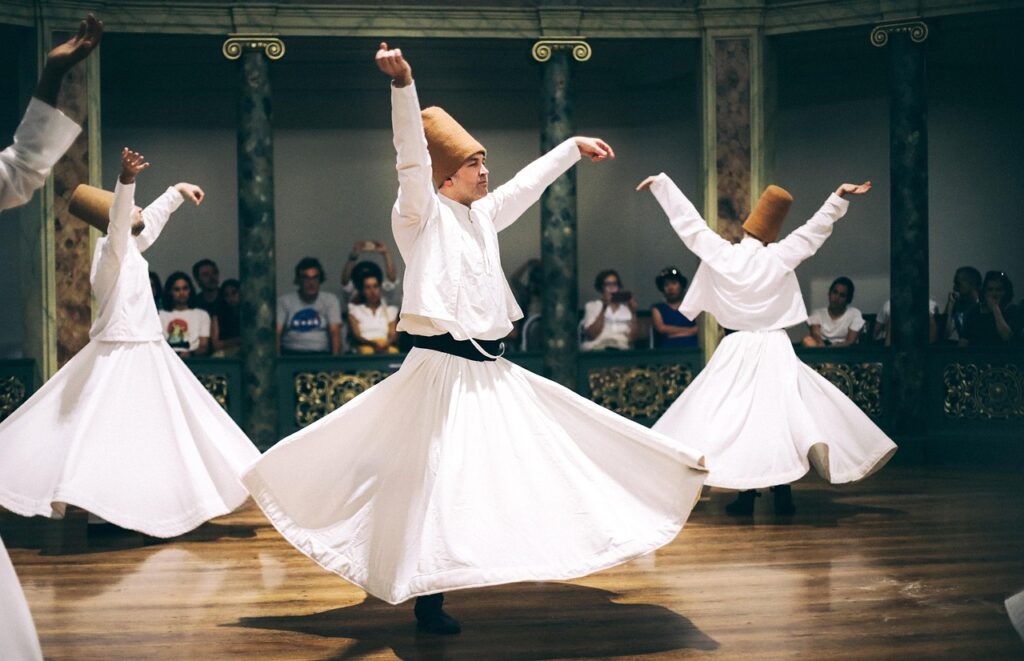
The sema is not a dance in the ordinary sense; it is a ritual of remembrance, a way of turning the whole being toward God. The word sema means listening, and the ceremony is built around the act of hearing the divine.
In the Mevlevi tradition, the sema represents the journey of the soul: its descent from God into the world, its life of longing and separation, and its return to the source from which it came.
The whirling itself is the image of this journey. As the dervish turns, he lets go of the self, of the ego, and of the world, and is drawn upward toward the divine, like the planets turning around the sun.
This is why the ceremony is so moving to watch. It is not technique but longing made visible, and the audience is invited to take part in spirit, to listen, and to remember along with the dervishes.
The Symbolism of the Whirling
Every part of the whirling carries meaning. The dervish turns on the left foot, and the right foot propels the body, so that the turning is driven by the heart side of the body, the seat of love.
The arms are outstretched in the famous pose: the right hand open to heaven, receiving the divine gift, and the left hand turned down, pouring that gift onto the earth. The dervish becomes a channel between the two worlds.
The head is inclined to the right, toward the heart, in an attitude of listening and submission. The face is calm and composed, for the dervish is not performing but praying.
The turning is not uniform; it quickens and slows with the music, and the sections of the ceremony, known as selams, mark the stages of the journey. The whole is a single, unbroken movement of ascent.

The Costume and Its Meaning
The costume of the dervish is as symbolic as the movement. The tall conical hat, known as the sikke, represents the tombstone, and the white skirt, the tennure, represents the shroud of the grave.
Over the white garments, the dervish wears a black cloak, known as the hırka, which represents the grave itself. At the beginning of the ceremony, the dervishes enter wearing the cloak, the sign of death to the world.
As the ceremony begins, the cloaks are cast off, and the dervishes appear in their white garments, the sign of rebirth into the spiritual life. To be born, one must first die to the self.
The costume turns the ceremony into a visible story: death, rebirth, and the journey between them. When you watch the dervishes shed their cloaks, you are watching the central act of the ritual.
The Music of the Ceremony
The music of the sema is as important as the whirling, and it is one of the great musical traditions of Turkey. At its heart is the ney, the reed flute, whose sound is the very voice of longing.
The opening solo of the ney is the most famous moment of the sema. It represents the breath of God and the cry of the soul separated from its source, and it is said to express the whole of Rumi’s teaching in a single breath.
The ney is joined by the kudum, a small drum that marks the rhythm, and by strings and voices that build the rich, flowing texture of the music. The composition accompanies each stage of the ceremony.
The music is not background; it is the vehicle of the ritual, carrying the dervishes through their turning and the audience into the ceremony. To hear the sema is to understand why music is called the language of the soul.

The Structure of the Sema
The sema follows a structure that has been preserved for centuries, and each part has its place in the story. It begins with the solo of the ney, the cry of the soul, played to a silent hall.
The dervishes then enter, bowing to one another, their cloaks black over their white garments. In the second part, the cloaks are cast off, and the whirling begins, unfolding in the sections known as selams.
Between the selams, the dervishes pause, bow, and move in patterns, and the ceremony builds steadily toward its climax. The turning grows faster, the music fuller, and the whole hall seems to turn with the dervishes.
The ceremony ends with a recitation from the Quran, a prayer, and a quiet close, as the dervishes bow and withdraw. The silence that follows is the final movement of the ritual.
The Ceremony in Ottoman Times
In the centuries of the Ottoman Empire, the Mevlevi order and its sema became an integral part of Turkish life. The lodges of the order stood in the great cities, and their ceremonies drew crowds of the faithful.
The order enjoyed the favor of the sultans, and many Ottoman rulers were patrons of the Mevlevis. The order’s music influenced Ottoman classical music, and its lodges were schools of the arts.
The sema was performed on the great religious occasions of the year, and the anniversary of Rumi’s death, in December, was the greatest of them, drawing pilgrims from across the empire.
When the Ottoman Empire fell and the modern Turkish Republic was established, the order was closed, and the ceremony was forbidden. The sema passed from public life, though its memory and its music survived.

The Modern Revival and UNESCO
The story of the sema in the twentieth century is one of loss and recovery. For decades, the ceremony was performed only rarely, and the Mevlevi tradition survived in the hearts of its followers.
In the later twentieth century, the sema was revived as a cultural and spiritual treasure of Turkey. The government permitted its performance, and the ceremony found a new audience among Turks and foreign visitors alike.
The city of Konya became the center of the revival, and the annual ceremonies in December, on the anniversary of Rumi’s death, grew into international gatherings of music and remembrance.
In recognition of its universal value, the sema was inscribed by UNESCO on its list of the intangible cultural heritage of humanity, confirming what its devotees had always known: that this ceremony belongs to the world.
The Meaning of the Ceremony Today
Today the sema is performed regularly in Turkey and around the world, and it carries multiple meanings. For the Mevlevi faithful, it remains what it has always been: a ritual of remembrance, a path to God.
For the wider Turkish public, it is a proud inheritance, a symbol of the country’s spiritual and artistic depth, and a connection to Rumi, whose poetry is beloved across the world.
For the foreign visitor, the sema is an encounter with a tradition unlike any other, an hour of beauty and stillness in the middle of a busy journey.
And for everyone, the ceremony remains what Rumi intended: an invitation to listen, to turn toward the divine, and to remember that love is the axis on which the universe turns. That meaning is as alive today as it was seven centuries ago.
Frequently asked questions
Why do the dervishes whirl?
The whirling represents the journey of the soul toward God, the turning of the planets around the sun, and the movement of all creation in love. As the dervish turns, he lets go of the self and is drawn upward toward the divine, and the motion becomes a prayer.
What does the dervish costume symbolize?
Every part of the costume carries meaning: the tall hat represents the tombstone, the white skirt the shroud, and the black cloak the grave. The dervish dies to the self and the world, and the casting off of the cloak at the start of the ceremony marks rebirth into the spiritual life.
Is the sema a dance or a prayer?
It is both and neither. The sema is a religious ritual, an act of worship in the form of motion and music, and it is not performed for entertainment. Yet it is also art of the highest order, and its beauty is part of its meaning. It is best approached as a prayer you can watch.

All Over Information
The All Over Information editorial team researches and writes practical English-language guides to Turkey. Facts are checked against official and local sources before publication, prices are published as dated ranges rather than quotes, and guides are revised when things change. We accept no sponsored posts, paid placements or paid links.
More guides like this

When and Where to See Nowruz in Eastern Turkey
Nowruz, the festival of the spring equinox, is one of the most vivid experiences eastern Turkey has to offer, and the timing…

When and Where to See Eid al-Fitr Celebrations
Eid al-Fitr, the Sugar Holiday, is the great festival that closes Ramadan, and in Turkey it is a national holiday of three…

The History and Meaning of Hidirellez Spring Festival
Hidirellez is one of the oldest and most beloved festivals of Turkey and the Balkans, a celebration of spring that arrives on…

The History and Meaning of the Cappadocia Hot Air Balloon Festival
Cappadocia and the hot air balloon have become inseparable in the world's imagination, and the Cappadocia Hot Air Balloon Festival celebrates that…
When and Where to See the Istanbul Film Festival
The Istanbul Film Festival fills the cinemas of the city every April with the best of world and Turkish cinema, and attending…
Experiencing the Istanbul Tulip Festival as a Foreign Visitor
Every April, Istanbul turns itself into a garden.