Hagia Sophia has outlived every empire that built it, and its history is a procession of centuries, each leaving its mark on the same walls. It began as the masterpiece of Justinian in the sixth century, survived the crises of the Byzantine millennium, passed to the Ottomans in 1453, became a museum under the Republic, and returned to a mosque in our own time. Through all of it, the great dome has stood. This guide walks you through Hagia Sophia century by century, so you can match the building’s layers to the eras that created them and understand the monument you are visiting.
The Age of Justinian
The sixth century belongs to Justinian, and the Hagia Sophia he built was the greatest gamble of his reign. After the Nika revolt burned the previous church in 532, the emperor rebuilt on a scale no one had attempted, and his architects completed the new cathedral in under six years, dedicated in December 537.
The first dome was a statement of imperial ambition, but it was fragile. In 558, earthquakes brought it down, and the rebuilt dome, raised by the younger Isidorus, was steeper and stronger. The age of Justinian thus produced both the building and its first great lesson: the dome would have to be earned again and again.
The century closed with the building at the center of Byzantine life, the coronation church of emperors and the cathedral of the patriarch. For the first time, a building existed that could carry the whole weight of the empire’s religious identity.
The Early Byzantine Centuries
The centuries after Justinian were a test of survival. The empire fought wars on every front, plague emptied cities, and Hagia Sophia, like Constantinople itself, endured waves of crisis, yet the great church remained the fixed point of Orthodox life.
These centuries shaped the liturgy that the building was built for. The great processions, the imperial entrances, and the ceremonies of the court and church were refined here, and the building’s spaces, the narthex, the nave, and the galleries, acquired the functions they would keep for a millennium.
The building also became the model for churches across the Orthodox world, its plan and its dome copied from the Balkans to the frontiers of Asia. By the end of these centuries, Hagia Sophia was not merely a building; it was the architectural definition of the faith itself.
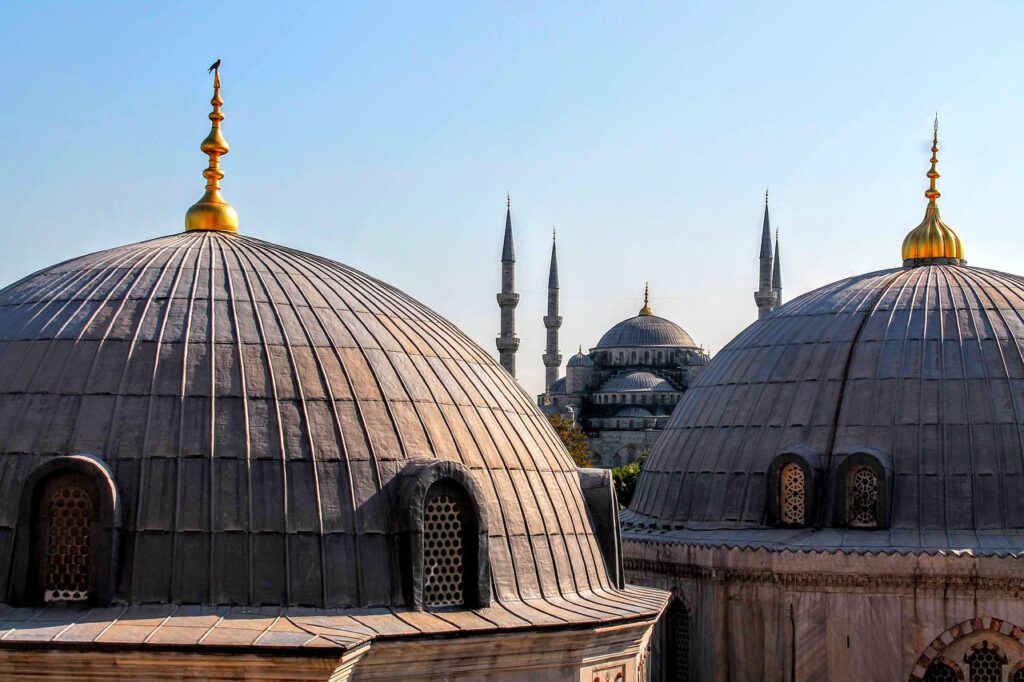
The Iconoclast Centuries
The eighth and ninth centuries brought the storm of iconoclasm, the long Byzantine struggle over the use of religious images. Hagia Sophia, as the empire’s principal church, was at the center of the conflict, and its mosaics, which had filled the building with holy images, were stripped and covered.
The struggle was bitter and physical. Emperors who banned images fought patriarchs who defended them, and the church’s decoration changed with every reversal of policy, its golden surfaces removed and restored more than once within living memory.
The iconoclast era ended in 843 with the Triumph of Orthodoxy, and the restoration of images began. The mosaics that followed, brighter and more formal, would define Byzantine art for the next six centuries, and Hagia Sophia once again became the showcase of the faith.
The Macedonian and Komnenian Golden Ages
From the ninth to the twelfth centuries, the Byzantine Empire recovered its strength, and Hagia Sophia shared in the renewal. The Macedonian and Komnenian dynasties adorned the church with new mosaics, and the building’s decoration reached its most complete form.
This was the age of the great images you can still see: the Virgin and Child in the apse, the imperial portraits in the galleries, and the brilliant narrative mosaics that taught the faith to the congregation. Emperors and empresses, patriarchs and saints, were fixed forever in gold and glass.
The centuries were not calm, but they were glorious. Crusaders passed through, pilgrims came from across Christendom, and Hagia Sophia stood at the height of its Byzantine splendor, the wonder of the medieval world, as it would be remembered for centuries after.

The Latin Interlude
The year 1204 was a catastrophe. The Fourth Crusade, diverted from its purpose, sacked Constantinople, and the crusaders made Hagia Sophia their cathedral, stripping the building of its relics, its treasures, and its sacred vessels,.
For nearly sixty years, the Latin Empire ruled from the city, and the great church served a foreign clergy. The damage was not only material: the golden icons were melted down, the imperial tombs were looted, and the building that had been the heart of Orthodoxy became a trophy of conquest.
The Byzantine restoration of 1261 recovered the church, but it could not recover what the sack had taken. The later emperors, poorer and besieged, repaired what they could, and Hagia Sophia entered its last Byzantine centuries as a diminished but still awe-inspiring presence.
The Last Byzantine Centuries
The final two centuries of Byzantine rule were a long decline, and Hagia Sophia declined with the city. The population of Constantinople shrank, the churches fell empty, and the great cathedral, still magnificent, was maintained with the resources of a state that was running out of time.
Yet the building retained its meaning. The last emperors were still crowned here, the patriarch still presided, and the dome still gathered the light. Visitors from the West in these years recorded the building with wonder, aware that they might be seeing the greatest church in Christendom for the last time.
On the night of May 28, 1453, the faithful gathered in Hagia Sophia for what they knew might be the final liturgy. The next day, the Ottoman army broke through the walls, and the history of the building, and of the empire, turned forever.

The Ottoman Conquest and Conversion
On May 29, 1453, Mehmed II entered Constantinople and rode to Hagia Sophia. The sultan ordered the great church converted into a mosque, the first of the building’s two great transformations, and the Christian cathedral became the principal mosque of the Ottoman capital.
The conversion was careful rather than destructive. The building was preserved, repaired, and used, the mihrab was set into the apse, and the first minaret rose from the fabric of the ancient church. For the Ottomans, Hagia Sophia was both a prize and a model, the building that the sultans’ own great mosques would try to equal.
The century after the conquest was a time of adaptation. The mosaics were covered, the interior was rearranged for prayer, and the building began its second life, no longer the cathedral of Byzantium but the imperial mosque of the world’s newest great power.
Sinan’s Century
The sixteenth century belongs to Mimar Sinan, the architect who saved Hagia Sophia. Under Sultans Selim II and Murad III, Sinan strengthened the building with massive external buttresses and added the pair of minarets that completed its silhouette, repairs that have carried the structure ever since.
Sinan studied the great dome closely, learning from its failures, and his own masterpieces, the mosques of Istanbul, built on the lessons of Hagia Sophia while correcting them. The building thus entered the mythology of Ottoman architecture as the model that had to be surpassed.
The century also saw the conversion completed. The interior took its Ottoman form, the outbuildings of the mosque complex were added, and Hagia Sophia settled into its long role at the heart of the Ottoman capital, the greatest mosque in the greatest city of the Islamic world.

The Long Ottoman Calm
From the seventeenth to the nineteenth centuries, Hagia Sophia entered its longest period of stable use. The Ottoman Empire, secure in its capital, maintained the building through regular repair, and the great mosque complex grew with mausoleums, a school, and a soup kitchen.
The nineteenth century brought the last great Ottoman additions, most famously the monumental calligraphic medallions that hang in the nave, and the restorations of the era, including the work after earthquakes, kept the ancient structure standing. The building was venerable, and it was treated as such.
For three hundred years, the pattern was maintenance and continuity. The mosque of Hagia Sophia was among the most famous in the Islamic world, and the building’s Byzantine past, hidden under plaster, was remembered by scholars even as the living mosque dominated its daily life.
The Museum Century
The twentieth century brought the building’s most surprising chapter. In 1935, under the young Turkish Republic, Hagia Sophia was converted into a museum, ending nearly five centuries as a mosque and opening the building to the world as a monument of both civilizations.
The museum decades were a triumph of conservation. The plaster was removed, the Byzantine mosaics re-emerged into the light, and the building became one of the most visited monuments on earth, a symbol of the meeting of East and West, read by millions as a bridge between faiths.
For eighty-five years, the museum version of Hagia Sophia dominated the world’s image of the building. The mosaics were the story, the queues were the proof, and the building’s double history was its message, until a new century brought the next transformation.
The Mosque Again
In July 2020, Hagia Sophia was reconverted into a mosque, closing its museum chapter and returning the building to the role it held for nearly five centuries before 1935. The decision restored the building to active worship, and it now functions as a living place of prayer.
Today the building carries all its centuries at once. The dome of 562, the mosaics of the Macedonian age, the medallions of the nineteenth century, and the carpet and mihrab of the twenty-first all share the same space, and the building’s history is no longer a sequence but a single, layered present.
The lesson of the centuries is continuity. Hagia Sophia has been rebuilt after earthquakes, plundered by crusaders, converted by sultans, secularized by a republic, and reconverted by a new age, and through it all, the dome has stood. The next centuries will add their layers, and the building will hold them, as it has always done.
Frequently asked questions
How many centuries has Hagia Sophia survived?
Hagia Sophia has stood for nearly fifteen centuries. It was dedicated in 537, and its dome was rebuilt in 562 after the original collapsed. Since then it has survived earthquakes, fires, riots, the Fourth Crusade’s sack, the Ottoman conquest, and the modern era, serving as church, mosque, museum, and mosque again.
When did Hagia Sophia become a mosque?
Hagia Sophia was converted into a mosque in 1453, immediately after the Ottoman conquest of Constantinople, under Sultan Mehmed II. It remained a mosque until 1935, when the Republic of Turkey made it a museum. In July 2020, it was converted back into a mosque.
What happened to the mosaics during the Ottoman centuries?
The Byzantine mosaics were covered with plaster after the Ottoman conversion, which is why they survived so well. They were rediscovered and restored during the museum era of the twentieth century, and many remain visible today, particularly in the upper galleries, alongside the building’s Ottoman elements.

All Over Information
The All Over Information editorial team researches and writes practical English-language guides to Turkey. Facts are checked against official and local sources before publication, prices are published as dated ranges rather than quotes, and guides are revised when things change. We accept no sponsored posts, paid placements or paid links.
More guides like this
Visiting Mevlana Museum: Tickets, Hours, and Tips
The Mevlana Museum of Konya — the tomb of the great mystic Rumi — is one of the most visited museums of…

The Complete History of Chora Church
The Chora Church — the Kariye, the church of the Chora Monastery — is one of the greatest monuments of Byzantine art,…

The Architecture of Hagia Sophia Explained
Hagia Sophia is the most influential building ever raised in Istanbul, and its architecture repays close attention.

The Complete History of Rumeli Fortress
On the European shore of the Bosphorus, where the strait narrows to its tightest point, stands one of the most dramatic monuments…

Best Time to Visit Selimiye Mosque to Avoid Crowds
The Selimiye Mosque in Edirne is one of the easiest great monuments in Turkey to visit peacefully.

Why Blue Mosque Should Be on Your Turkey Bucket List
Every Istanbul itinerary includes the Blue Mosque, and the clichés are all true.