Sultanahmet’s headline monuments swallow the crowds, and that is exactly why the neighborhood’s quieter corners remain so rewarding. Ten minutes from the Blue Mosque, there are lanes where the tour groups never go: wooden houses that have stood since the Ottoman century, tea gardens where the customers are all locals, and courtyards where the only sound is the call to prayer echoing off stone. This guide collects the hidden gems of Sultanahmet that most visitors walk straight past.
The Lanes of Cankurtaran
Most people treat Cankurtaran as the corridor between Topkapi Palace and the Marmara shore. It is actually the neighborhood’s oldest residential quarter, a tangle of steep lanes, laundry lines, and nineteenth-century wooden houses with bay windows that lean toward each other like old friends.
Start at the bottom of the hill near the sea walls and walk up. There is no route to follow; the point is the wandering. You will pass cats sunning themselves on doorsteps, a corner grocer slicing watermelon for a customer, and the occasional glimpse of the Bosphorus between rooftops. At the top, near the palace walls, you emerge onto a square that most guidebooks do not mention, with a tea garden that has been serving the same families for decades. Order cay, sit, and watch the neighborhood do its evening business.
The Arasta Bazaar’s Quiet Corner
The Arasta, the small covered arcade beside the Blue Mosque, is known to anyone who has shopped for ceramics in Istanbul. What most miss is what sits above and behind it: the restored Ottoman houses that now hold carpet workshops, and the courtyard that opens out from the bazaar’s far end.
Walk the length of the Arasta slowly. The shops here are small, family-run, and markedly less aggressive than the Grand Bazaar’s. The carpet workshops in the upper rooms welcome visitors to watch the weavers at work — a genuinely good twenty minutes that costs nothing. And the cafe terrace at the end, overlooking the courtyard and the mosque’s domes, is one of the best cheap seats in the old city.

The Basilica Cistern’s Forgotten Sibling
Everyone queues for the Basilica Cistern. Almost nobody knows that Istanbul has dozens of underground cisterns, several of them open to visitors, and the closest one to Sultanahmet is the Binbirdirek Cistern — the “Cistern of a Thousand and One Columns,” a few hundred meters from the Basilica and a fraction as crowded.
Binbirdirek is older than the Basilica, built in the fourth century, and its brick-vaulted hall holds 224 columns in two levels. It has been restored in recent years and now hosts exhibitions and occasional concerts, which is an excellent excuse to descend. If the Basilica is the neighborhood’s blockbuster, Binbirdirek is the art-house screening.
The Hippodrome’s Back Wall
The Hippodrome square gets its fifteen minutes from every tour group, but the monument everyone ignores is the one at the far end of the square, past the Walled Obelisk: the Sphendone, the great curved back wall of the Byzantine racetrack, still standing seven meters high after sixteen centuries.
Run your hand along it. This is original Roman-era masonry, studded with the brick courses that later Byzantine builders added. Behind it, the slope drops away into a warren of old houses, and the side streets there hold some of Sultanahmet’s least-touristed cafes. It is the kind of place where the tea comes with a view of a wall that outlasted an empire.

The Little Hagia Sophia
Down the hill from the Hippodrome, a five-minute walk past the railway tracks, stands a small domed church that most visitors mistake for a private house. The Little Hagia Sophia was built in the 520s, a decade before the great Hagia Sophia, and it is the surviving dry run for Justinian’s masterpiece: the same octagonal plan, the same dome-on-squinches geometry, shrunk to a neighborhood scale.
It is a working mosque now, calm and unvisited, and its courtyard is a genuine hidden gem of Sultanahmet. Sit on the wall, watch the storks on the chimneys across the street, and reflect that you are in a building that has stood through the plague of Justinian, the crusades, the Ottoman conquest, and every earthquake since.
Balat and Fener: The Hidden District Over the Hill
Strictly speaking, Balat and Fener lie outside Sultanahmet, over the ridge and down toward the Golden Horn. They are the old Greek and Jewish quarters, and they are the single best “hidden gem” day within a half hour of the old city: pastel-painted wooden houses, steep cobbled streets, vintage shops, and a view down the Golden Horn that rivals anything in the guidebooks.
Take the bus from the tram stop or walk the twenty-five minutes through the back streets. Balat’s streets — Vodina Caddesi and the lanes around it — are where the photographers go when they want the colorful Istanbul, and the neighborhood’s coffee shops and antique sellers have made it quietly fashionable without losing its character. Go in the late afternoon, when the light turns the facades gold, and finish with tea on the Golden Horn shore.
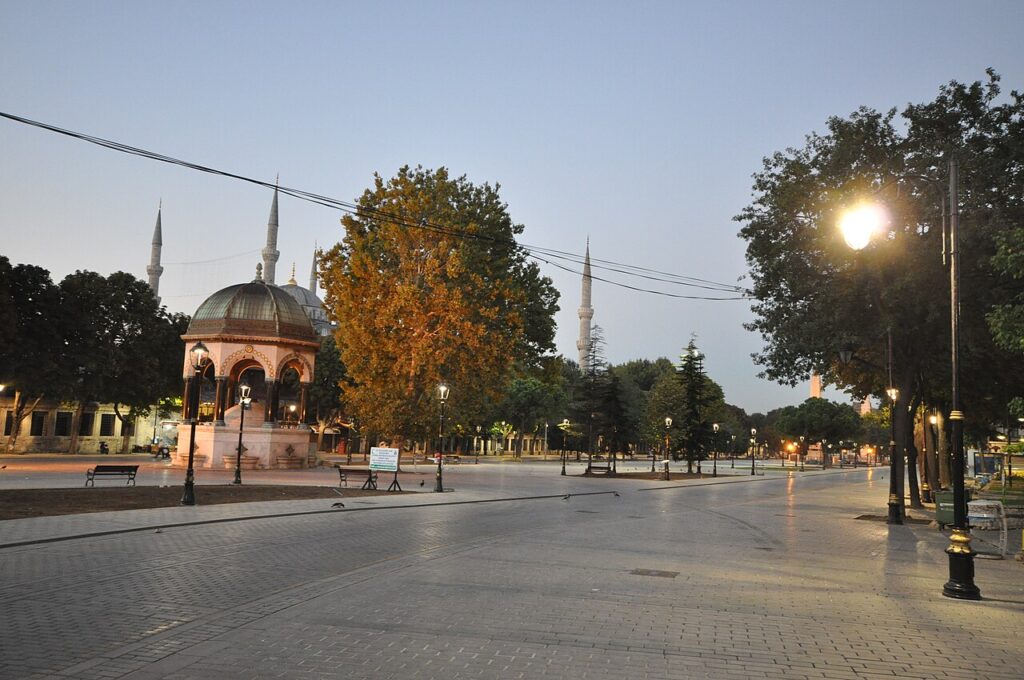
Practical Notes on the Hidden Side
A few things make the hidden side of Sultanahmet more pleasant:
- Go in the afternoon. The big sights are morning business; the lanes are at their best from 3 p.m. onward, when the tour buses have left.
- Carry small bills. The hidden gems are small businesses: tea gardens, grocers, workshops. They rarely break a large note.
- Expect Turkish, not English. In Balat and Cankurtaran you will meet people with more warmth than English. A smile, a “merhaba,” and a point at the menu works everywhere.
- Let yourself get lost. The neighborhood’s charm is in the accidental discoveries. The only rule: keep the sea or the mosque domes in sight and you can always find your way back.
A Self-Guided Hidden-Gems Walk
If the individual spots sound scattered, here is a single afternoon route that stitches the best of them together:
- Start at the Hippodrome (3 p.m.). Walk the square’s full length to the far end, past the Walled Obelisk, and spend five minutes at the Sphendone — the great curved back wall of the Byzantine racetrack. Run your hand along the Roman masonry.
- Descend toward the railway. Follow the street downhill past the tracks to the Little Hagia Sophia. Twenty minutes in its courtyard, and the neighborhood’s calmest five minutes of the day.
- Climb back through Cankurtaran. Don’t take the main street — take the steep lanes behind the palace walls, where the wooden houses lean over the cobbles and the cats own the doorsteps. Emerge near the sea walls for a glimpse of the Marmara.
- Loop to the Arasta. Cut through the back of Topkapi’s lower gardens to the Arasta Bazaar, walk its full length slowly, and finish with tea on the courtyard terrace behind the carpet workshops.
- If the legs still have life, take the bus or a short taxi to Balat for the golden-hour light on the painted houses, and close the day with cay on the Golden Horn shore.
The whole route is about four kilometers and three hours, with stops. It is the hidden Sultanahmet in one afternoon — and it will cost you about the price of a single tea.

The Takeaway
The hidden gems of Sultanahmet are not secret places — they are just the places the crowds don’t bother with. The neighborhood’s real character lives in its back lanes, its quiet courtyards, its forgotten cistern and its small church-cum-mosque, and in the twenty-minute walk to Balat’s painted houses. Take the detour, order the tea, and give the old city the afternoon it deserves.
One last note: the hidden gems are also the neighborhood’s most generous places. The tea gardens charge almost nothing, the workshops welcome watchers, and the lanes cost nothing at all. In a district where the headline sights are famous and crowded, the quiet corners are the ones that make you feel like a guest rather than a customer — and that is the version of Sultanahmet worth going home and telling people about.
Frequently asked questions
Is Sultanahmet worth exploring beyond the main sights?
Absolutely. The neighborhoods of Cankurtaran, the Arasta courtyard, and the Little Hagia Sophia are a short walk from the monuments and give you a version of Istanbul the crowds never see.
How do you get to Balat from Sultanahmet?
Walk about twenty-five minutes through the back streets, or take the bus from the Eminonu or Sultanahmet area toward Fener-Balat. A taxi is cheap and fast if your legs are done.
Are the hidden gems free?
Nearly all of them. The Little Hagia Sophia, the Sphendone, Cankurtaran’s lanes, and the Arasta courtyard cost nothing. Binbirdirek Cistern has a small entry fee.
Is it safe to wander the side streets?
Yes. Sultanahmet’s back lanes are residential, well-lit, and safe in daylight and early evening. The usual city commonsense applies at night.
What is the best hidden spot for a photo?
The view from the courtyard of the Little Hagia Sophia at sunset, or Balat’s pastel houses in the late-afternoon light.

All Over Information
The All Over Information editorial team researches and writes practical English-language guides to Turkey. Facts are checked against official and local sources before publication, prices are published as dated ranges rather than quotes, and guides are revised when things change. We accept no sponsored posts, paid placements or paid links.
More guides like this

Sultanahmet in Summer: A Complete Travel Guide
Summer is when Sultanahmet is at its fullest and its most demanding.
Sultanahmet in Winter: What to Expect
Winter is Istanbul's secret season, and Sultanahmet is its best-kept secret.
A Solo Traveler’s Guide to Sultanahmet
Istanbul is one of the best solo travel cities in the world, and Sultanahmet is its best solo neighborhood.

Family-Friendly Activities in Sultanahmet
Sultanahmet is a surprisingly excellent family destination.

Nightlife Guide to Sultanahmet
Let's be honest about Sultanahmet's nightlife: it is not a party neighborhood, and pretending otherwise would be a disservice. m. — the…
Sultanahmet on a Budget: Money-Saving Travel Tips
Sultanahmet is one of the easiest great cities to visit cheaply, once you know the local arithmetic.