The Maiden’s Tower has one of the longest and strangest resumes of any building in Turkey: customs post, watchtower, quarantine station, lighthouse, restaurant, and finally museum. It has watched the Bosphorus since antiquity, and its small walls hold the history of the strait itself. This guide follows the tower through the centuries in order, from the ancient customs rock to the restored landmark of today, so you can place every chapter of its story in the flow of Istanbul‘s long past.
Antiquity: The Customs Rock
Long before the tower, the islet was a working point in the life of the strait. In antiquity the area around modern Üsküdar was settled shore, and the rock offshore served as a station for watching shipping and collecting duties from the vessels that passed.
The ancient settlement at the site, known in the Greek world as Chrysopolis, was an important crossing point, and the islet was part of that busy world of boats and trade. Whatever stood on the rock was small, but it was useful.
Those early centuries set the pattern. The islet was never a palace or a pleasure ground; it was always a place of watch and duty, and that practical identity would define the site for the next two thousand years.
The Byzantine Centuries
Under the Byzantine Empire, the islet gained its first proper fortification. In the early twelfth century the emperor Alexius Comnenus built a tower on the rock, part of the defensive system that guarded the approaches to Constantinople.
The tower was maintained and rebuilt by later Byzantine rulers, and it joined the chain of watch posts along the strait. From its top, watchers could signal approaching fleets and warn the imperial capital across the water.
The Byzantine centuries were hard on the little tower. Wars, earthquakes, and the passage of the crusades all left their marks, and by the end of the era the structure was old, much-repaired, and ready for a change of masters.`n`nThe tower’s Byzantine chapters are shadowy, since records are scarce, but the sources agree on the essentials: a fortified post on the rock, linked to the wider system of the strait. Its garrison was small, its importance constant, and its survival through those turbulent centuries is itself a testimony to the site’s value.

The Ottoman Conquest of the Strait
When the Ottomans took Constantinople in 1453, the tower passed to its new rulers, and the strait became the waterway of an empire. The islet’s position in the narrows made it valuable to the Ottomans just as it had been to everyone before them.
The tower served as a lookout and a defensive post in the early Ottoman centuries, watching the shipping that was now the lifeblood of the imperial capital. Its garrison kept watch over the approaches to the city.
The Ottoman era also gave the tower its long association with the legend of the sultan’s daughter, the story that would eventually name the building. The empire adopted the rock, and the rock adopted the empire’s stories.
The Sixteenth and Seventeenth Centuries
Through the sixteenth and seventeenth centuries the tower settled into the routine of the strait. It was maintained as a lookout, and its light and signals guided the ships that crowded the Bosphorus.
The area around the tower on the Asian shore grew into a busy part of the city, and the islet became a familiar landmark for everyone who crossed the water. Poets and travelers began to mention the tower in their accounts of the strait.`n`nThe tower also entered the imagination of the city during these centuries. Travelers described the islet, artists sketched it, and the story of the princess began its long life as one of the best-known tales of the Bosphorus, so that the tower became a landmark of the mind as well as of the water.
The centuries were not without incident. Storms and earthquakes damaged the structure repeatedly, and each time the city repaired it, so that the tower continued its quiet service without interruption across the generations.

The Eighteenth Century
The eighteenth century brought more of the same rhythm of damage and repair. The tower’s exposed position meant constant attention, and the records of the era show the small building being patched, reinforced, and maintained by the city.
The tower also took on the role of a signal and customs point in the growing Ottoman state, watching the traffic of the strait that carried goods, people, and news between the capital and the wider world.`n`nThe maintenance of the tower was a small but constant item in the city’s life. Stone had to be brought, mortar mixed, and workmen ferried to the rock, and the authorities took the upkeep seriously, because a tower in the middle of the strait could not be allowed to fall.
By the end of the century the tower was a fixture of the shore, known to every sailor and every resident of the district. It was old, it was small, and it was entirely dependable, exactly as the strait needed it to be.
The Nineteenth-Century Rebuild
The nineteenth century transformed the tower. Sultan Mahmud II, the great reformer, ordered a major rebuilding of the structure, and the work gave the tower the form it wears today, the familiar silhouette that now crowns the islet.
The rebuilt tower was taller and more finished than its predecessors, and it took on the elegant upper section that makes it recognizable. The rebuild also refreshed the tower’s role in the life of the strait.
The century brought new duties. The tower served as a quarantine station during the cholera epidemics, isolating the sick on the rock, and it continued its work as a lighthouse, guiding the increasingly busy shipping of the Bosphorus.

Quarantine and the Modern City
The tower’s service as a quarantine station is among its strangest chapters. During the great epidemics of the nineteenth century, the islet was used to hold and isolate those who might carry disease, protecting the city that surrounded it.
The work was grim but essential, and it showed the tower’s stubborn usefulness. A building that could watch, signal, and isolate was a building that earned its maintenance, and the quarantine years kept the tower firmly in the city’s service.`n`nThe quarantine years also connected the tower to the wider world of medicine and empire. Ships arriving from distant ports were watched and checked, and the islet’s role in protecting the city from epidemic showed how a medieval watchtower could be reborn as an instrument of modern public health.
Around the same period, Istanbul was modernizing, and the tower was modernizing with it. The lighthouse equipment improved, the signals became more sophisticated, and the little tower took its place in the new age of the strait.
The Early Republic
With the founding of the Turkish Republic, the tower passed to the new state, and the twentieth century brought change. The tower continued to serve as a landmark and a signal point, its light still guiding the ships of the strait.
The middle decades of the century were hard on the structure. A major fire in the mid-twentieth century badly damaged the tower, and the disaster threatened the landmark that had survived so many centuries.
The city chose to save it. The restoration that followed returned the tower to its place, and the work prepared the building for its final transformation from utility to destination.
Decay and Restoration
The decades after the fire saw the tower restored and gradually reborn as an attraction. The old working tower was adapted for a new life, and the idea of the islet as a destination began to take hold.
The restoration work was delicate, because the tower stood in running water and exposed to the weather. Engineers and conservators worked on the structure, the foundations, and the islet together, securing the building for the future.`n`nThe restoration also recovered the tower’s story. The work preserved the layered fabric of the building, and the reopened tower presented its long history to visitors, from the ancient customs rock to the nineteenth-century rebuild, in the rooms and terraces of a single small building.
By the late twentieth century the tower was once again a place of gathering, hosting visitors and diners on its terraces. The working landmark had become a romantic one, and the centuries of duty gave way to a new era.
The Tower Today
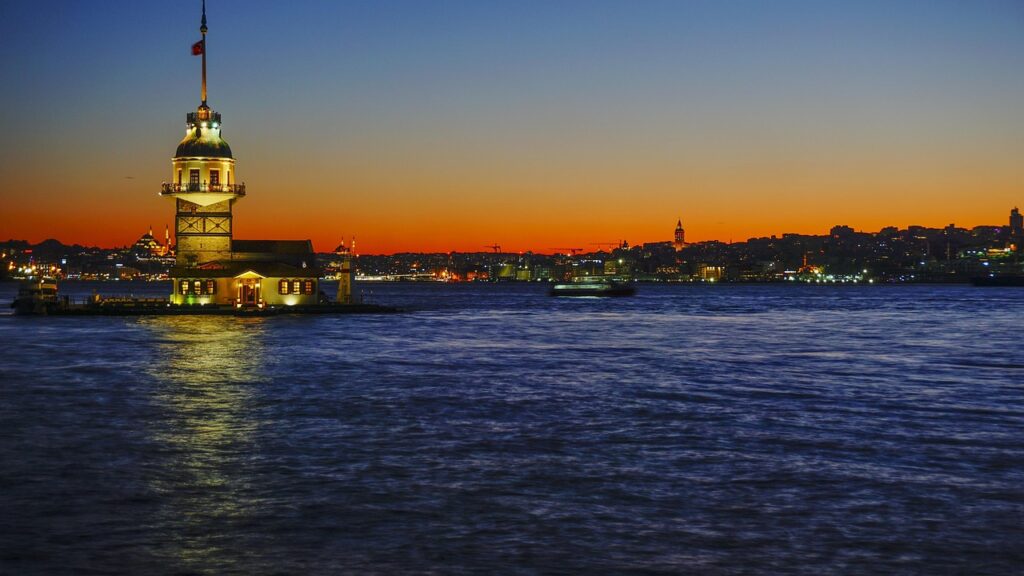
Today the Maiden’s Tower is one of Istanbul’s most beloved landmarks, and after a long restoration it has reopened to the public as a museum and meeting place. Boats carry visitors to the islet through the day, and the tower tells its own long story.
The tower now combines its old roles with new ones. Its rooms present the history and the legends, its terraces offer the views, and its cafe continues the hospitality that the building has offered in recent decades.
For the traveler, the tower is a complete experience: a boat ride, an islet, and a building that has served the strait since antiquity. After two thousand years of watch and duty, it has finally become the landmark that all those centuries were preparing.
Frequently asked questions
When was the tower first fortified?
The islet was used as a customs point in antiquity, and the first proper fortification came in the early twelfth century, when the Byzantine emperor Alexius Comnenus built a tower on the rock. Later rulers maintained and rebuilt it over the centuries.
What was the tower used for in the nineteenth century?
It had several duties: it was substantially rebuilt by Sultan Mahmud II, served as a lighthouse for the busy shipping of the strait, and was used as a quarantine station during the cholera epidemics, isolating the sick on the islet.
How was the tower damaged in the twentieth century?
A major fire in the mid-twentieth century badly damaged the structure, threatening the ancient landmark. The restoration that followed saved the tower and prepared it for its modern life as a museum, cafe, and visitor destination.

All Over Information
The All Over Information editorial team researches and writes practical English-language guides to Turkey. Facts are checked against official and local sources before publication, prices are published as dated ranges rather than quotes, and guides are revised when things change. We accept no sponsored posts, paid placements or paid links.
More guides like this
Islamic Architecture of the Ottoman Empire
The Ottoman Empire ruled Anatolia and much of the world around it for over six centuries, and it left behind one of…

Best Time to Visit Hagia Sophia to Avoid Crowds
Hagia Sophia is Istanbul's most visited monument, and its popularity means the experience of visiting depends heavily on when you go.

The Complete History of Chora Church
The Chora Church — the Kariye, the church of the Chora Monastery — is one of the greatest monuments of Byzantine art,…

Suleymaniye Mosque Through the Centuries
Since its completion in 1557, the Suleymaniye Mosque has watched over Istanbul for nearly five centuries.

Best Time to Visit Basilica Cistern to Avoid Crowds
The Basilica Cistern is one of the most popular attractions in Istanbul, and at busy times its walkways are crowded, its railings…

Visiting Ishak Pasha Palace: Tickets, Hours, and Tips
Ishak Pasha Palace is not a quick stop; it is a destination that demands a journey.