The Blue Mosque is the final masterpiece of Ottoman classical architecture, and reading its design is the best education in that tradition available anywhere. Built between 1609 and 1616 for Sultan Ahmed I, it was designed by Sedefkâr Mehmed Ağa, the last great student of the architect Mimar Sinan, and it refines every lesson of its ancestors: the dome of Hagia Sophia, the engineering of Sinan, and the tilework of Iznik. The result is a building that is both a working mosque and a treatise in stone, and understanding how it works deepens every minute you spend in it. This guide explains the architecture of the Blue Mosque, element by element.
The Big Idea: Answering Hagia Sophia
The Blue Mosque began as an argument. Sultan Ahmed I ordered it built directly facing Hagia Sophia, the greatest church of the Byzantine Empire, and the siting was deliberate: the new mosque would stand across the square from the old cathedral and answer it, dome for dome, for the ages.
The dialogue with Hagia Sophia shaped the design. Mehmed Ağa studied the great Byzantine dome, and his mosque repeats its logic, a central dome resting on a square through pendentives, refined into a cascade that reads as more integrated than its ancestor.
The result is not a copy but a reply. Where Hagia Sophia is a vast hall under one immense dome, the Blue Mosque is a layered composition of domes that step up to a climax. The Byzantine building astonishes; the Ottoman one persuades.
The Architect and the Tradition
The architect, Sedefkâr Mehmed Ağa, was the heir of the greatest name in Ottoman architecture. He had trained under Mimar Sinan, the genius who built the Suleymaniye and the Selimiye, and he inherited the accumulated craft of a century of dome building.
His biography shaped his art. Mehmed Ağa had begun as a craftsman in mother-of-pearl inlay, and the decorative sensitivity of his training shows in the Blue Mosque, the most richly ornamented of the great imperial mosques.
The Blue Mosque was his masterpiece and, in a sense, the end of his tradition. After it, Ottoman architecture moved toward European styles, and no later imperial mosque was built in the classical manner. Standing in the building, you are in the presence of the final chapter of a golden age.

The Dome System
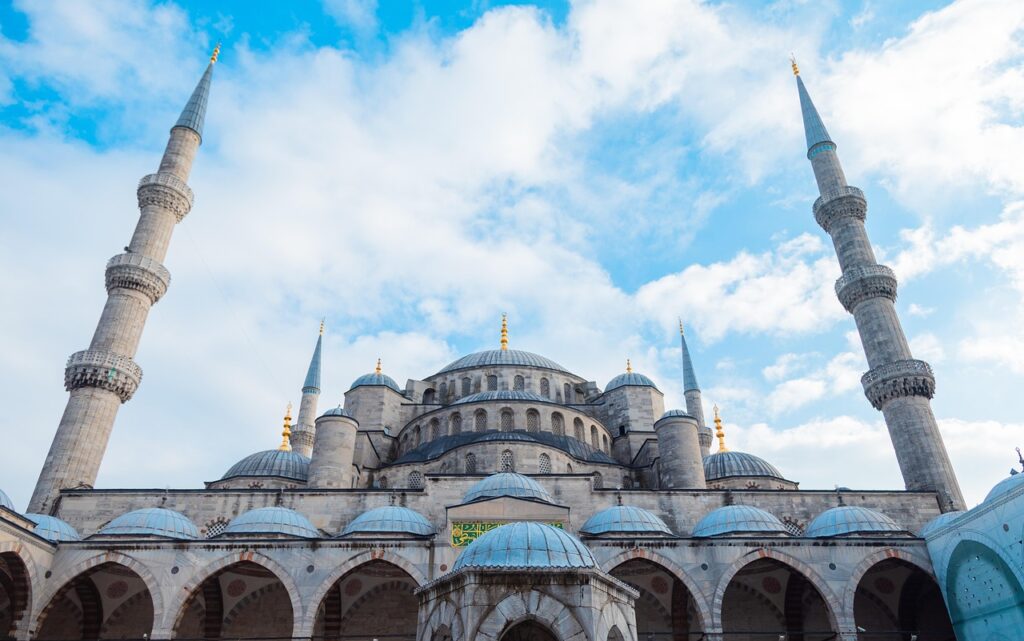
At the heart of the design is the dome system, the signature of Ottoman classical architecture. A great central dome, more than twenty meters across, rests on four massive piers through pendentives, and its weight is spread outward through half-domes and smaller domes in a continuous cascade.
The system reads clearly from inside. The central dome is ringed by windows, and the half-domes open the space east and west while the smaller domes step down toward the edges, so the ceiling appears to flow from the crown of the dome to the walls.
The engineering is invisible and perfect. The dome reaches more than forty meters above the floor, and the piers that carry it are integrated into the walls, so the space feels uninterrupted. It has held the building safely for four centuries of earthquakes.
The Six Minarets and the Exterior
The exterior of the Blue Mosque is defined by its six minarets, a number unmatched by any other mosque in Istanbul. Four of the minarets rise from the corners of the mosque itself, and two more stand at the outer corners of the courtyard, framing the whole composition.
The minarets are not decoration; they are engineering. Each one balances the dome visually, and the six together give the building the silhouette that has become an image of Istanbul, their shafts and balconies following the classical Ottoman formula.
From outside, the building is a study in mass and light. The lead-covered domes step down to the ground, the stone walls are pierced by rows of windows, and the great courtyard wall, with its monumental gate, prepares the visitor for the interior with a crescendo of scale.

The Courtyard: The Approach
The approach to the Blue Mosque is through one of the great courtyards of the Islamic world. The vast arcaded court is paved in marble, surrounded by a continuous colonnade of domed bays, and dominated by the square fountain at its center, where worshippers once performed their ablutions.
The courtyard is the overture to the architecture. The dome of the prayer hall rises above the arcade, visible from every angle, and the rhythm of the bays, the arches, and the domes prepares the eye for the greater rhythm inside. It is a space designed for gathering, for waiting, and for wonder.
The monumental entrance gate faces the courtyard, framed by carved stone, and the transition from the bright court to the dim, glowing interior is one of the great threshold experiences in architecture. The mosque was built to be approached slowly, and the courtyard enforces that pace.
The Interior: Tiles and Light
The interior of the Blue Mosque is its glory, and its architecture is inseparable from its decoration. More than twenty thousand Iznik tiles cover the walls below the gallery level, painted in blues, greens, and turquoise, with tulips, carnations, and calligraphic bands flowing around the building.
The tiles are structural to the effect. The blue they carry is picked up by the stained glass of more than two hundred windows, and the light that falls through them is tinted before it touches the tile, so the whole interior glows with a color that seems to come from the building itself.
The upper walls and the domes are painted in the same palette, so the eye travels from the tile at the base to the painted shell of the dome without a break, the effect of a single, continuous skin of blue.
The Sultan’s Box and the Imperial Elements
The Blue Mosque was built for a sultan, and its architecture carries imperial fittings that reward attention. On the eastern side of the interior, the sultan’s box, the hünkâr mahfili, stands raised and screened, where Ahmed I could attend prayer unseen, and a private ramp allowed him to ride to it.
The imperial elements extend through the building. The mihrab, the niche marking the direction of Mecca, is framed in carved and painted marble, and the minbar, the pulpit, is a masterpiece of carved stone and wood, its surfaces inlaid and gilded.
These elements are integrated into the architecture rather than added to it. The sultan’s box is part of the gallery system, the mihrab anchors the axis of the building, and the composition is organized around the imperial presence at prayer.
The Complex Beyond the Mosque
Like every great Ottoman foundation, the Blue Mosque was built as a complex, a small city serving the faith and the neighborhood. Around the mosque rose a madrasa for students, a hospital, baths, a school, and a market street whose rents supported the foundation.
The complex is the architecture of charity. The market street, with its vaulted shops, still stands and serves visitors, while the other buildings have taken on new lives. The whole compound is part of the monument.
The tomb of Ahmed I, completed after his death in 1617, is the architectural heart of the complex’s memorial life, a tiled jewel at the edge of the square. It completes the design: the mosque, the services, and the founder, gathered in one ensemble.

Engineering and Survival
The survival of the Blue Mosque is an engineering story as much as an artistic one. The building stands on the slope above the sea, on ground that once held the Byzantine imperial palace, and its deep foundations were built to carry the immense weight of the dome system.
The structure is designed to ride earthquakes. The piers, the arches, and the tie-beams distribute the forces of the dome, and the geometry is inherently stable, refined over a century of Ottoman experimentation.
Four centuries of maintenance have completed the work. The building has been repaired, restored, and reinforced continuously, most recently in a long restoration that cleaned the tiles and the stone and returned the interior to its full glory. The Blue Mosque you see today is architecture and maintenance working together.
Symbolism and Meaning
The architecture of the Blue Mosque is also a language of symbols. The six minarets declared the power and piety of a young sultan, the dome represented the vault of heaven, and the cascade of domes below it suggested the divine order descending to the world.
The blue itself carried meaning. In Islamic tradition, blue and turquoise evoke paradise and the sky, and the building wraps the worshipper in those colors, an image of the gardens promised to the faithful.
Even the siting was symbolic. Facing Hagia Sophia across the square, the Blue Mosque claimed the Christian cathedral’s ground for Islam, dome answering dome, and the rivalry of the two buildings became a dialogue written in stone at the center of the city.
Reading the Building Today
To read the Blue Mosque today, look for the layers of intention. The exterior is a statement of power, the courtyard is an invitation, the interior is an image of paradise, and the complex is an act of charity, all held together by the architecture of the classical Ottoman tradition.
The building also reads as a living place. The carpets, the worshippers, and the call to prayer are part of the design, and the architecture is completed by the community that uses it, exactly as Mehmed Ağa intended four centuries ago.
Stand in the courtyard, then step inside, and let the building speak. The blue, the light, the dome, and the silence will do the rest, and you will understand why this mosque, the last of its age, is the one the world remembers.
Frequently asked questions
What style is the Blue Mosque built in?
The Blue Mosque is the final masterpiece of Ottoman classical architecture, the tradition perfected by Mimar Sinan in the sixteenth century. It combines a central dome on pendentives, cascading half-domes, six minarets, and extensive Iznik tile decoration, and it is the last great mosque built in this classical manner.
Who was the architect of the Blue Mosque?
The architect was Sedefkâr Mehmed Ağa, the last great student of Mimar Sinan. He had trained as a craftsman in mother-of-pearl inlay before becoming chief imperial architect, and the Blue Mosque, his masterpiece, is the most richly decorated of the great imperial mosques of the classical age.
Why does the Blue Mosque have so many windows?
The more than two hundred windows are part of the architectural system. They ring the dome and pierce the walls to fill the interior with light, which is filtered through stained glass before falling onto the blue Iznik tiles. The light is central to the building’s effect of a glowing, sky-like interior.

All Over Information
The All Over Information editorial team researches and writes practical English-language guides to Turkey. Facts are checked against official and local sources before publication, prices are published as dated ranges rather than quotes, and guides are revised when things change. We accept no sponsored posts, paid placements or paid links.
More guides like this
Islamic Architecture of the Ottoman Empire
The Ottoman Empire ruled Anatolia and much of the world around it for over six centuries, and it left behind one of…

The Complete History of Anitkabir
Anıtkabir — the mausoleum of Mustafa Kemal Atatürk, the founder of the Turkish Republic — is the most important monument of modern…

Visiting Anitkabir: Tickets, Hours, and Tips
Anıtkabir — the mausoleum of Atatürk, the founder of the Turkish Republic — is the essential visit of Ankara, and the practical…

Rumeli Fortress Through the Centuries
The Rumeli Fortress — the great castle that commands the narrowest point of the Bosphorus — is one of the most dramatic…
The Complete History of Blue Mosque
The Blue Mosque is the last great imperial mosque of the Ottoman classical age, and its history is a story of ambition,…

Why Anitkabir Should Be on Your Turkey Bucket List
Anıtkabir — the mausoleum of Atatürk, the founder of the Turkish Republic — is the most important monument of modern Turkey, and…