The Blue Mosque is the most visited mosque in Istanbul, and visiting it is simpler than most travelers expect. It is free to enter, open to visitors for most of the day, and located in the middle of Sultanahmet, the old city’s great square. But because it is a working mosque, your visit must respect the rhythm of prayer, the dress code, and the crowds, and a little planning makes the difference between a hurried glance and a genuine encounter with one of the most beautiful interiors on earth. This guide covers everything you need to know: getting there, hours, etiquette, what to see, and how to time your visit well.
The First Thing to Know
The Blue Mosque, officially the Sultan Ahmed Mosque, is a working place of worship, and that fact shapes every aspect of the visit. It was built between 1609 and 1616 for Sultan Ahmed I, and it has been prayed in continuously since, which makes it one of the great living monuments of the Islamic world.
Because it is a mosque, entry is free. There are no tickets, no turnstiles, and nothing to book, which surprises visitors who have queued for museums across the city. You simply arrive, respect the rules of the building, and walk in, which makes it one of the most accessible great sights in Istanbul.
The working status also means the building is alive. Worshippers come and go, the carpets are laid for prayer, and the call to prayer rings from the minarets five times a day. Seeing the Blue Mosque as a place of worship, rather than a monument, is the whole point of the visit.
Getting There
The Blue Mosque sits at the heart of Sultanahmet, Istanbul’s old city, facing Hagia Sophia across the great square that was once the Hippodrome. The tram line T1 stops at Sultanahmet, and the mosque is a short walk across the square, past the fountain and the obelisks.
If you are staying in the old city, you will almost certainly walk. Hagia Sophia, Topkapi Palace, the Basilica Cistern, and the Grand Bazaar are all within a comfortable radius, and the tram connects the area to the ferry ports, the train stations, and the rest of the city.
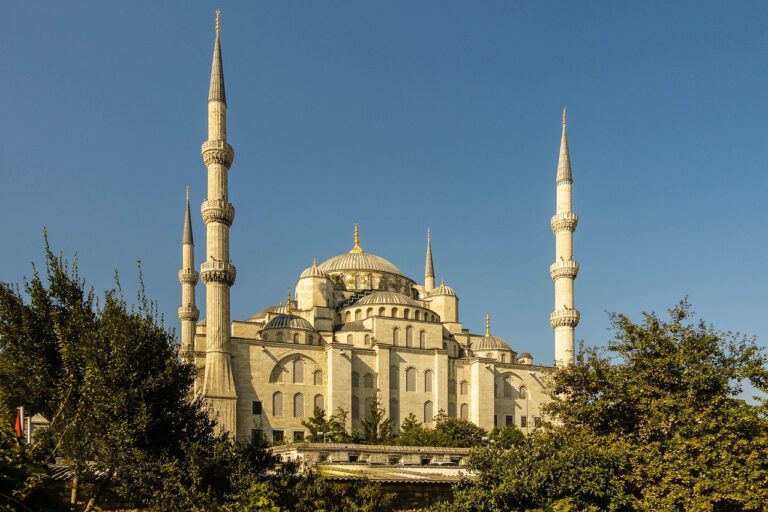
From the airport or the Asian side, the same advice applies: take the Marmaray train or the T1 tram toward Sultanahmet and walk the last stretch. The approach across the square, with the six minarets and the cascade of domes ahead, is the moment every first-time visitor photographs, and it deserves your full attention.

Hours and Prayer Times
The Blue Mosque is open to visitors throughout the day, except during the five daily prayers, when it closes to non-worshippers. The prayer times move with the sunrise and the seasons, so the schedule cannot be assumed from a printed list, and checking the daily times for Istanbul is the essential first step of planning.
Around each prayer, the mosque closes for roughly half an hour, and the midday prayer on Friday, the congregational prayer of the week, is the longest closure. The early morning prayer, before most travelers are awake, is the least disruptive to a visitor’s day.
The best strategy is to plan around the schedule: arrive just after a prayer ends, when the building has reopened and the first wave of the queue has passed. The interior is also at its most atmospheric during the quieter moments between prayers, when the carpet is empty and the light does the talking.
The Queue and Security
There is no ticket line at the Blue Mosque, but there is a security check, and the queue it creates is the main practical hurdle of the visit. The line forms at the entrance and moves steadily, but it can stretch long in the middle of the day, when the tour groups arrive.
Travel light to move quickly. Bags are screened, and large items slow things down, so leave the daypack at the hotel if you can. The queue also tends to compress into a single moving stream, and it moves faster than it looks, so do not be discouraged by its length.
The strategic advice is timing. The queue is shortest in the first hour of the visitor day and in the late afternoon, and longest between mid-morning and mid-afternoon. If you arrive at the right hour, the wait is a matter of minutes rather than the half hour that midday visitors endure.

Dress Code and Etiquette
As a working mosque, the Blue Mosque enforces a dress code at the door. Shoulders and knees must be covered for everyone, women are asked to cover their hair, and the staff provides scarves and coverings at the entrance for visitors who arrive unprepared.
Shoes come off before you step onto the carpet, and you carry them in a bag provided at the entrance. This is the moment the comfortable slip-on shoes you packed earn their keep, and the carpet itself, soft underfoot, becomes part of the experience.
Inside, the rules are simple and universal. Speak quietly, keep a respectful distance from worshippers, and never walk in front of someone at prayer. Photography is permitted, but the flash stays off, and photographing worshippers without their welcome is poor manners anywhere, and worse here.
What You’ll See Inside
The interior of the Blue Mosque opens as a vast, light-filled space beneath the great dome, and the first impression is of blue. More than twenty thousand Iznik tiles cover the lower walls, painted in blues, greens, and turquoise, with patterns of flowers and calligraphy that flow around the building.
The eye moves upward through the layered domes and half-domes, which rise in stages to more than forty meters, with more than two hundred windows letting in the light. The stained glass of the lower windows is original to the building, and the light falling through it onto the tile is the mosque’s great spectacle.
The fittings reward attention too: the marble mihrab, the carved minbar with its precious wood and marble inlay, and the great painted medallions hanging high on the walls. Above the entrance, on the eastern side, the sultan’s box stands raised and screened, where Ahmed I attended prayer without being seen.

The Courtyard and the Complex
Before you enter the prayer hall, take time with the courtyard, which is one of the great ceremonial spaces of Istanbul. The arcaded courtyard, paved in marble and dominated by the central fountain, is where the mosque’s architecture is best read, with the domes stepping up in rhythm around it.
The courtyard also holds the main entrance, a monumental gate faced with carved stone, and it frames the view of the six minarets, which rise at the corners of the courtyard and the mosque itself. The contrast between the cool, shaded arcade and the bright square beyond is a small architectural pleasure.
The complex around the mosque is part of the visit. The former market street, the baths, the school, and the hospital that Ahmed built for the city now serve the neighborhood in new ways, and a stroll around the compound after your visit completes the picture of a sultan’s foundation.
The Tomb of Ahmed I
At the edge of the mosque complex, beside the square, stands the tomb of Sultan Ahmed I, the young sultan who built the mosque and died in 1617, a year after its completion. The mausoleum is a jewel of the period, with its tiled interior, its carved wooden doors, and its quiet garden.
Inside, the tomb holds Ahmed himself, along with several of his sons, including the tragic young sultans Osman II and Murat IV. The space is a place of pilgrimage, and Turkish visitors come quietly to pray, which gives the building a depth that no museum display could match.
The tomb is usually open to visitors, and it is worth the few minutes it takes. It completes the story of the mosque: the building that a teenager ordered, and the man who ordered it, resting together in the garden of his great work.

Combining the Blue Mosque with the Neighborhood
The Blue Mosque sits at the center of the densest cluster of monuments in Istanbul, and it combines effortlessly with everything around it. Hagia Sophia is directly across the square, and the two buildings, Byzantine cathedral and Ottoman mosque, are best seen as a pair.
The former Hippodrome runs along one side of the square, with its Egyptian obelisk, its serpent column, and its walled obelisk, and Topkapi Palace is a short walk through the park. The Basilica Cistern, the Grand Bazaar, and the Spice Bazaar complete the neighborhood’s treasure map.
The classic plan: start with Hagia Sophia in the early morning, cross to the Blue Mosque mid-morning, and spend the afternoon at Topkapi or in the bazaars. The mosque’s prayer schedule will dictate the details, but the neighborhood absorbs the timing easily, because everything is within walking distance.
Practical Tips for a Smooth Visit
A few habits will make your visit easy. Carry a scarf for the mosque, wear shoes you can slip off quickly, and travel light, because the security check and the shoe ritual reward simplicity. Dress for the mosque before you leave your hotel, and you will sail past the queues at the cover-up stand.
Check the prayer times the night before and build your day around them, and treat the mosque’s closures as invitations rather than obstacles: the call to prayer across the square, with the minarets lit, is one of the great moments of an Istanbul evening.
Finally, go slowly. The Blue Mosque is a building that rewards looking, and the visitors who rush through in ten minutes remember a blue room; the ones who sit in the courtyard, watch the light, and listen to the silence remember the building itself. Give it the hour it deserves.
Frequently asked questions
Do you need tickets for the Blue Mosque?
No. The Blue Mosque is a working mosque, and entry is free for everyone. There are no tickets and nothing to book in advance. You simply join the security queue at the entrance and walk in, which makes it one of the most accessible great sights in Istanbul.
What are the visiting hours at the Blue Mosque?
The mosque is open to visitors outside the five daily prayer times, which shift daily with the sunrise. It closes for roughly half an hour around each prayer, with the longest closure at Friday’s midday prayer. Check the daily prayer schedule for Istanbul before you plan your visit.
What is the dress code for the Blue Mosque?
Shoulders and knees must be covered for everyone, and women are asked to cover their hair. Scarves and coverings are provided at the entrance for visitors who arrive unprepared. Shoes must be removed before stepping onto the carpet, and you will carry them in a bag provided at the door.

All Over Information
The All Over Information editorial team researches and writes practical English-language guides to Turkey. Facts are checked against official and local sources before publication, prices are published as dated ranges rather than quotes, and guides are revised when things change. We accept no sponsored posts, paid placements or paid links.
More guides like this
The Architecture of Chora Church Explained
The Chora Church — the Kariye — is the architectural treasure of the Byzantine world, and its design holds the story of…

Visiting Ishak Pasha Palace: Tickets, Hours, and Tips
Ishak Pasha Palace is not a quick stop; it is a destination that demands a journey.

The Architecture of Selimiye Mosque Explained
The Selimiye Mosque in Edirne is the final and finest achievement of Ottoman classical architecture, the building in which the architect Mimar…

Suleymaniye Mosque Through the Centuries
Since its completion in 1557, the Suleymaniye Mosque has watched over Istanbul for nearly five centuries.
Mimar Sinan: Ottoman Turkey’s Master Architect
No single person shaped the skyline of Turkey more than Mimar Sinan, the chief architect of the Ottoman Empire in its golden…

The Architecture of Suleymaniye Mosque Explained
The Suleymaniye Mosque is the masterpiece of Mimar Sinan, the chief architect of the Ottoman golden age, and it is the building…