The Ottoman Empire ruled Anatolia and much of the world around it for over six centuries, and it left behind one of the great architectural traditions of Islam. From the soaring domes of Istanbul‘s imperial mosques to the stone bridges and caravanserais of the provinces, Ottoman buildings still define the skyline of Turkey and shape the experience of every traveler. This guide introduces the principles, the masterpieces, and the master builders of Ottoman Islamic architecture, and shows you where to see the tradition at its finest.
An Empire of Builders
The Ottoman dynasty emerged in western Anatolia in the late thirteenth century and grew into a world empire that stretched from the Balkans to Arabia. With power came building, and the Ottomans constructed on a scale that matched their ambition: mosques, palaces, schools, hospitals, and entire cities.
Ottoman architecture drew on the traditions around it, blending the domed buildings of Anatolia and the Byzantine world with the forms of Islamic architecture from Persia and the Arab lands. Out of this synthesis, the Ottomans created a style unmistakably their own, centered on the dome and the skyline.
For the traveler, this heritage is everywhere. Nearly every city in Turkey has its Ottoman mosques and monuments, and even small towns preserve the fountains, bridges, and tombs of the imperial centuries. To understand Ottoman architecture is to understand the country you are visiting.
The Rise of the Ottoman Mosque
The earliest Ottoman buildings were modest, but the tradition grew quickly. In the fourteenth and fifteenth centuries, the Ottomans developed the single-domed mosque, a simple, powerful form that became the basis of their style. The mosques of Bursa, the first Ottoman capital, show this evolution clearly.
The Ottoman mosque is built for prayer and for the community. It typically centers on a large prayer hall beneath one or more domes, with a mihrab niche indicating the direction of Mecca and a minbar pulpit for the Friday sermon. The interior is flooded with light from windows set in the walls and drums of the domes.
The conquest of Constantinople in 1453 gave the tradition its greatest challenge and its greatest opportunity. The sultans set out to build mosques that would rival the city’s great churches, and the result was a series of imperial foundations that pushed the architecture to new heights.

Sinan and the Golden Age
The architect who defined Ottoman architecture was Sinan, who served as chief imperial architect in the sixteenth century. A military engineer by training, Sinan designed hundreds of buildings over a career of fifty years, and his work set the standard for the entire tradition.
Sinan’s genius lay in structure. He perfected the great dome, balancing it on half-domes, arches, and buttresses to create interiors of astonishing lightness and space. His mosques seem to float, their domes rising in layers that draw the eye ever upward.
His three masterpieces are the Sehzade Mosque, the Suleymaniye, and the Selimiye in Edirne, which he considered his greatest work. Each demonstrates a different solution to the problem of the dome, and each is a landmark of world architecture.
The Great Imperial Mosques
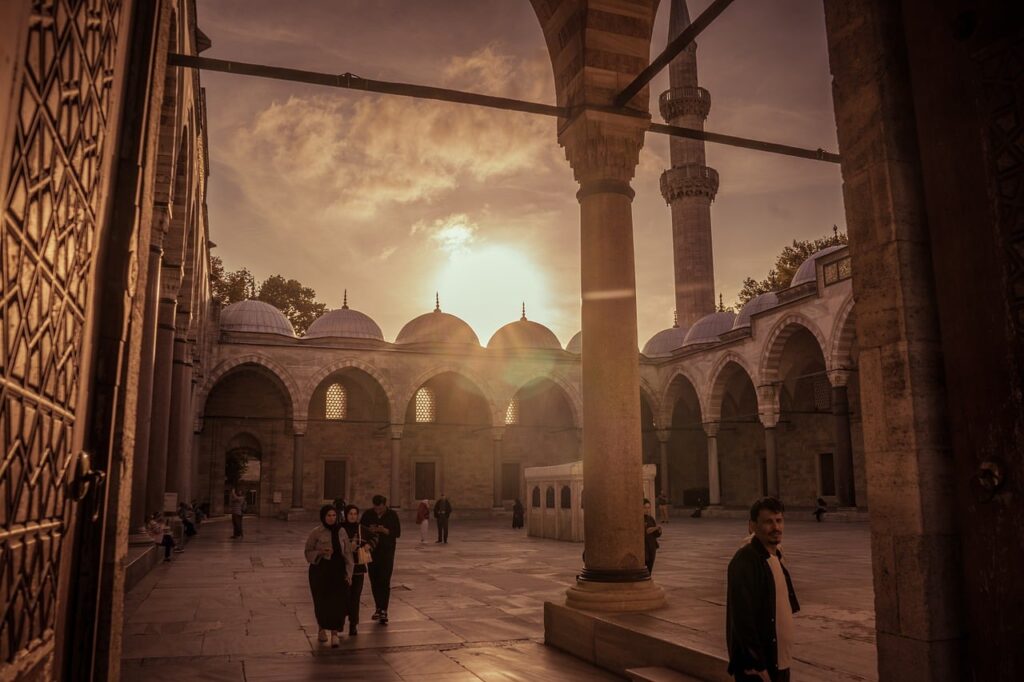
Istanbul’s skyline is the Ottoman Empire’s greatest monument, and its imperial mosques are the crown of the tradition. The Suleymaniye, built for Suleyman the Magnificent on the city’s highest hill, combines colossal scale with serene harmony, its four minarets and great dome visible across the Bosphorus.
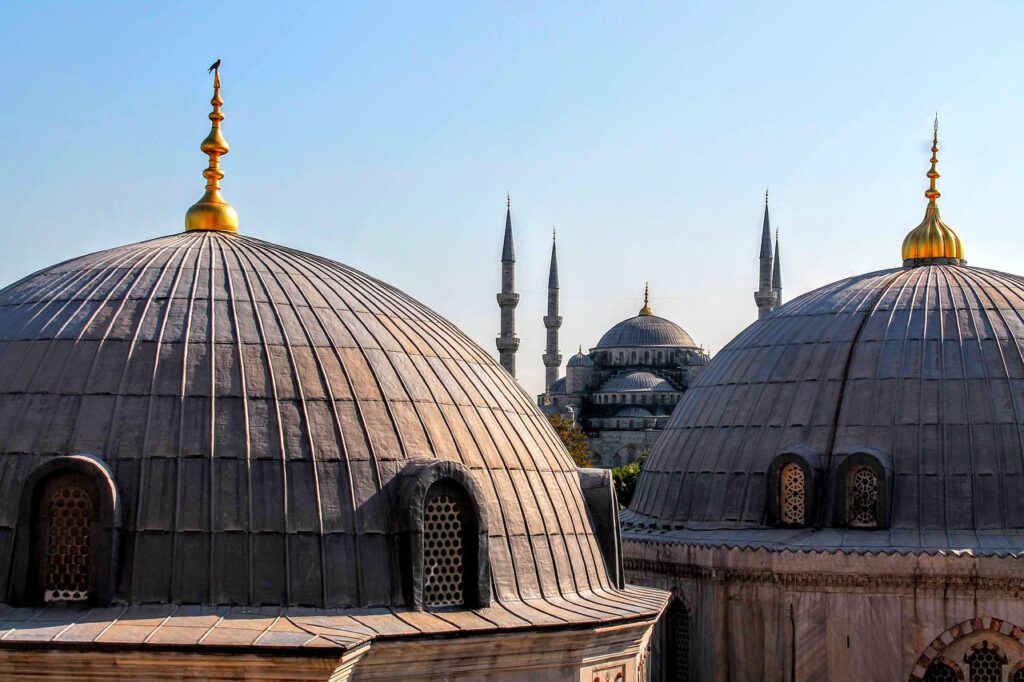
The Blue Mosque, built a century later for Sultan Ahmed, answers the Suleymaniye with six minarets and an interior sheathed in tens of thousands of blue tiles. Its courtyard, with its cascading domes, is one of the most beautiful spaces in the Islamic world.
Beyond Istanbul, the Selimiye Mosque in Edirne, built by Sinan in his eighties, is considered the summit of Ottoman achievement, its great dome supported by an ingenious system that the architect himself declared unmatched. These buildings are not only places of worship; they are the imperial statement of a world power.

Domes and Minarets
Two forms define Ottoman architecture: the dome and the minaret. The dome, inherited from Byzantine and Islamic traditions, was perfected by the Ottomans into the emblem of their power, a hemisphere of brick and stone that seems to hover over the prayer hall.
The minaret, the tower from which the call to prayer is given, evolved from a thick, fluted pencil shape with one or more balconies. The imperial mosques of Istanbul carry several minarets, each with two or three galleries, and their silhouettes are among the most famous in the world.
Ottoman builders were masters of the engineering that made these forms possible. Lead-covered domes, iron ties, and carefully calculated buttresses allowed spans that earlier builders could not achieve, and the surviving buildings have withstood earthquakes for centuries. The forms are beautiful; the skill behind them is extraordinary.
The Kulliye: A City Within a City
The great Ottoman mosques were rarely built alone. Around them, the sultans and their ministers constructed whole complexes, known as kulliye, that functioned as the social infrastructure of their cities: schools, hospitals, kitchens for the poor, baths, libraries, and caravanserais.
The Suleymaniye is the classic example. Its surrounding complex includes four madrasas, a hospital, a public kitchen, a caravanserai, and the tombs of Suleyman and his wife, all arranged on the terraces around the mosque. The complex was a small city of learning and charity.
These complexes reveal the social vision of Ottoman architecture. The mosque was the center of a community’s life, and the buildings around it served education, healing, and hospitality. For travelers, visiting a kulliye means understanding not just architecture but the daily life of the Ottoman world.
Palaces and Power
Ottoman palaces expressed power in a different language. The Topkapi Palace in Istanbul, the seat of the sultans for four centuries, is a series of courtyards, pavilions, and gardens behind high walls, its restrained exteriors concealing interiors of dazzling tile and gold.
The palace architecture is deliberately intimate. The sultan’s private quarters, the harem, and the kiosks of the gardens created a world of ceremonial leisure, and the view from the terraces over the Bosphorus was part of the imperial statement.
Later palaces, like the Dolmabahce on the Bosphorus shore, abandoned Ottoman forms for European style, but Topkapi remains the purest expression of Ottoman palace architecture. Its tiled pavilions and courtyards are among the most visited spaces in the country.
Bridges, Caravanserais, and Fountains
Ottoman architecture extended far beyond mosques and palaces. The empire’s roads were lined with caravanserais, fortified inns where travelers and merchants found shelter, stables, and supplies. The great stone caravanserais of Anatolia still stand along the old trade routes.
Bridges were another Ottoman specialty. The stone bridges of the empire, many of them built by Sinan and his successors, carried roads across rivers in elegant arcs, and some, like the bridge at Mostar in the Balkans, became symbols of the lands they served.
Fountains completed the picture. The Ottomans built public fountains at every scale, from the great sebils of Istanbul to the village fountains of Anatolia, and their carved stone and inscriptions made water a work of art. Together, these smaller monuments show an architecture devoted to the comfort of the public.
Decorative Arts and Tiles
Ottoman architecture is inseparable from its decoration. The tiles of Iznik, with their blues, turquoises, and coral reds, cover the walls of mosques and palaces, and the calligraphy of the imperial workshops crowns domes and panels in flowing script.
Interiors were enriched with carved marble, painted wood, and stained glass, while the exterior walls of the great mosques were often left in clean stone, making the decoration within all the more striking. The Blue Mosque’s tiles and the Suleymaniye’s calligraphy are the most famous examples.
This decoration was never merely ornamental. Calligraphy carried the words of the Quran, tiles depicted paradise gardens, and every element had meaning. For the modern visitor, the richness of Ottoman decoration is one of the great visual pleasures of traveling in Turkey.
Where to See Ottoman Architecture
The essential course in Ottoman architecture begins in Istanbul, with the Suleymaniye, the Blue Mosque, the Topkapi Palace, and the smaller mosques of the old city. From there, Bursa preserves the early tradition, and Edirne holds Sinan’s masterpiece, the Selimiye.
The provinces are full of treasures. The great mosques of Konya, the caravanserais of the Anatolian highways, and the Ottoman quarters of cities like Safranbolu and Amasya extend the story far beyond the capital. In the Balkans, the Ottoman buildings of towns once ruled from Istanbul continue the tradition.
A week gives you the highlights; a lifetime would not exhaust the tradition. The best approach is to read a little, look carefully, and visit at your own pace, letting the buildings teach you the genius of the empire that built them.
Frequently asked questions
Who was the greatest Ottoman architect?
Sinan, who served as chief imperial architect in the sixteenth century, is universally regarded as the greatest. Over a fifty-year career he designed hundreds of buildings, including the Suleymaniye in Istanbul and the Selimiye in Edirne, which he considered his masterpiece. His innovations in dome construction influenced builders for generations, and his surviving works are among the most important monuments of Islamic architecture in the world.
What makes Ottoman mosques distinctive?
The Ottoman mosque is defined by its great central dome, often supported by half-domes and arches to create a vast, light-filled interior. Slender pencil-shaped minarets with balconies complete the silhouette. Complexes called kulliye surrounded the imperial mosques with schools, hospitals, and kitchens. The decoration, particularly the tiles of Iznik and calligraphy, is also a hallmark of the Ottoman style.
Where can you see Ottoman architecture beyond Istanbul?
Edirne holds the Selimiye Mosque, Sinan’s masterpiece, and Bursa preserves the early Ottoman tradition with its Green Mosque and tombs. The caravanserais along the old trade routes, the Ottoman houses of Safranbolu and Amasya, and the great provincial mosques of Konya and Manisa extend the story. Former Ottoman lands in the Balkans also preserve important buildings, so the tradition can be followed across several countries.

All Over Information
The All Over Information editorial team researches and writes practical English-language guides to Turkey. Facts are checked against official and local sources before publication, prices are published as dated ranges rather than quotes, and guides are revised when things change. We accept no sponsored posts, paid placements or paid links.
More guides like this

The Architecture of Selimiye Mosque Explained
The Selimiye Mosque in Edirne is the final and finest achievement of Ottoman classical architecture, the building in which the architect Mimar…
The Architecture of Sumela Monastery Explained
Architecture is usually the art of building on solid ground, and Sumela Monastery is the exception that proves the rule.

Turkey’s Best Museums Beyond Istanbul
Istanbul has the museums everyone knows, from the great archaeological collections to the palaces and cisterns.

Visiting Rumeli Fortress: Tickets, Hours, and Tips
The Rumeli Fortress is one of the most impressive sights on the Bosphorus, a vast medieval castle of towers and walls that…

Visiting Grand Bazaar: Tickets, Hours, and Tips
The Grand Bazaar is one of the great experiences of Istanbul, and it is also one of the most confusing places for…

Basilica Cistern Through the Centuries
Few buildings can match the Basilica Cistern for the strangeness of its history.