Ani is a ghost city with a thousand-year story. For almost a century it was the dazzling capital of the medieval Armenian kingdom, a wealthy crossroads of the Silk Road called the City of a Thousand and One Churches, and then it collapsed into ruin and silence on the remote eastern frontier of Turkey. Today its crumbling cathedrals and mosques stand empty beside the Arpacay river, a UNESCO World Heritage Site since 2016.
Origins: A Fortress on the Frontier
Ani began as a stronghold on a natural border. The site sits on a triangular plateau above the Akhurian river, now called the Arpacay, which forms the frontier with Armenia, and the steep gorges on three sides made it almost impossible to attack. A settlement and fortress existed here from early medieval times, guarding the crossing routes between the highlands and the plains.
The surrounding region, the heartland of historic Armenia, had been ruled by a succession of empires. By the ninth century, as the Arab caliphate weakened, the Armenian Bagratid dynasty was building its power across the region, with its capital first at Kars and then at Ani.
Ani’s moment came in the second half of the tenth century, when King Ashot III of the Bagratid dynasty moved his capital there in 961. The plateau was defensible, the river valley was fertile, and the trade routes were growing busier, and the city began its transformation into one of the great centres of the medieval world.
The Bagratid Capital
The move to Ani in 961 was the turning point. The Bagratid kings made the city the seat of their court, their church, and their administration, and within a few decades it grew into a metropolis whose wealth astonished visitors. At its peak, Ani may have held more than a hundred thousand people, an extraordinary number for the Middle Ages.
The city’s prosperity rested on trade. Ani stood on the great routes connecting the Black Sea, the Caucasus, Persia, and the Mediterranean, moving silk, spices, horses, and metalwork through the passes. The profits flowed back into the city as churches, palaces, and walls, and the skyline filled with the domes and conical roofs that gave Ani its nickname, the City of a Thousand and One Churches.
The Bagratid kings also made Ani a religious capital. The Armenian church, with its patriarchs and monasteries, flourished under their protection, and the city drew scholars, scribes, and artists from across the Armenian world. For the best part of a century, Ani was the most important Armenian city on earth.

The Golden Age of the Cathedral
The crowning monument of Bagratid Ani is the cathedral, begun in 989 by the architect Trdat and completed around 1001. Trdat was one of the great engineers of his age, a master of the vaulted stone architecture that Armenian builders had developed over centuries, and the cathedral he designed was the largest church in the kingdom.
The cathedral’s design is deceptively simple: a long hall covered by a great vault, with clustered columns and pointed arches that anticipate Gothic architecture by two centuries. The building was a technical triumph, and its ruins still dominate the city today, roofless but standing, one of the most important monuments of medieval architecture anywhere.
The completion of the cathedral marked the high point of Bagratid Ani. Around the same time King Gagik I was covering the city with palaces and churches, and the walls were being strengthened into the defences that still ring the plateau.
The Walls of Smbat
Ani’s great walls are the work of King Smbat II, who ruled in the second half of the tenth century. The city’s natural defences were already formidable, with sheer gorges on three sides, but the approach from the west, along the plateau, needed a man-made barrier. Smbat built a double line of walls across that neck, studded with towers, that made the city almost unbreakable.
The walls are among the finest military architecture of their time. Built of dark volcanic stone, they run for more than four kilometers, with semicircular towers at intervals and gates that could be defended from above; later rulers strengthened them further, and sections still stand to their full height.
The fortifications were tested again and again. Ani withstood sieges by Byzantines, Seljuks, and nomad armies, and the walls that survive bear the marks of centuries of war. Walking along them today, you can see why the city was so hard to take: the defenders held the high ground, and every approach was covered.

The Byzantine Interlude
The Bagratid dynasty’s grip on Ani loosened in the middle of the eleventh century. Rivalries within the royal family, and pressure from the Byzantine empire to the west, weakened the kingdom, and in 1045 the Byzantines annexed Ani outright. The last Bagratid king was packed off to Constantinople, and the city became the easternmost outpost of the Byzantine world.
Byzantine rule changed Ani’s character. The city was now a frontier garrison rather than an independent capital, and its churches passed under the authority of the Byzantine church. The great building boom stopped, and the population began to drift as a greater storm gathered in the east.
That storm was the Seljuk Turks, who were sweeping through Persia and the Caucasus. In 1064, a vast Seljuk army under Sultan Alp Arslan marched on the city. After a heroic defence, Ani fell, and the sack that followed was one of the most destructive in its history.
The Seljuk Conquest
The fall of Ani in 1064 ended the Armenian capital forever. The Seljuks held the city briefly before handing it to the Shaddadids, a dynasty of Muslim emirs who ruled Ani for more than a century. Under the Shaddadids, Ani recovered some of its old prosperity, and the new rulers built mosques alongside the churches.
The most beautiful of their monuments is the mosque of Manuchihr, built in the late eleventh century, with a minaret that still stands beside the river gorge, one of the earliest surviving Seljuk monuments in Anatolia.
Ani remained a mixed city, Armenian and Muslim, and the two communities built side by side. The churches were kept in repair for the Armenian population, while the emirs added palaces and bathhouses; the city was no longer a capital, but it was still a living place on the frontier of two worlds.

The Zakarid Renaissance
In 1199, Ani passed to the Zakarids, an Armenian noble family serving the Georgian crown. Under their rule the city enjoyed a final renaissance, a century of renewed building and cultural life that produced some of Ani’s most beautiful surviving monuments, including the church of St Gregory of Tigran Honents, completed in 1215.
That church is a masterpiece of the Zakarid age. Its exterior is covered with rich stone carving, and its interior preserves frescoes, rare in Armenian churches, showing scenes from the life of Christ and the saints. The frescoes are among the most important medieval paintings in Anatolia, and they survived because the church’s solid construction protected them.
Trade revived under the Zakarids, and Ani once again grew rich on the Silk Road. The city’s merchants connected the Black Sea ports with the markets of Persia, and the population rebounded.
The Silk Road City
Trade was the engine of Ani’s greatness. The city sat where the routes from the Black Sea, the Caucasus, and Persia converged, and its bazaars moved goods across half of Asia. Silk from the east, furs from the north, and horses and carpets from the region all passed through its gates.
The wealth of this commerce funded the building boom. Merchants, not just kings, endowed churches and monasteries, and the hundreds of religious buildings that gave Ani its nickname were paid for by the profits of the caravan trade. Ani was, in essence, a merchant city wearing the robes of a capital.
The Silk Road also made Ani cosmopolitan. Its population included Armenians, Greeks, Georgians, Persians, and Jews, and travellers described a city of many languages and many faiths. That diversity was Ani’s strength, and its loss, when the trade routes shifted and the invasions came, was part of its slow death.
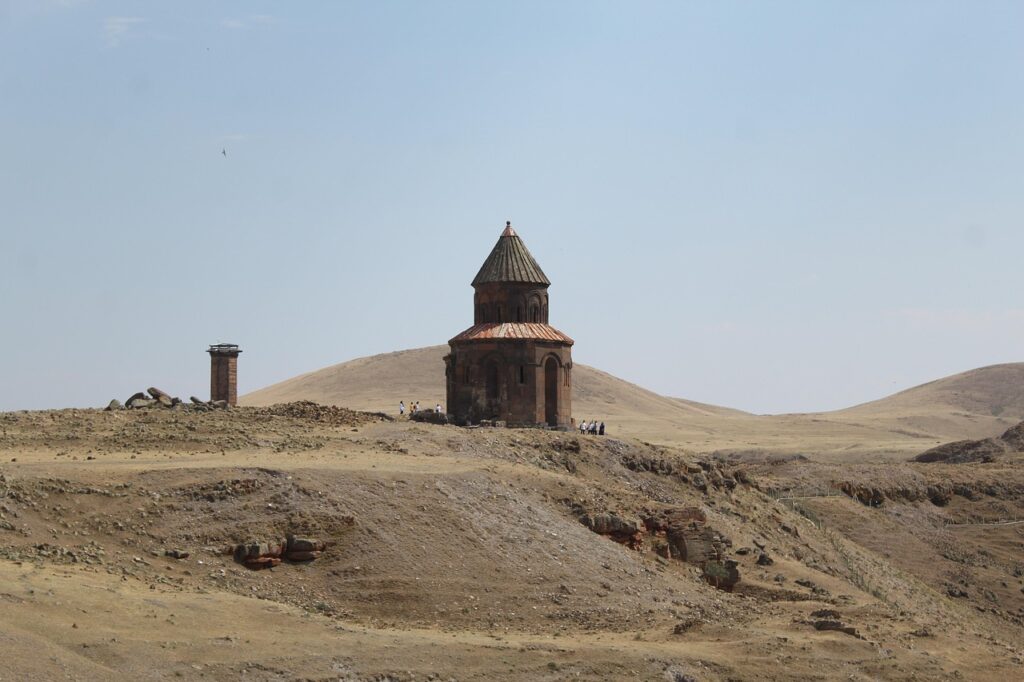
The Mongol Storm and the Long Decline
In 1239, the Mongols took Ani. The city surrendered and was spared the worst, but the Mongol conquest broke its prosperity for good: the trade routes were disrupted, the taxes were crushing, and the Zakarid line faded. Ani entered a long decline that lasted two centuries.
The final blow came in 1319, when a massive earthquake struck the region. The cathedral lost part of its structure, and the great vaults and domes collapsed across the city. Ani never recovered; the survivors drifted away, and the once-great capital became a small town.
Through the Ottoman centuries the city shrank further. By the nineteenth century, Ani was a ghost town of empty churches and broken walls, known only to shepherds and the occasional traveller.
Ruin, Earthquake, and World Heritage
Modern study of Ani began in the late nineteenth century, and the Russian archaeologist Nicholas Marr conducted major excavations between 1892 and 1917. His work revealed the city’s plan, its churches, and its history, and made Ani famous among scholars. Further earthquakes and the shifting border completed the transformation of the site into an open-air museum.
In 2016, the archaeological site of Ani was inscribed on the UNESCO World Heritage List, recognised as an exceptional example of medieval urbanism and architecture. The listing has brought conservation, visitors, and a protective management plan to the long-neglected city.
Today Ani is one of the most atmospheric archaeological sites in Turkey. The cathedral still stands roofless against the sky, the mosque still overlooks the river, and the walls still encircle the empty plateau. A thousand years after its glory, the ghost city finally has the protection its history deserves.
Frequently asked questions
Why is Ani called the City of a Thousand and One Churches?
The nickname reflects the extraordinary density of religious buildings in medieval Ani. The city is known to have contained dozens of churches, monasteries, and chapels within its walls, an exceptional number for a medieval city of its size. The name captured the impression of a skyline crowded with domes and towers.
What destroyed Ani?
Ani declined through a combination of disasters. The Mongol conquest of 1239 disrupted its trade and prosperity, and the great earthquake of 1319 destroyed many of its buildings. The city never recovered, and by the Ottoman period it had been largely abandoned, leaving the ruins that survive today.
How did the Ani frescoes survive?
The frescoes of the church of St Gregory of Tigran Honents survived because the building remained substantially intact while other churches collapsed. The church was used and maintained for centuries, and the frescoes were protected from the weather by the surviving roof and walls. Conservation work continues to protect them today.

All Over Information
The All Over Information editorial team researches and writes practical English-language guides to Turkey. Facts are checked against official and local sources before publication, prices are published as dated ranges rather than quotes, and guides are revised when things change. We accept no sponsored posts, paid placements or paid links.
More guides like this

The Architecture of Cappadocia’s Underground Cities Explained
The underground cities of Cappadocia are among the most remarkable pieces of architecture ever created, not because they are beautiful but because…

The Architecture of Miletus Explained
Miletus is a textbook of ancient architecture, a site where you can see the development of Greek and Roman building over nearly…

Troy Through the Centuries
Troy is usually remembered as a single moment, the ten years of the Trojan War, but the real city lived for three…

Why Gobekli Tepe Should Be on Your Turkey Bucket List
Most of the great wonders of the world are famous for what they are; Gobekli Tepe is famous for what it changed.

Best Time to Visit Derinkuyu Underground City to Avoid Crowds
Derinkuyu Underground City is one of Cappadocia's most popular attractions, and its narrow corridors were never designed for tour groups.

The Complete History of Troy
Troy is the most famous name in Western literature, the city of Helen, Achilles, and the wooden horse, and it is also…