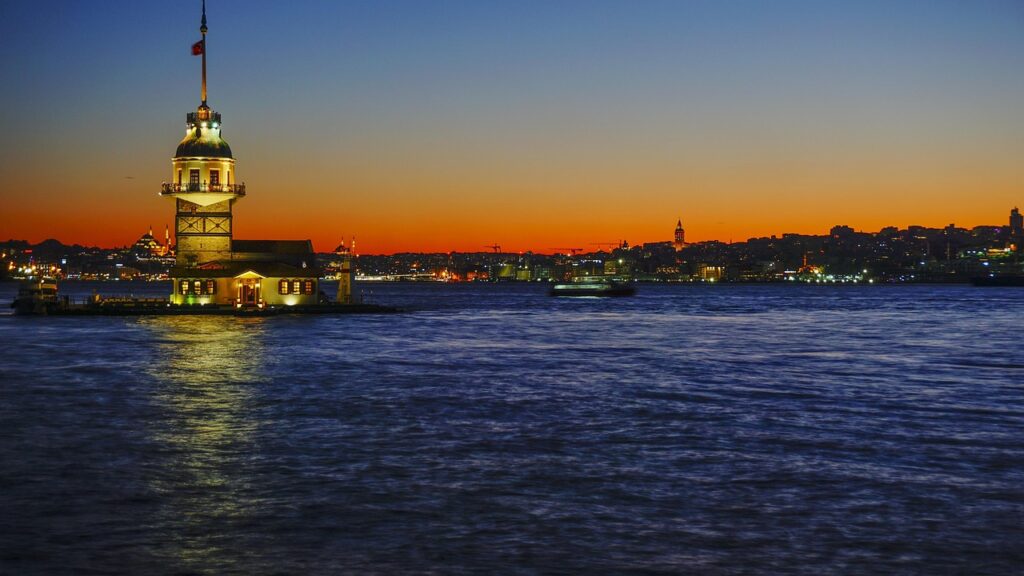
Of all the landmarks that dot the Bosphorus, none is more romantic than the Maiden’s Tower. A small stone tower on a tiny islet off the Asian shore at Üsküdar, it has stood for centuries at the point where the strait narrows, watching the ferries pass and collecting legends as it went. Its history stretches back to the ancient world, and its name carries one of the most famous stories in Turkish tradition. This guide traces the complete history of the Maiden’s Tower, from its earliest foundations to the restored landmark that welcomes visitors today.
A Rock in the Bosphorus
The tower’s story begins with its setting. The islet on which it stands lies close to the Asian shore, a few hundred meters from the coast at Üsküdar, in one of the narrowest stretches of the Bosphorus. The currents here are strong and famous.
That position made the rock valuable long before any tower stood on it. In ancient times the spot was used as a customs point, where ships passing through the strait could be watched and their cargoes checked, and the crossing here was one of the busiest in the region.
The islet was also a natural stage for defense and signaling. Whatever stood on the rock could command the shipping lane, and this simple fact explains why the site has been fortified again and again over the centuries.`n`nFor sailors the islet was a familiar landmark, a fixed point in the shifting waters, and its presence helped them judge the currents of the strait. Even before the tower existed, the rock was part of the mental map of everyone who worked these waters, a small stone reference in a landscape of sea and shore.
The Legends: The Sultan’s Daughter
The tower’s name comes from its most famous legend. According to the story, an astrologer warned a sultan that his beloved daughter would die of a snakebite, and the sultan built the tower on the rock to keep her safe from all serpents.
The princess lived in the tower, guarded and protected, until a basket of fruit arrived from the shore one day. Hidden inside was a snake, which bit the princess, and the prophecy was fulfilled despite every precaution.
The tale is told in many versions across the region, and it explains the tower’s name in Turkish, which means simply Maiden’s Tower. Whatever its origins, the legend has made the tower one of the most emotionally charged landmarks on the strait.`n`nThe details shift with each telling. In some versions the prophecy comes from a soothsayer, in others from a dream, and the snake arrives by different means, but the heart of the story never changes: no amount of love or care can defeat fate. It is a tale about protection and inevitability, and it gives the tower its soul.

The Legend of Hero and Leander
The tower carries a second, older story from the classical world. In the Greek legend of Hero and Leander, a young man named Leander swam the Hellespont each night to visit his beloved, guided by the light of her lamp, until a storm extinguished the light and drowned him.
The tale was retold by poets for centuries, and at some point the tower in the Bosphorus became tangled with the story, so that Western travelers long called it Leander’s Tower. The name persists in guidebooks even today.
The legend suits the setting perfectly. The strait, the light, the swimmers, and the lovers all belong to this narrow stretch of water, and the tower gives the ancient story a physical home in the modern city.
The Ancient Watchtower
Long before the legends, the rock was a practical place. In antiquity the area around modern Üsküdar was a settled shore, and the islet served as a station for watching the strait and collecting duties from the ships that passed.
The exact form of the earliest structures is lost to time, but the pattern is clear: a small fortified post on the rock, maintained by whichever power controlled the shore. For centuries the site was a modest but useful outpost.
That ancient role set the template for everything that followed. The rock has never been a residence or a pleasure garden; it has always been a working point in the life of the strait, from customs post to lighthouse to quarantine station.
The Byzantine Tower
The Byzantines, who ruled Constantinople for a thousand years, gave the site its first substantial fortification. In the early twelfth century the emperor Alexius Comnenus built a defensive tower on the rock, part of the system that guarded the approaches to the capital.
Later Byzantine rulers rebuilt and maintained the tower, and it joined the network of watch posts along the Bosphorus. From its top, watchers could signal approaching fleets and warn the city across the water.`n`nThe tower also belonged to the chain of defenses that protected Constantinople itself. Along with the fortresses of the strait, it formed a system that could delay an enemy fleet and buy the capital time, and its small garrison played its part in that larger story. For the Byzantines the rock was a thread in a wide net.
The Byzantine centuries were turbulent, and the tower changed hands and purposes more than once. By the end of the Byzantine era it was an old, much-repaired structure, and it was about to pass into a new world.
The Ottoman Restorations
With the Ottoman conquest in 1453, the tower entered Ottoman hands, and the new rulers were quick to appreciate its position. It served as a lookout and a defensive post, watching the strait that was now the heart of an empire.
Over the following centuries the tower was restored repeatedly. Earthquakes, storms, and the constant salt air took their toll on the small structure, and each generation of builders repaired the stone and kept the tower standing.`n`nThe Ottoman centuries also gave the tower its place in the city’s poetry and music. It appears in folk songs, in the verses of poets, and in the memory of generations who grew up watching its light on the water, so that the tower became a cultural landmark as much as a military one.
The most important Ottoman restoration came in the early nineteenth century, when Sultan Mahmud II rebuilt the tower in much the form you see today. The work gave the landmark its familiar silhouette and its place in the modern skyline.

Lighthouse, Quarantine, and Duty
As Istanbul modernized in the nineteenth century, the tower took on new duties. It served as a lighthouse, guiding the ships that passed through the busy strait, and its light became part of the nightly landscape of the Bosphorus.
The tower also played a remarkable role in public health. During the cholera epidemics of the nineteenth century, it was used as a quarantine station, isolating the sick and protecting the city, a strange and poignant chapter in the story of a building linked to a princess.
These working roles saved the tower from neglect. A structure that could be used was a structure that would be kept, and the tower’s practical services to the city ensured its survival through the transformations of the era.
The Tower in the Republican Era
With the founding of the Turkish Republic, the tower passed into the care of the state, and its modern history began. For decades it continued as a working structure, serving at times as a signal station and a landmark for shipping on the strait.
The twentieth century brought damage and repair in turn. A major fire in the mid-century damaged the tower badly, and the subsequent restoration saved it for the future, returning it to its place on the Bosphorus.
The tower also began its long association with dining and tourism during this period, as the city started to see the little building on the rock as an attraction rather than merely a utility. The seeds of its modern life were planted.`n`nThe restoration that followed the fire was a delicate operation, because the islet is exposed to the weather and the foundations stand in running water. Engineers and conservators worked on the structure and its setting together, and the tower carries the marks of that careful modern work alongside its ancient stone.

The Tower Today
Today the Maiden’s Tower is one of the most photographed landmarks in Istanbul, and after a long restoration it reopened to visitors as a museum and gathering place. Boats carry guests to the islet from the nearby shores throughout the day.
The tower now serves as a viewpoint, a venue for events, and a cafe with one of the most remarkable settings in the world. Its rooms tell the story of the legends and the centuries, and its terraces frame the Bosphorus in every direction.
For travelers, the tower is a small adventure in itself: a boat ride, an islet, and a landmark that has watched over the strait since antiquity. After all its centuries of duty, it has finally become the romantic landmark the legends always promised.`n`nThe short crossing to the islet is part of the pleasure of the visit. The boat ride gives you the tower from the water, the best possible view of its setting, and the approach lets you watch the landmark grow from a silhouette into a building, the way generations of sailors first saw it.
Frequently asked questions
Why is it called the Maiden’s Tower?
The name comes from the legend of a sultan’s daughter who was prophesied to die of a snakebite. Her father built the tower to protect her, but a snake hidden in a basket of fruit still reached her, giving the tower its name and its most famous story.
Is the Maiden’s Tower connected to the legend of Hero and Leander?
Western travelers long called it Leander’s Tower, linking it to the classical story of the lovers Hero and Leander and the swimming youth who drowned in the strait. It is a borrowed association, but the legend has stuck to the tower for centuries.
What was the tower used for historically?
The islet served as a customs point in antiquity, a Byzantine watchtower, an Ottoman lookout, a lighthouse, and even a quarantine station during the cholera epidemics of the nineteenth century. It was restored in the modern era and reopened to visitors.

All Over Information
The All Over Information editorial team researches and writes practical English-language guides to Turkey. Facts are checked against official and local sources before publication, prices are published as dated ranges rather than quotes, and guides are revised when things change. We accept no sponsored posts, paid placements or paid links.
More guides like this

Best Time to Visit Galata Tower to Avoid Crowds
Galata Tower has a crowd problem, and it is entirely of its own making: one small elevator, one narrow gallery, and millions…

Ishak Pasha Palace Through the Centuries
Few buildings in Turkey have witnessed a history as turbulent as the Ishak Pasha Palace.

Visiting Grand Bazaar: Tickets, Hours, and Tips
The Grand Bazaar is one of the great experiences of Istanbul, and it is also one of the most confusing places for…

Why Hagia Sophia Should Be on Your Turkey Bucket List
Every travel list for Turkey includes Hagia Sophia, and the lists are right. This is not a monument you visit to tick…

Best Time to Visit Dolmabahce Palace to Avoid Crowds
Dolmabahce Palace is one of Istanbul's busiest sights, and its guided-tour system means crowds are not just uncomfortable but limiting: you wait…

Why Aspendos Theatre Should Be on Your Turkey Bucket List
Every country has its must-see ruins, but few ruins anywhere in the world do what the theatre of Aspendos does: they make…