The theatre of Aspendos has been standing for nineteen centuries, and in all that time it has never quite ceased to be what it was made to be. It was built as a place of spectacle in the golden age of the Roman Empire, served the great festivals of a proud city, survived the collapse of the ancient world, was taken over and restored by the Seljuk Turks, and finally returned to performance in the twentieth century. No other ancient theatre in the world can tell that story so completely. This guide follows the theatre century by century, from its foundation to the festival nights of the present day.
The City Before the Theatre
The theatre was not the beginning of Aspendos. The city was already ancient when the theatre was built, with a history reaching back to the Greek colonization of the Pamphylian coast, and it had grown rich on its river port and its fertile plain.
The city’s coinage, stamped with the name Estwediiys, shows a community of considerable pride, and its position on the navigable Eurymedon River tied it to the trade of the eastern Mediterranean. By the Roman period, Aspendos was one of the leading cities of the region.
The theatre therefore rose in a city that was already wealthy and confident, and it was the product of that confidence. The building was one of the great public projects of the city, an expression of its prosperity and its ambition.
The Antonine Age and the Building
The theatre was built in the second century AD, in the age of the Antonine emperors, when the Roman world was at the height of its power and its cities competed to build the grandest monuments. Aspendos entered the competition in style.
The building is dated by its inscriptions, which also name its architect: Zenon, son of Theodorus, a citizen of Aspendos. The record of his name is rare and precious, and it gives the theatre a personal authorship that few ancient buildings possess.
The construction was a major undertaking for a provincial city. The stone, the labor, and the engineering all had to be organized, and the finished theatre, rising against its hill, was a statement that Aspendos ranked with the greatest cities of the age.

The Theatre in Roman Life
In its early centuries, the theatre was the center of the city’s public life. It staged the great festivals of the Roman calendar, theatrical performances, and the spectacles of the imperial cult, filling its seats with the whole population of the city.
The theatre was also a stage for the city’s social order. The seating was arranged by rank, with the elite nearest the stage, and the festivals were paid for by the leading citizens, who gained honor by their generosity. The building was where the city saw itself.
The acoustics, already noted in antiquity, made Aspendos a particularly successful venue. Performers could be heard in every row, and the theatre’s reputation spread through the region as a place where spectacle was done properly.
The Late Empire
From the third century onward, the world changed. The Roman Empire entered its long crisis, and the cities of Asia Minor, burdened by war, plague, and inflation, could no longer maintain their great buildings as before.
Aspendos declined with the age. The theatre was used less and less, the festivals became rarer, and the building began to suffer from neglect and from the earthquakes that periodically struck the region.
By the end of antiquity, the theatre was no longer the vibrant center of the city. The city itself was shrinking, and the great building, still standing, was becoming a monument to a richer past.
The Byzantine Silence
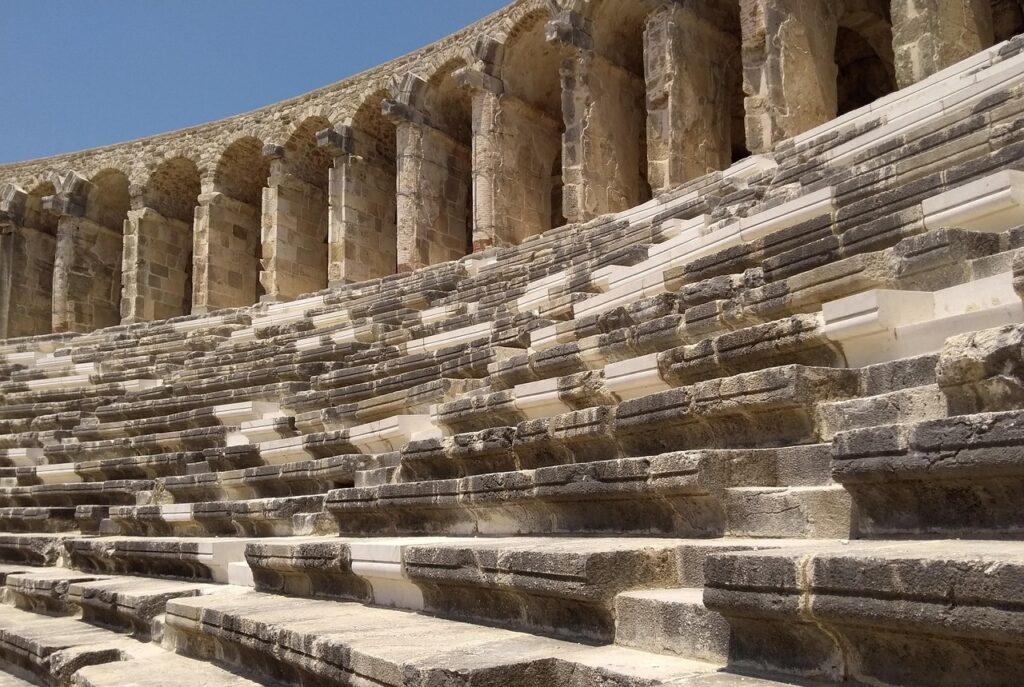
In the Byzantine centuries, Aspendos faded further. The once-great city was reduced to a modest settlement, and the theatre, though still standing, had lost its purpose, its vast spaces serving at most as a shelter and a source of stone.
The Byzantine period was one of quiet decay for the building. The stage building survived, the seating remained, but the theatre was no longer repaired or maintained, and the centuries accumulated their wear upon the stone.
Yet the theatre’s strength carried it through. The structure, built into the hill and built to last, resisted the neglect that would have destroyed a lesser building, and it emerged from the Byzantine age battered but fundamentally intact.
The Seljuk Century
The theatre’s rescue came in the thirteenth century, when the Seljuk Turks ruled the region. The Seljuk sultan Alaeddin Keykubad is recorded as having ordered the theatre restored, and the Seljuk builders repaired and strengthened the ancient structure.
The Seljuks also put the building to new use, converting parts of it into a palace and a caravanserai. The ancient theatre became a seat of Seljuk power and a resting place for travelers, and its survival was assured by its new life.
The Seljuk restoration is the hinge of the theatre’s story. Without it, the building would almost certainly have collapsed into the ruin that overtook every other ancient theatre, and the world would have lost the most complete example of Roman theatre architecture.

The Ottoman Countryside
Under the Ottomans, the theatre returned to quiet. The region around it was farmed, the ancient city was reduced to fields, and the great building stood in the countryside, part ruin and part legend, known to the people of the district.
The Ottoman centuries were gentle to the theatre in their way. No one quarried it systematically, no one rebuilt over it, and the building survived as a vast, silent presence in the landscape, admired by the occasional traveler who found it.
This long quiet is one of the reasons Aspendos is so complete today. While other ancient cities were built over or carried away, Aspendos slept in its fields, waiting for the century that would wake it.
Travelers and the Rediscovery
The rediscovery of Aspendos belongs to the travelers and scholars of the modern era. From the eighteenth and nineteenth centuries onward, European travelers visited the region and described the theatre with amazement, and their accounts made its fame international.
The identifications of the site, the reading of the inscriptions, and the first studies of the architecture built the modern understanding of the theatre. Zenon’s name, recorded over the entrances, was recovered and read again after centuries.
By the early twentieth century, Aspendos was recognized as one of the great monuments of the ancient world, and its photographs had begun to appear in books and magazines, preparing the way for its modern life.
The Twentieth-Century Rescue
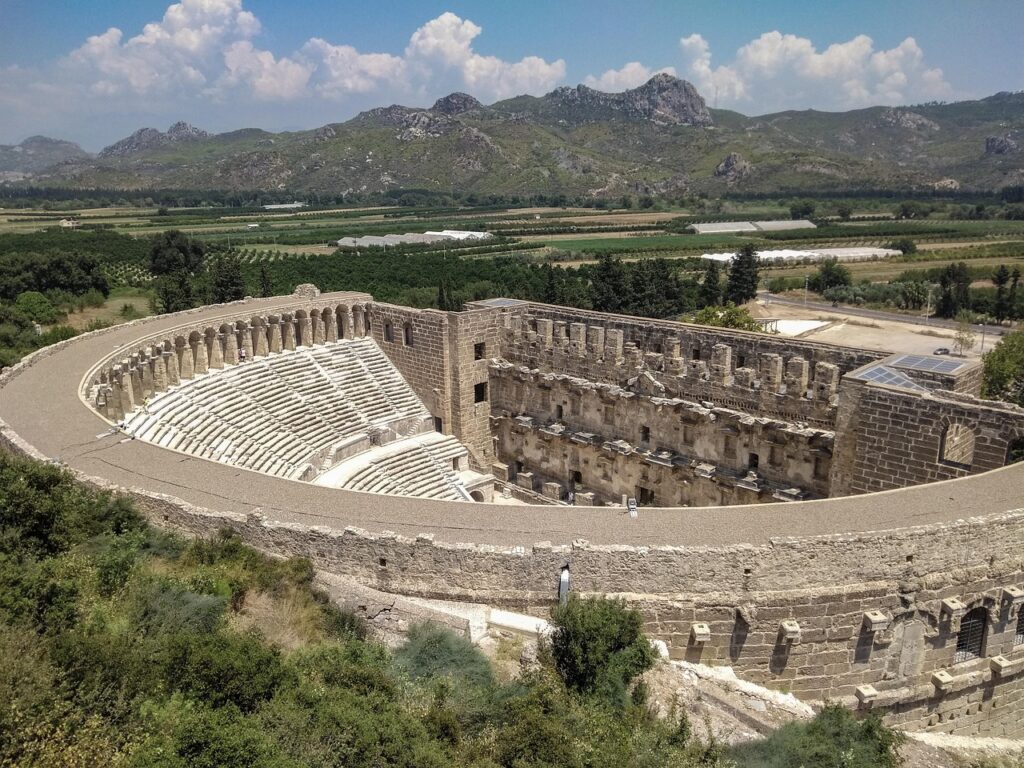
The twentieth century brought the theatre back into care. Excavations cleared the accumulated debris, restorations stabilized the structure, and the site was opened to visitors as a protected national monument of the Republic of Turkey.
The restoration work of the twentieth century was careful and sustained. The stage building was repaired, the seating was consolidated, and the theatre was made safe for the thousands of visitors who now come each year.
The greatest sign of the rescue was the return of performance. In the 1930s, Ataturk visited the region, and in the later twentieth century the theatre began to host performances again, culminating in the founding of the Aspendos Opera and Ballet Festival.
The Theatre in the Twenty-First Century
Today the theatre is at the height of its modern life. It is one of the most visited monuments of the Turkish Riviera, a landmark of the Mediterranean, and it has been placed on Turkey’s tentative list for UNESCO World Heritage status.
The summer festival fills the ancient seats with audiences, and the theatre performs the role it was built for, nineteen centuries after Zenon designed it. The building is also the subject of constant conservation, ensuring it will last for the centuries to come, and each season of performances proves that the ancient engineering remains as sound as the day it was finished.
Standing in the theatre today, you are standing at the end of a continuous story that has no parallel anywhere: a building that was made for spectacle, lost its world, was saved by new masters, and has now returned to spectacle. The centuries have given Aspendos many lives, and it has outlived them all.
The Festival Returns
The return of performance to Aspendos was the final chapter in the theatre’s long story. In the later twentieth century, the idea took hold that the best-preserved ancient theatre in the world should once again be heard, and the first modern performances filled the ancient seats.
The Aspendos Opera and Ballet Festival, founded in the 1990s, made the return permanent. International companies now perform in the theatre each summer, and the building, silent for so many centuries, once again rings with music, applause, and the sound of an audience.
For the theatre, the festival is the completion of a circle. Built for spectacle, the building has been restored to spectacle, and its ancient acoustics, designed to carry a voice to the highest rows, are serving exactly the purpose Zenon intended when he drew his plans.
Frequently asked questions
How old is the Aspendos Theatre?
The theatre was built in the second century AD, making it around nineteen centuries old. It was constructed in the Antonine age of the Roman Empire, at the height of Rome’s power, by the architect Zenon of Aspendos.
Who saved the theatre from ruin?
The Seljuk sultan Alaeddin Keykubad ordered the theatre restored in the thirteenth century, and the Seljuk reuse of the building as a palace and caravanserai protected it from collapse. Modern restoration in the twentieth century completed the rescue.
Is the theatre still used today?
Yes. The Aspendos Opera and Ballet Festival and other performances fill the theatre every summer, and its acoustics and stage are still fully functional. The theatre has been on Turkey’s tentative list for UNESCO World Heritage status since 1994.

All Over Information
The All Over Information editorial team researches and writes practical English-language guides to Turkey. Facts are checked against official and local sources before publication, prices are published as dated ranges rather than quotes, and guides are revised when things change. We accept no sponsored posts, paid placements or paid links.
More guides like this

The Complete History of Galata Tower
Galata Tower has watched over Istanbul for nearly seven centuries, and its history is a compressed version of the city's own: born…

Best Time to Visit Selimiye Mosque to Avoid Crowds
The Selimiye Mosque in Edirne is one of the easiest great monuments in Turkey to visit peacefully.

Ishak Pasha Palace Through the Centuries
Few buildings in Turkey have witnessed a history as turbulent as the Ishak Pasha Palace.

Best Time to Visit Hagia Sophia to Avoid Crowds
Hagia Sophia is Istanbul's most visited monument, and its popularity means the experience of visiting depends heavily on when you go.

Visiting Rumeli Fortress: Tickets, Hours, and Tips
The Rumeli Fortress is one of the most impressive sights on the Bosphorus, a vast medieval castle of towers and walls that…
Why Selimiye Mosque Should Be on Your Turkey Bucket List
Most travelers to Turkey fill their lists with Istanbul and the coast and never reach Edirne.