The Suleymaniye Mosque crowns the Third Hill of Istanbul, its great dome and four minarets visible across the Golden Horn from almost anywhere in the old city. Built for Suleyman the Magnificent, the longest-reigning sultan of the Ottoman Empire, and designed by Mimar Sinan, the greatest of Ottoman architects, it is the grandest statement of the empire’s golden age. More than four and a half centuries after its completion, it remains a working mosque, a tomb complex, and the architectural heart of the city. Its complete history is the history of Ottoman Istanbul in miniature.
The Sultan and the Architect
Suleyman I ruled the Ottoman Empire from 1520 to 1566, the longest reign of any Ottoman sultan, and by mid-century he commanded a realm that stretched from Hungary to Iraq and from the Crimea to North Africa. He was known to Europeans as the Magnificent and to his own people as the Lawgiver, because he reformed the empire’s legal code. A ruler of such stature required a mosque worthy of his name, and none built since the conquest had matched the scale he imagined.
His architect was Mimar Sinan, a former military engineer who had risen through the Ottoman ranks while building bridges and fortifications on campaign. Appointed chief imperial architect around 1538, Sinan had already designed hundreds of buildings. For Suleyman’s mosque he planned to surpass everything built before, and contemporaries understood that the sultan was building a monument to his own age as much as to God.
The Commissioning of 1550
The story of the mosque’s construction is told in the records of the time with unusual detail. By 1550 the site on the Third Hill had been chosen, and the sultan had assigned the project to Sinan with full authority. The hill was the highest of the city’s seven, and its position, overlooking the Golden Horn and the Bosphorus, meant the mosque would dominate the skyline of the entire peninsula.
The funding was equally grand. The sultan drew on the spoils of his campaigns, including treasure from the conquests in Hungary and Egypt, and dedicated the revenues of entire provinces to the mosque’s upkeep. Nothing like this scale of building had been attempted in the city since the conquest of 1453, and the whole empire watched as the scaffolding rose above the hill.
Building the Mosque, 1550-1557
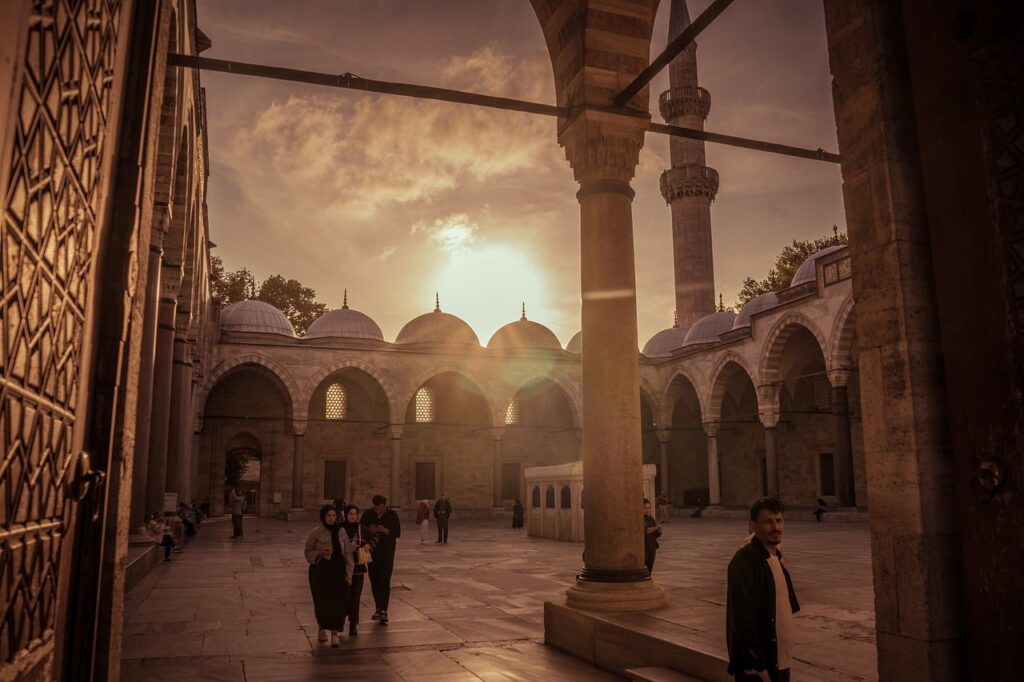
Construction began in 1550 and took seven years. Thousands of workmen, including stonemasons, carpenters, and tile makers, were employed on the site, and the building was completed with astonishing speed for its size. The great dome, more than fifty meters above the floor, was raised in 1557, and the finished mosque was ready for its inauguration in October of that year.
The project was not without its dramas. The builders quarried stone from across the empire, and the columns that support the interior were gathered from ancient sites, a practice that linked the new mosque to the classical past. Sinan himself, who was already about sixty years old, worked on the site throughout, and the mosque he produced was immediately recognized as the finest work of the age.
The Inauguration of 1557
The opening of the Suleymaniye Mosque in 1557 was one of the great ceremonies of the Ottoman century. Suleyman himself attended the first Friday prayers, and the chroniclers of the court recorded the event in lavish detail, describing the carpets, the lamps, the crowds of dignitaries, and the sultan’s progress through the courtyards. The mosque was immediately the largest and most splendid in the city, exceeding even the imperial mosques built by his ancestors.
For Suleyman, the completion was personal as well as political. His favorite wife, Hürrem Sultan, was seriously ill at the time, and he is said to have been deeply affected by the mosque’s completion. The building became the spiritual center of his capital, the place where the sultan himself came to pray on Fridays, and the symbol of his reign to every traveler who saw it.

A Complex Like a Small City
The mosque was never meant to stand alone. Around it, Sinan designed a vast complex of charitable buildings that functioned as a small city: four madrasas for religious and legal learning, a school for the study of the Quran, a medical school, a hospital, a soup kitchen for the poor, a caravanserai for travelers, a public bath, and rows of shops whose rents helped pay for it all.
The scale of this charity was enormous. Hundreds of people were employed by the foundation, from teachers and doctors to cooks and bath attendants, and every day the soup kitchen fed hundreds of the city’s poor. The complex made the Suleymaniye not just a mosque but the heart of a whole district, and the neighborhood that grew around it still bears the mosque’s name today.
The Tombs of Suleyman and Hürrem
Behind the mosque, in a garden enclosed by a high wall, stand the tombs that complete the monument. Suleyman the Magnificent died in 1566 during his campaign against the fortress of Szigetvar in Hungary, and his body was brought back to Istanbul to be buried in the great domed mausoleum that Sinan had designed for him. His wife Hürrem Sultan, who had died eight years earlier, rests in her own tomb in the same garden.
The two mausoleums are masterpieces in miniature, decorated with the finest Iznik tiles and calligraphy of the period. For visitors today they are among the most moving parts of the complex, the resting place of the couple whose story, with its slave-girl-to-empress arc, has fascinated historians and novelists for centuries. The garden around them remains a quiet, shaded corner of the bustling city.
The 17th and 18th Centuries: Fires and Earthquakes
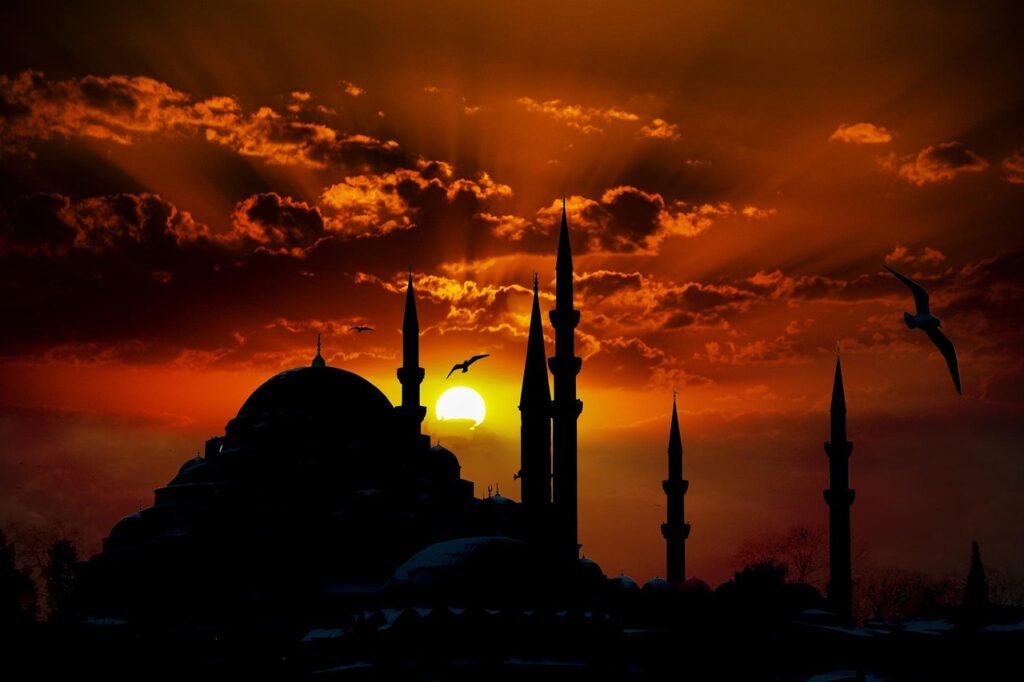
The centuries after Suleyman’s death tested the mosque. A great fire swept through the surrounding district in the seventeenth century, damaging parts of the complex, and the earthquakes that regularly shook Istanbul took their toll on the great dome and the minarets. Each disaster brought repairs, and the records of the Ottoman court show a long series of maintenance campaigns aimed at keeping the sultan’s monument sound.
The mosque survived because it was built to move with the earth. Sinan’s design, with its deep foundations and balanced weight distribution, proved remarkably resilient, and the dome that seemed so daring in 1557 proved its engineering genius time and again. By the eighteenth century the Suleymaniye had become, in the eyes of the city, a symbol of permanence itself.
The 19th Century: Restoration and Change
The nineteenth century brought modernization and another cycle of restoration. The Ottoman state, reforming itself along European lines, took renewed interest in the monuments of its past, and the Suleymaniye received a major program of repair in the middle of the century. The interior was cleaned and redecorated, and the surrounding complex began to change as the city modernized around it.
Change also came to the neighborhood. The old charitable institutions gradually lost their original functions as the modern state took over education and welfare, and the madrasa buildings began a slow transformation into other uses. The mosque itself, however, remained what it had always been: the city’s grandest house of prayer and the landmark that defined the skyline of old Istanbul.

The 20th Century: Republic and Renewal
In the early twentieth century, war came close. The surrounding district suffered damage during the First World War, and in 1918 a fire destroyed the old madrasa buildings around the mosque, which were later rebuilt and given new uses. Under the Turkish Republic, the mosque continued to function, and the state took responsibility for the great monuments of the empire, including the Suleymaniye.
The mid-twentieth century brought the most thorough restoration the mosque had yet seen. Between the 1950s and the 1970s, the building was cleaned, the dome and minarets were repaired, and the complex was gradually restored to a condition closer to its original splendor. The work was watched by the world, and by the end of the century the Suleymaniye was again, as it had been in 1557, the pride of the city.
The 21st Century: Restoration and Today
Between 2007 and 2010 the Suleymaniye Mosque was closed to visitors for the most comprehensive restoration of its modern history. The lead of the dome was renewed, the stonework was cleaned, the calligraphy was conserved, and the interior emerged from the scaffolding in the state Sinan intended. The reopening was celebrated across Turkey, and the mosque once again became a daily destination for worshippers and travelers.
Today the Suleymaniye stands at the center of a UNESCO-listed historic district, still a working mosque, still serving the neighborhood’s community, and still one of the most beautiful buildings ever raised. Its four minarets, its great dome, and its hillside setting above the Golden Horn make it, for many travelers, the finest single view in Istanbul. After four and a half centuries, the work of Sinan and Suleyman remains complete.
Frequently asked questions
Can you visit the Suleymaniye Mosque without a ticket?
Yes. Like all Turkish mosques, the Suleymaniye is free to enter, and no ticket is required. You should dress modestly, remove your shoes at the entrance, and time your visit between the five daily prayers, when the mosque is closed to visitors. A small donation to the upkeep of the mosque is appreciated but entirely optional.
Where are Suleyman and Hürrem buried?
Both are buried in the walled garden behind the mosque. Suleyman’s large domed mausoleum holds his sarcophagus and those of several of his successors, while Hürrem Sultan rests in a smaller tomb nearby, decorated with Iznik tiles. The garden is open to visitors and is one of the most atmospheric corners of the entire complex.
What is the best way to reach the Suleymaniye Mosque?
The mosque stands on the Third Hill, a short walk above the Eminönü waterfront and the Spice Bazaar. You can take the tram to the Eminönü or Beyazıt stops and climb the hill, or walk from the Grand Bazaar area. The uphill walk is the only real effort, and it rewards you with one of the best views in the city from the mosque’s terrace.

All Over Information
The All Over Information editorial team researches and writes practical English-language guides to Turkey. Facts are checked against official and local sources before publication, prices are published as dated ranges rather than quotes, and guides are revised when things change. We accept no sponsored posts, paid placements or paid links.
More guides like this

Why Galata Tower Should Be on Your Turkey Bucket List
Every Istanbul itinerary needs at least one perfect viewpoint, and Galata Tower is the strongest candidate in the city.

Anitkabir Through the Centuries
Anıtkabir is the youngest of the great monuments of Turkey — the mausoleum built in the twentieth century for the founder of…

Turkey’s Best Museums Beyond Istanbul
Istanbul has the museums everyone knows, from the great archaeological collections to the palaces and cisterns.

The Complete History of Galata Tower
Galata Tower has watched over Istanbul for nearly seven centuries, and its history is a compressed version of the city's own: born…
Visiting Aspendos Theatre: Tickets, Hours, and Tips
The theatre of Aspendos is the most complete ancient theatre in the world, and it is one of the easiest great monuments…

Basilica Cistern Through the Centuries
Few buildings can match the Basilica Cistern for the strangeness of its history.