The Suleymaniye Mosque is the great imperial mosque of the Ottoman golden age, a masterpiece by the architect Mimar Sinan set on the Third Hill of Istanbul above the Golden Horn. It is also one of the easiest major monuments in the city to visit: free to enter, rarely crowded, and surrounded by a beautiful complex of tombs, gardens, and courtyards. A little planning around prayer times and the uphill walk turns it into one of the most rewarding afternoons of any Istanbul trip. This guide covers everything you need to know before you go.
Free Entry: No Tickets Needed
The Suleymaniye is a functioning mosque, not a museum, and like all Turkish mosques it is free to enter. There is no ticket office, no admission gate, and no fee for the interior or the courtyard. You will find a small donation box near the entrance, and many visitors leave a little money to support the upkeep of the building, but it is entirely optional and no one will pressure you.
This makes the Suleymaniye one of the best-value experiences in Istanbul. The tombs behind the mosque are also free, as is the famous terrace with its view over the Golden Horn. The only costs you might face are optional: a guided tour, refreshments in the surrounding cafes, or the small fees some of the restored madrasa buildings charge for exhibitions.
Opening Hours and Prayer Closures
The mosque is open every day of the year, but the visiting hours follow the rhythm of the five daily prayers. The building closes to visitors about half an hour before each prayer and reopens roughly an hour after the prayer begins, once the service is over. Because prayer times shift with the seasons, the exact schedule changes from week to week, so checking the day’s prayer times before you set out is wise.
The longest closure is around the midday prayer on Friday, when the congregation is largest. In summer the early morning and late evening windows are long; in winter they are short. A typical visit is best planned for mid-morning or mid-afternoon, when you are least likely to collide with a closure, and you can always enjoy the courtyard and the terrace while you wait.

Dress Code and Mosque Etiquette
Mosque etiquette is simple and welcoming. Men and women should cover their shoulders and knees, and women should cover their hair with a scarf, which you can borrow free of charge at the entrance if you do not have one. You must remove your shoes before stepping onto the carpeted prayer hall and carry them in the plastic bag provided. Modesty and quiet are the only real rules.
Inside, the prayer hall is shared space. Avoid walking in front of anyone who is praying, keep conversations to a whisper, and leave your phone camera flash off out of respect. The mosque is a living place of worship, and the staff and worshippers are generally happy to see visitors who show care. The atmosphere rewards patience with one of the most beautiful interiors in the world.
Getting There: The Walk Up the Hill
The Suleymaniye stands on the Third Hill, and the walk up is part of the experience. The most scenic route starts at Eminönü, beside the Spice Bazaar and the ferries, and climbs through narrow streets lined with bookshops, tea gardens, and timber houses. From the tram stops at Eminönü or Beyazıt, the climb takes about fifteen minutes of steady walking, and the last stretch passes through the restored madrasa courtyards.
The hill also makes the mosque’s position clear. Sinan chose the highest of the seven hills so that the dome would rule the skyline, and as you climb, the city reveals itself beneath you. If the walk is difficult, taxis can bring you close to the main entrance, but most visitors find the climb, with its changing views, an essential part of the Suleymaniye experience.

The Courtyard and the Minarets
Before entering the prayer hall, take time in the great courtyard. Framed by porticoes of columns and small domes, it is one of the most elegant spaces in Istanbul, centered on a fountain where worshippers once performed their ablutions. The courtyard is where you can best appreciate the four minarets: the two flanking the prayer hall each carry three balconies, and the two at the courtyard corners carry two, ten in all.
The number is a deliberate message. Suleyman was the tenth sultan of the Ottoman dynasty, and the ten balconies of his mosque’s minarets announce that fact to the city. Look up as you cross the courtyard and you will see the calligraphy and the carved stonework of the gate, details that repay a slow approach before you even enter the building.
Inside the Prayer Hall
The interior is dominated by the great dome, which rises more than fifty meters above the floor, carried on four massive piers and lit by a ring of windows. The space is vast yet calm, its walls covered with elegant calligraphy and painted decoration rather than the dense tilework of the Blue Mosque. The contrast between the two great mosques of Istanbul is one of the pleasures of visiting both.
The mihrab, the niche that marks the direction of Mecca, is carved from marble and framed by fine tile panels, and the qibla wall holds some of the finest calligraphy of the Ottoman period. On clear days, shafts of sunlight fall through the windows and move across the carpet throughout the day. Sit quietly for a few minutes, and you will understand why this is considered Sinan’s masterpiece of light.
The Terrace View over the Golden Horn
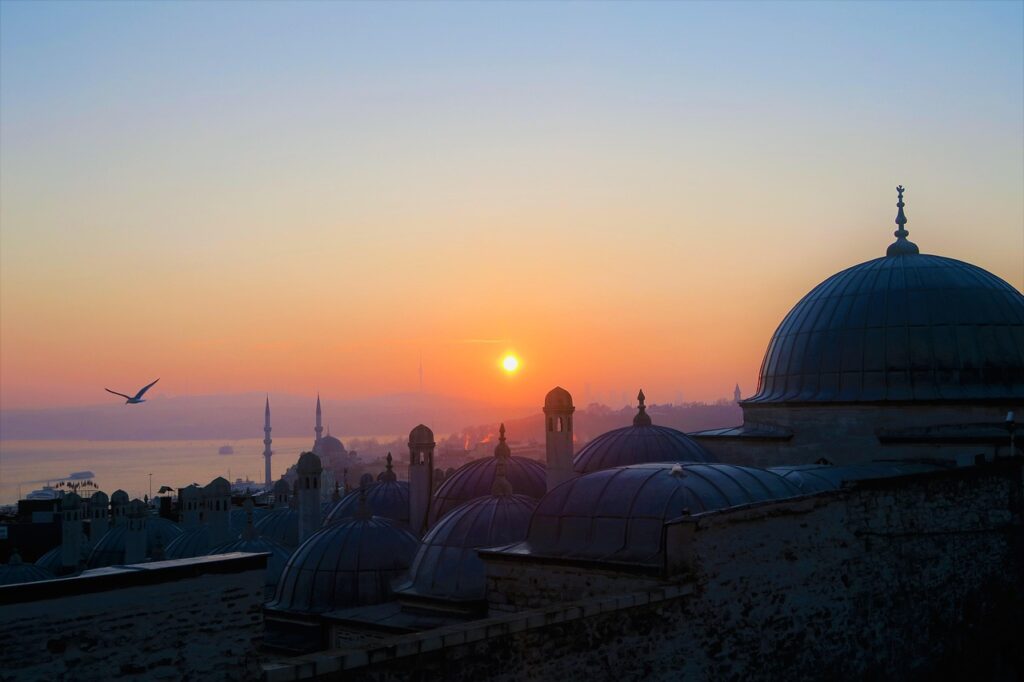
On the far side of the mosque, below the courtyard wall, a terrace overlooks the Golden Horn and the city beyond. This is one of the finest free views in Istanbul, taking in the bridges, the Galata Tower, the rooftops of the old city, and, on clear days, the Bosphorus and the islands beyond. The sunset light here is extraordinary, and photographers gather at golden hour.
The terrace is also the perfect place to understand the mosque’s siting. From below, the dome appears to float above the city; from the terrace, you see how the building was planned to dominate the landscape without blocking it. Many travelers say the view alone is worth the climb, and they are right. Bring a drink from a nearby tea garden and stay for the changing light.
The Tombs in the Garden
Behind the prayer hall, through a passage in the high wall, lies the tomb garden. Here rest Suleyman the Magnificent, who died in 1566, and his wife Hürrem Sultan, whose remarkable rise from captive to empress made her one of the most famous women in Ottoman history. Suleyman’s tomb is the larger, a domed building whose interior is decorated with tiles, calligraphy, and the turbans and textiles of the era.
The tombs are open to visitors and free, and they are among the most atmospheric places in the complex. The garden itself, shaded by cypress and plane trees, is a quiet green refuge from the city. For many visitors, the tombs transform the mosque from an architectural marvel into a place of human history, where the people behind the monument feel suddenly close.

Around the Mosque: The Complex
Around the mosque, Sinan built an entire district of charitable institutions, and many of those buildings survive. The four madrasas, arranged symmetrically around the mosque, now house shops, cafes, and cultural spaces, while the old soup kitchen, hospital, and bath stand nearby in various states of restoration. The neighborhood that grew up around the complex is itself worth an hour of wandering.
The former madrasa courtyards are especially pleasant, their arcades now home to bookshops, workshops, and tea gardens where you can rest after the climb. The street below the mosque, descending toward the Golden Horn, is lined with the shops and cafes of the old district. Visiting the Suleymaniye properly means leaving time for the complex, not just the prayer hall.
Practical Tips for a Smooth Visit
A few small decisions make the visit smoother. Go early, ideally between nine and eleven in the morning, when the light is good and the crowds are small. Wear shoes that are easy to remove, dress modestly, and carry a scarf if you want to be sure. If you arrive during a prayer closure, visit the terrace and the tombs first, then return for the interior.
Allow at least an hour and a half for the whole complex, and more if you want to explore the madrasas and the streets below. Combine the Suleymaniye with the Spice Bazaar and the Grand Bazaar, which are both downhill from the mosque, and you have a full, varied day in the old city. The mosque is one of the few great monuments of Istanbul that repays a slow visit.
Frequently asked questions
How much does it cost to visit the Suleymaniye Mosque?
Nothing. The mosque, the courtyard, the tombs, and the terrace are all free to enter, and there is no ticket to buy. A donation box is available at the entrance if you wish to support the mosque’s upkeep. The only costs you are likely to face are for guides, refreshments, or optional exhibitions in the surrounding buildings.
Do you have to dress a certain way to enter the mosque?
Yes, modest dress is expected. Men and women should cover their shoulders and knees, and women should cover their hair with a scarf, which is usually available to borrow at the entrance. Everyone removes their shoes before stepping onto the prayer carpet. Following these simple customs is appreciated and takes only a minute.
How long should you spend at the Suleymaniye Mosque?
Plan for at least an hour and a half. The prayer hall deserves twenty quiet minutes, the courtyard and minarets another twenty, and the tomb garden and terrace at least half an hour. If you also explore the madrasa courtyards and the streets around the complex, allow two hours or more for the full visit.

All Over Information
The All Over Information editorial team researches and writes practical English-language guides to Turkey. Facts are checked against official and local sources before publication, prices are published as dated ranges rather than quotes, and guides are revised when things change. We accept no sponsored posts, paid placements or paid links.
More guides like this

Why Dolmabahce Palace Should Be on Your Turkey Bucket List
Every trip to Turkey needs its defining moments, and few places deliver them like Dolmabahce Palace.

Why Blue Mosque Should Be on Your Turkey Bucket List
Every Istanbul itinerary includes the Blue Mosque, and the clichés are all true.

Visiting Sumela Monastery: Tickets, Hours, and Tips
Sumela Monastery is not an easy visit, and that is exactly why it is unforgettable.

Best Time to Visit Maiden’s Tower to Avoid Crowds
The Maiden's Tower is a small site with a big reputation, and its crowds are limited by the water: only the people…

Why Aspendos Theatre Should Be on Your Turkey Bucket List
Every country has its must-see ruins, but few ruins anywhere in the world do what the theatre of Aspendos does: they make…
Best Time to Visit Chora Church to Avoid Crowds
The Chora Church — the Kariye — is one of the great monuments of the Byzantine art, and the visitors of the…