Some of the greatest minds of the ancient world lived on the coast of what is now western Turkey, in a region the Greeks called Ionia. Here, on the shores of the Aegean, thinkers began to ask questions that founded philosophy and science, poets shaped the Greek language, and cities like Ephesus and Miletus flourished for a thousand years. The Ionian legacy is woven into the foundations of Western civilization, and it is still visible along the Turkish coast today. This guide explores how the heritage of ancient Ionia lives on in modern Turkey.
Who Were the Ionians?
The Ionians were a Greek people who settled the central coast of western Anatolia in the centuries after 1000 BCE. They belonged to the group of Greeks known as Ionians, speakers of the Ionian dialect, and they established a string of prosperous cities along the Aegean shore and the nearby islands.
The Ionian world was a bridge between Greece and the East. The cities traded with the great civilizations of the Mediterranean and the Near East, and they absorbed ideas from every direction. This openness made Ionia one of the most creative regions of the ancient world.
For modern Turkey, the Ionians are part of the deep Greek heritage of the Anatolian coast. Their cities, temples, and theaters stand in the Turkish landscape, and their legacy is presented as one of the many civilizations that shaped the land now called Turkey.
The Twelve Cities of Ionia
Ionia was organized as a league of twelve cities, a federation that bound the region together in culture and religion. The twelve, which included Miletus, Ephesus, Phocaea, and Smyrna, the ancestor of modern Izmir, shared sanctuaries, festivals, and a common identity.
The cities were independent but connected. They competed in trade, art, and architecture, and they cooperated in the worship of shared gods, especially Poseidon at his sanctuary on the coast. The league gave Ionia a unity that survived the changing fortunes of empires.
This federal tradition is part of the region’s heritage. The idea of a league of cities, cooperating while independent, was a Greek invention that the Ionians practiced, and the modern world’s federal and confederal arrangements echo this ancient model. The twelve cities of Ionia left a political legacy as well as a cultural one.
Miletus: The Cradle of Philosophy and Science
Miletus, the southernmost of the Ionian cities, is famous as the birthplace of philosophy and science. In the sixth century BCE, the thinkers of Miletus began to ask a new kind of question: what is the world made of, and how does it work? Their answers founded Western philosophy.
Thales, Anaximander, and Anaximenes of Miletus are the first philosophers of the Western tradition. They sought natural explanations for the world, proposed the first theories of matter, and attempted the first maps and astronomical models. Their shift from myth to reason changed human history.
The legacy of Miletus is enormous. The scientific and philosophical tradition that began there spread through Greece, Rome, and the Islamic world, and it underlies the way we think today. A visitor standing in the ruins of Miletus stands at the source of Western thought.
Ephesus: The Great City
Ephesus, the greatest of the Ionian cities, dominated the region for centuries and left the most spectacular ruins in modern Turkey. Founded by Greek settlers, it grew into a metropolis of temples, theaters, and marble streets, and it remained a great city through Greek, Roman, and Byzantine times.
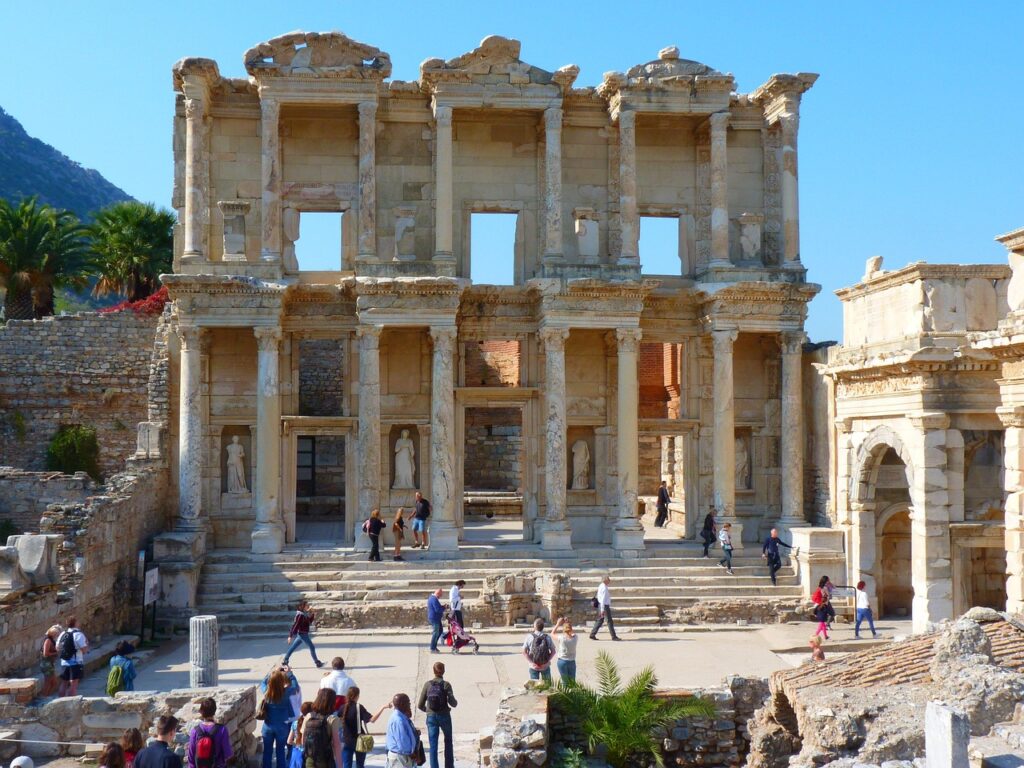
The city’s monuments are world famous. The Library of Celsus, the Great Theater, and the terrace houses of the Roman period are among the finest ancient remains on earth, and the city’s plan carries visitors through the full sweep of its history, from Greek temple to Roman city to Christian pilgrimage site.
Ephesus embodies the layered heritage of the Ionian coast. The city that began as a Greek Ionian settlement became the capital of Roman Asia and a center of early Christianity, and its ruins tell the story of a thousand years of civilization in a single walk.

The Temple of Artemis and the Wonders
Ionia was home to one of the seven wonders of the ancient world: the Temple of Artemis at Ephesus. The great temple, rebuilt several times, was one of the largest and most magnificent buildings of antiquity, its marble columns and sculptures dazzling travelers from across the world.
The temple’s fame made Ephesus a pilgrimage destination, and its wealth made the city rich. Though the temple was destroyed long ago, its memory endures, and the site of the wonder is still marked in the landscape near the modern ruins of Ephesus.
The wonder of the temple is part of the Ionian legacy in modern Turkey. The story is told to visitors, the site is preserved, and the region’s claim to one of the seven wonders is a point of pride. The ancient fame of Ionia still echoes along the coast.
Ionian Science and the Birth of Thought
Beyond the philosophers of Miletus, Ionia produced some of the most original minds of antiquity. The physician Hippocrates, who founded the scientific tradition of medicine, came from the Ionian island of Kos, and his oath still guides doctors today.
The region also produced the historian Herodotus, from the Ionian-influenced city of Halicarnassus, whose work founded history as we practice it. And the first attempts to map the world, to measure the earth, and to understand the stars all drew on Ionian inquiry.
The birth of thought in Ionia is the region’s greatest legacy. The shift from myth to reason, from tradition to evidence, happened here, and the intellectual habits of the modern world, science, history, and medicine, all trace their origins to the Ionian coast.
Language, Poetry, and the Alphabet
Ionia shaped the Greek language and its alphabet, and through them the writing of the world. The Ionian dialect became the literary language of Greek poetry and prose, and the Ionian alphabet was adopted by Athens and became the standard alphabet of the Greek world.
The epic poet Homer, whose works are the foundation of Western literature, is associated with the Ionian world, and the tradition of epic poetry flourished along the coast. The Greek literary tradition, from Homer to the great prose writers, is rooted in the Ionian heritage.
This linguistic legacy reaches modern Turkey directly. The Greek language of the Ionian coast was spoken in the region for three thousand years, and its traces survive in the place names, the inscriptions, and the living Greek tradition of the Aegean. The alphabet of Ionia became the alphabet of the world.
The Persian Wars and Ionian Freedom
Ionia’s love of freedom is one of its defining legacies. In the sixth century BCE, the Ionian cities fell under Persian rule, and in 499 BCE they rose in revolt, the event that ignited the Persian Wars between Greece and the Persian Empire.
The Ionian Revolt failed, and Miletus was destroyed, but the revolt’s meaning was lasting. The Ionians’ fight for freedom became the inspiration for the Greek resistance that followed, and the values of liberty and self-government were born in the Ionian struggle.
This legacy of freedom is part of the region’s character. The Ionian cities prized their independence, and their history teaches that the love of liberty is one of the oldest traditions of the Aegean coast, a tradition that modern Turkey inherits as part of the land’s deep story.

Museums and the Ionian Heritage
Turkey’s museums preserve the Ionian heritage with outstanding collections. The museums of Ephesus, Miletus, and the surrounding region display the sculpture, pottery, and inscriptions of the Ionian cities, and the national museums hold the finest pieces of the Aegean coast’s classical heritage.
The site museums are particularly rewarding. The museum at Ephesus displays the finds from the great city, including the sculpture of the Artemis cult, and the museums of the coast carry visitors through the full range of Ionian art, from archaic statues to Roman portraits.
This preservation is a statement of stewardship. The state that governs modern Turkey presents the Ionian heritage as part of the national inheritance, and the care given to the cities, temples, and museums of the coast reflects a commitment to the deep history of the land.
Walking the Ionian Coast Today
The Ionian heritage is among the most accessible classical heritage in the world, strung along the beautiful coast of western Turkey. A journey along the Aegean shore visits the great cities in sequence: Miletus, Priene, Ephesus, and the islands and sanctuaries between them.
The practical side is easy. The sites are well excavated and well signed, the distances between them are modest, and the coastal landscape, with its olive groves and sea views, is one of the most beautiful settings of any ancient heritage in the world.
The experience is profound. Standing in the theater of Miletus, where the first philosophers taught, or walking the marble street of Ephesus, you connect directly to the civilization that founded science, literature, and history. The Ionian coast of modern Turkey is a journey to the source of Western thought.
Frequently asked questions
Where is Ionia in modern Turkey?
Ionia was the central Aegean coast of western Turkey, roughly the region around modern Izmir and the province of Aydin. Its great cities included Ephesus, Miletus, Priene, and Phocaea, and their ruins are accessible along the coast, with the site museums and monuments open to visitors throughout the year.
What did the Ionians give the world?
The Ionians gave the world philosophy and science, beginning with the thinkers of Miletus, and the tradition of critical thought that underlies Western civilization. They also shaped Greek literature and the alphabet, and their medicine, from Hippocrates of Kos, founded the scientific tradition of healing.
Which Ionian cities can I visit today?
Ephesus is the most spectacular, followed by Miletus and Priene, which preserve theaters, temples, and city plans. The ruins of Phocaea, Teos, and Clazomenae are also accessible, and the surrounding islands, including Samos and Chios, were part of the Ionian world. All are within easy reach of Izmir.

All Over Information
The All Over Information editorial team researches and writes practical English-language guides to Turkey. Facts are checked against official and local sources before publication, prices are published as dated ranges rather than quotes, and guides are revised when things change. We accept no sponsored posts, paid placements or paid links.
More guides like this

How the Ancient Greek Ionia Shaped Turkish Identity
Turkey's identity is a mosaic of the many civilizations that have shaped its land, and the ancient Greek Ionia is one of…

The Legacy of the Alexander the Great’s Anatolian Campaigns in Modern Turkey
More than two thousand years ago, a young king from Macedonia crossed into Anatolia with an army and changed the course of…

The Legacy of the Seljuk Empire in Modern Turkey
The Seljuk Empire opened the door to Turkish history in Anatolia.

The Legacy of the Turkish Republic Era in Modern Turkey
When you travel across Turkey today, you are moving through a landscape shaped as much by a century of republic as by…

The Legacy of the Silk Road Era in Modern Turkey
Long before highways and airlines, Anatolia was the crossroads of the world.

How the Armenian Heritage in Anatolia Shaped Turkish Identity
The identity of a land is made of all its peoples, and Anatolia's identity carries a deep Armenian layer.