Ancient Greek Ionia is one of the most important regions you have never studied in detail, and its story is astonishing. On the coast of what is now western Turkey, a group of Greek cities produced the first philosophers, the founders of science, and some of the greatest poets and artists of the ancient world. The ruins of their cities, at Ephesus, Miletus, and Priene, are among the most beautiful in modern Turkey. This beginner’s guide explains what Ionia was, who the Ionians were, and why they changed the world.
What Was Ancient Greek Ionia?
Ancient Greek Ionia was a region of Greek cities on the central Aegean coast of Anatolia, the peninsula that is now Turkey. The Ionians were Greeks, speakers of the Ionian dialect, who settled this coast in the centuries after 1000 BCE and built a chain of prosperous cities.
The region was Greek but at the edge of the Greek world, facing the great civilizations of the East. This position made Ionia a meeting place, where Greek culture encountered the ideas of the Near East, and the exchange produced an extraordinary burst of creativity.
For a beginner, the simplest way to think of Ionia is as the birthplace of Western thought: a small region, a handful of cities, and a civilization that asked the questions that founded philosophy and science. Its importance is out of all proportion to its size.
Where Was Ionia?
Ionia occupied the central part of the Aegean coast of Turkey, roughly the region around the modern city of Izmir and extending south toward the Meander River. The region was about 150 kilometers of coastline, backed by fertile valleys and fronted by the sea, with a mild climate and rich soil that made the Ionian cities unusually prosperous.
The great Ionian cities were strung along this coast and on the nearby islands. From north to south they included Phocaea, Clazomenae, Smyrna, the ancestor of Izmir, Ephesus, Colophon, and Miletus, and the islands of Samos and Chios were part of the Ionian world.
The geography shaped the Ionian character. The coast faced the Aegean and the Greek world, while the interior connected to the great empires of the East, and the Ionians drew on both worlds. The landscape of modern western Turkey, with its bays, islands, and olive groves, is the landscape of Ionia.

The Settlement of the Ionian Coast
The Ionian settlement of the Anatolian coast began in the centuries after 1000 BCE, when Greek-speaking peoples crossed the Aegean and established cities on the coast. The settlers came in waves, founding the cities that would become the Ionian league.
The settlement was part of the great Greek colonization of the Mediterranean world. Like the Greeks who settled Italy and Sicily, the Ionians carried their language, religion, and institutions to new shores, and they built cities that rivaled those of the homeland.
The new cities prospered. The coast was fertile, the harbors were good, and the position was ideal for trade, and within a few generations the Ionian cities were among the wealthiest and most cultured in the Greek world, their merchants and artists known across the Mediterranean. The settlement of the coast set the stage for Ionia’s golden age.
The Ionian League
The Ionian cities were bound together in a league, one of the earliest federations in history. The league, traditionally twelve cities, united the Ionians in religion and politics, and its members shared sanctuaries and festivals that strengthened their common identity.
The most important sanctuary of the league was the Panionion, dedicated to Poseidon, where the cities gathered for worship and discussion. The league had no single ruler; the cities were independent, and they cooperated as equals, a striking experiment in self-government.
The Ionian League left a lasting legacy. The idea that independent cities could unite in a common organization, without losing their freedom, was an Ionian invention, and it foreshadowed the federal ideas that shape the modern world. The league is part of the political genius of Ionia.

Miletus and the Birth of Philosophy
Miletus, the greatest city of early Ionia, is remembered as the birthplace of philosophy. In the sixth century BCE, the thinkers of Miletus began to ask a new kind of question about the natural world, and their answers marked the beginning of Western philosophy and science.
Thales of Miletus is usually named the first philosopher. He predicted an eclipse, sought the underlying substance of the world, and began the tradition of natural explanation. His successors, Anaximander and Anaximenes, developed the first theories of matter, motion, and the cosmos.
The revolution was enormous. Instead of explaining the world through myth and gods, the Milesians sought natural causes, and this shift from myth to reason became the foundation of science. Every scientist and philosopher today stands in a tradition that began in Miletus.
The Great Cities: Ephesus and Beyond
Beyond Miletus, Ionia was home to a series of great cities, each with its own character and achievements. Ephesus became the largest and most splendid, a city of temples, theaters, and commerce that remained great for a thousand years.
Smyrna, the ancestor of Izmir, was a major port; Phocaea founded colonies as far away as France and Italy; and the island cities of Samos and Chios were centers of trade, art, and shipbuilding. Each city contributed to the brilliance of the Ionian world.
The cities also competed, and the competition was creative. They built ever grander temples, produced ever finer art, and patronized poets and thinkers, and the rivalry raised the whole region’s achievement. The ruins of these cities, scattered along the Turkish coast, preserve the evidence of that golden age.

Ionian Art and Architecture
Ionia was a center of Greek art and architecture, and its achievements shaped the Greek world. The Ionians developed the Ionic order of architecture, with its graceful scroll capitals, and their temples were among the most magnificent in the ancient world.
The Temple of Artemis at Ephesus, one of the seven wonders, was the greatest of the Ionian temples, and the sculpture of Ionia, with its graceful figures and flowing drapery, set standards for Greek art. Ionian artists were prized across the Mediterranean.
The artistic legacy is visible today in the ruins and the museums of the Turkish coast. The columns, the sculpture, and the city plans of the Ionian cities are among the treasures of world art, and they show the refinement and beauty of the Ionian achievement.
Ionian Trade and Wealth
Trade was the foundation of Ionian wealth. The cities of the coast controlled the exchange between the Aegean world and the interior of Anatolia, and their harbors handled goods from across the Mediterranean and the East.
The Ionians were also the great sailors of the Greek world. The ships of Phocaea explored the western Mediterranean, the traders of Samos and Chios carried Greek goods everywhere, and the Ionians founded colonies along the shores of the sea they sailed.
The wealth of Ionia made its civilization possible. The prosperity of the cities funded the temples, the art, and the leisure that allowed philosophy to flourish, and the trade routes of Ionia carried Greek culture, its pottery, its sculpture, and its ideas, to the wider world. The commercial genius of Ionia underwrote its intellectual glory.
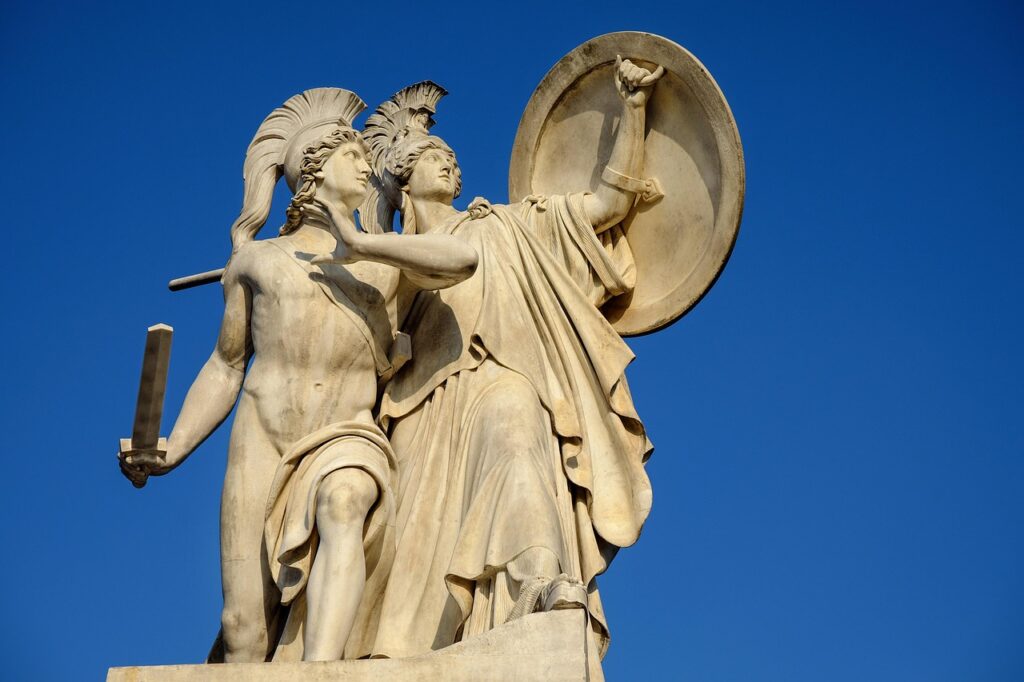
The Ionian Revolt and Persian Wars
Ionia’s history took a dramatic turn in the sixth century BCE, when the region fell under the rule of the Persian Empire. The Ionian cities lost their freedom, and in 499 BCE they rose in revolt, one of the most consequential events of the ancient world.
The Ionian Revolt failed. Miletus was destroyed, and the Persians punished the rebels, but the revolt drew the Persian Empire into conflict with mainland Greece, and the Persian Wars that followed decided the future of Western civilization.
The Ionian struggle left a lasting legacy of freedom. The revolt became the symbol of Greek resistance to tyranny, and the values of liberty and self-government that the Ionians fought for became the ideals of the Western tradition. Ionia’s defeat was followed by its immortal fame.
The Legacy of Ionia
The legacy of Ionia is one of the most important in history. The region gave the world philosophy, science, medicine, and history, the very disciplines of thought that define the modern mind, and its art and architecture shaped the classical tradition.
The legacy passed through Greece and Rome into the wider world. The questions the Ionians asked, the methods they developed, and the values they held became the foundation of Western civilization, and they remain alive in every laboratory, library, and courtroom today.
For the visitor to modern Turkey, the legacy is wonderfully accessible. The ruins of the Ionian cities, the museums of the coast, and the beauty of the Aegean landscape all preserve the memory of the region that began the adventure of human thought, and walking among them is walking to the source.
Frequently asked questions
When did Ionia flourish?
Ionia flourished from its settlement after 1000 BCE through the archaic and classical periods, with its golden age of philosophy in the sixth century BCE. The cities continued as major centers through Roman times, and Ephesus remained great for a thousand years. The ruins span a millennium of history.
Why was Ionia so important?
Ionia was the birthplace of philosophy and science, beginning with the thinkers of Miletus, and it shaped Greek literature, art, and architecture. Its revolt against Persia ignited the Persian Wars, and its values of freedom influenced the Western tradition. A small region, it changed the course of civilization.
What happened to the Ionian cities?
The Ionian cities declined gradually after the Hellenistic period, as trade shifted and silting closed their harbors. Ephesus endured longest, as a Roman and Byzantine city, but the others faded into ruins. Their remains, preserved and excavated, now form some of the most beautiful ancient sites in Turkey.

All Over Information
The All Over Information editorial team researches and writes practical English-language guides to Turkey. Facts are checked against official and local sources before publication, prices are published as dated ranges rather than quotes, and guides are revised when things change. We accept no sponsored posts, paid placements or paid links.
More guides like this

Turkish Cinema’s Rise on the Global Stage
Turkish cinema has moved from the local screens to the world stage in a remarkable few decades.

Understanding the Sufi Mevlevi Tradition
The Mevlevi tradition, known to the world through the whirling dervishes, is one of the great spiritual currents of Islam and one…

Understanding the Ottoman Naval History: A Beginner’s Guide
The Ottoman Empire was a land power that became a sea power, and its navy carried its flag across three seas for…

A Deep Dive into Turkish Superstitions
Turkish superstition is a vast and living tradition that reaches back through millennia of Mediterranean, Anatolian, and Islamic belief.

Turkish Football Clubs and Their Rivalries
Football is the great passion of Turkey, and its rivalries are among the most intense in the world. The clubs of Istanbul…

Best Turkish Movies to Watch Before Visiting
Watching Turkish films before a trip is the best preparation you can give yourself.