The Seljuk Empire is the great missing chapter in most people’s knowledge of Turkish history, and it is one of the most important. Before the Ottomans built their vast empire, the Seljuks opened Anatolia to the Turkish world and created the civilization that the Ottomans inherited. Their victory at Manzikert, their capital at Konya, and their beautiful stone architecture set the stage for everything that followed. This beginner’s guide explains who the Seljuks were, how their empire rose and fell, what they achieved, and why they matter, in plain terms from the steppes to the sultanate.
What Was the Seljuk Empire?
The Seljuk Empire was a Turkish state that rose to power in the eleventh century and became the leading power of the Islamic world. It took its name from its ancestor Seljuk, and its rulers, known as sultans, built an empire that stretched from Central Asia to the Mediterranean Sea.
The Seljuks were part of the great movement of Turkic peoples from the steppes of Central Asia. They converted to Islam and became its fierce defenders, defeating rivals, expanding their territory, and creating a state that united much of the Islamic world under Turkish leadership.
The empire had two main phases. The Great Seljuk Empire ruled the Middle East from Persia, and the Sultanate of Rum ruled Anatolia. For a beginner, the simplest way to think of the Seljuks is as the first great Turkish empire, and the bridge between the steppe world and the civilizations of the Middle East.
The Rise from Central Asia
The Seljuk story begins on the steppes of Central Asia, where the Turkic peoples had long lived as herders and warriors. In the tenth century, the clan of Seljuk migrated westward, moving into the lands of the Islamic world, where they embraced Islam and entered the service of local rulers.
The Seljuks rose quickly through ability and ambition. Their warriors proved superior to their rivals, and their leaders built alliances that carried them into the heart of the Islamic world. By the mid-eleventh century, they had become the dominant military power of the region.
The rise culminated in the conquest of Persia. In the 1040s and 1050s, the Seljuk leader Tughril took control of the great cities of Persia and received the title of sultan from the caliph of Baghdad, the spiritual leader of Islam. The Seljuk Empire had arrived.

The Great Seljuk Empire
The Great Seljuk Empire, centered on Persia, became the leading state of the Islamic world in the eleventh century. Its sultans ruled from Isfahan and other great cities, controlling territory that stretched from Central Asia to the Mediterranean and the Arabian Peninsula.
The Great Seljuks are remembered for their revival of Sunni Islam. They patronized scholars, built madrasas, and defended the orthodox faith against its rivals, and their empire became the center of Islamic learning and culture. The great poet and mathematician Omar Khayyam lived under their rule.
The empire also faced serious challenges. The Crusades arrived in its territories in 1096, and internal conflicts among the sultans’ heirs weakened the state. But the Great Seljuk achievement was lasting: a Turkish dynasty had become the leading power of the Islamic world, and the pattern was set for the centuries that followed.
The Battle of Manzikert
The Battle of Manzikert in 1071 is the pivotal event of Seljuk history and of Turkish history in Anatolia. The Seljuk sultan Alp Arslan met the Byzantine emperor in battle in eastern Anatolia, and the result was a stunning Seljuk victory. The emperor was captured, and the Byzantine army was destroyed. The battle took place in the summer of 1071, and its outcome was decided by Seljuk cavalry skill against a Byzantine army exhausted by months of campaigning.
The consequences were enormous. With Byzantine power broken in the east, Turkish tribes entered Anatolia in waves, settling the land that had been the heartland of the Christian empire. Within decades, Anatolia was becoming a Turkish and Islamic land.
For the Turks, Manzikert is the founding moment of their presence in Anatolia, the event that made modern Turkey possible. The battle is taught in every Turkish school, and the Seljuk victory is remembered as the opening of the long Turkish history in the peninsula.

The Sultanate of Rum
The Sultanate of Rum was the Seljuk state in Anatolia, and it is the Seljuk inheritance that matters most for modern Turkey. Founded in the late eleventh century, it grew into the dominant power of the peninsula, ruling from its capital at Konya over two centuries.
The name Rum, meaning Rome, reflected the sultans’ claim to the lands of the Roman world. The sultanate absorbed Byzantine territories, built new cities, and created a distinctive Anatolian Turkish civilization that combined Islamic faith with the region’s deep heritage.
The Sultanate of Rum reached its height in the thirteenth century, when Konya was a center of culture and trade and the sultans were patrons of architecture and learning. This was the world of the great caravanserais, the tile-covered madrasas, and the mystic Rumi. The thirteenth century was the sultanate’s golden age, a time of relative peace and prosperity that allowed the arts and commerce to flourish together.
Konya: Capital of the Sultanate
Konya, the capital of the Sultanate of Rum, is the city that best preserves the Seljuk world. For two centuries it was the political and cultural heart of Anatolia, and its Seljuk monuments survive in remarkable number and beauty, making the city a living museum of the era.
The city’s great buildings date from the Seljuk golden age. The Alaeddin Mosque crowns the central hill, the Karatay and Ince Minare madrasas display the finest Seljuk stone carving and tile work, and the city’s other monuments, from tombs to baths, preserve the Seljuk cityscape.
Konya is also the city of Rumi, the great mystic who made it his home and whose mausoleum is the city’s spiritual center. For visitors, Konya offers the most complete encounter with the Seljuk world: its architecture, its learning, and its faith.

Seljuk Art and Architecture
Seljuk art and architecture are the most beautiful legacy of the empire. The signature of the style is the monumental stone portal, carved with intricate geometric patterns, and the Seljuk builders carried the tradition across Anatolia in mosques, madrasas, and caravanserais.
The Seljuks were masters of tile as well as stone. Their glazed turquoise tiles, covering domes, walls, and interiors, created some of the most luminous surfaces in Islamic art, and the tile tradition they developed became a hallmark of Turkish architecture for centuries.
The caravanserais are the most distinctive Seljuk buildings. Built along the trade routes, they provided shelter for travelers and their animals, and the great examples, like Sultanhan, are vast and beautiful. They show the Seljuk genius for combining beauty with practical purpose.
The Seljuk Economy and Trade
The Seljuk Empire was a trading state, and its economic legacy shaped Anatolia. The sultans understood that trade meant wealth, and they invested in the roads, bridges, and caravanserais that made long-distance commerce possible and safe.
The trade routes crossed Anatolia from east to west, connecting the markets of the East with the Mediterranean world. Seljuk cities grew rich on this traffic, and the empire’s stability made the routes profitable for merchants and for the state itself.
The commercial culture of the Seljuks left a lasting mark. The Anatolian cities that flourished under Seljuk rule remain economic centers, and the caravanserai tradition of hospitality survives in Turkish culture. The Seljuk investment in trade built the commercial bones of the land.

Sufism and Rumi
The Seljuk centuries were the golden age of Sufism, the mystical tradition of Islam, and its greatest figure lived in Seljuk Konya. The poet and mystic Rumi, known as Mevlana, wrote his masterworks under the patronage of the Seljuk sultans.
Rumi’s message of love and tolerance made him one of the most beloved poets in history, and his influence has spread around the world. His followers founded the Mevlevi order, known for the whirling dervishes, and the order’s ritual continues to be performed in Konya today, where visitors can watch the whirling ceremony with its music and turning dancers.
The Seljuk patronage of Sufism left a profound spiritual inheritance. The mystical tradition shaped Turkish religious culture, and the values of love and openness that Rumi preached remain part of how Turkey presents itself to the world. The Seljuk legacy is spiritual as well as architectural.
The End of the Seljuk World
The Seljuk world came to an end through a combination of invasions and internal decay. The Mongol invasions of the thirteenth century devastated the region, and the Sultanate of Rum, weakened and divided, could not survive the storm. The Seljuk state collapsed in the late thirteenth century.
The collapse did not end the Turkish presence in Anatolia. The Seljuk lands fragmented into smaller Turkish principalities, called beyliks, and out of one of these, in the far northwest of the peninsula, grew the state that would become the Ottoman Empire.
The Seljuk legacy passed into the Ottomans and into Turkey. The architecture, the trade networks, the religious culture, and the Turkish presence in Anatolia all survived the empire that created them. The Seljuk world ended, but its inheritance became the foundation of everything that followed.
Frequently asked questions
Who were the Seljuks?
The Seljuks were a Turkish dynasty that rose in the eleventh century to become the leading power of the Islamic world. They came from Central Asia, conquered Persia, and defeated the Byzantines at Manzikert in 1071, opening Anatolia to Turkish settlement. Their Sultanate of Rum ruled Anatolia for two centuries from Konya.
What happened at the Battle of Manzikert?
In 1071, the Seljuk sultan Alp Arslan defeated a Byzantine army at Manzikert in eastern Anatolia and captured the emperor. The victory broke Byzantine power in the east and allowed Turkish tribes to enter and settle Anatolia, making possible the Turkish homeland that became modern Turkey.
How did the Seljuk Empire end?
The Mongol invasions of the thirteenth century devastated the Seljuk world, and the weakened Sultanate of Rum collapsed by the end of the century. Its lands fragmented into smaller Turkish principalities, and from one of these, in northwestern Anatolia, the Ottoman Empire rose to carry the Turkish story forward.

All Over Information
The All Over Information editorial team researches and writes practical English-language guides to Turkey. Facts are checked against official and local sources before publication, prices are published as dated ranges rather than quotes, and guides are revised when things change. We accept no sponsored posts, paid placements or paid links.
More guides like this
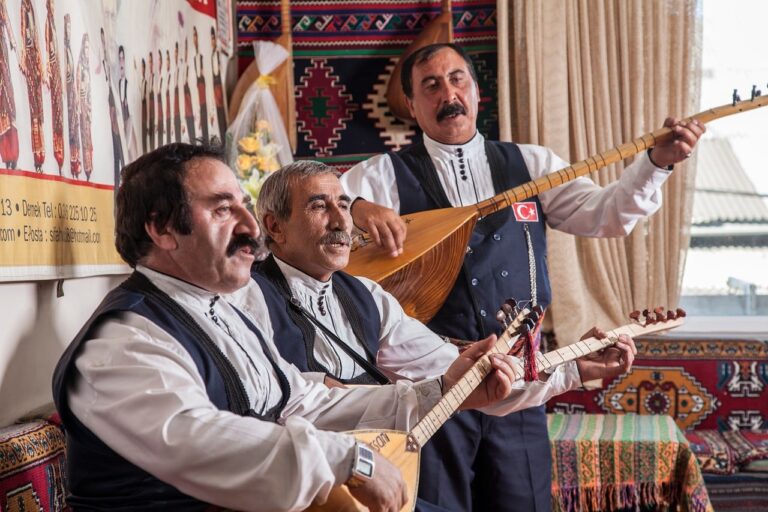
Traditional Instruments in Turkish Folk Music
The instruments of Turkish folk music carry the sound of the land itself.

Turkish Coffee Fortune Telling Explained for Foreigners
You are sitting at the end of a Turkish meal, and the coffee arrives in a small cup, strong and dark. Then…

Understanding Turkish Barbershop Culture
If you spend any time in Turkey, you will notice the barbershops on nearly every street corner, their windows polished, their chairs…

Armenian Heritage Sites in Turkey
Long before the modern borders were drawn, the lands of eastern Turkey were the heartland of Armenian civilization.

Understanding the Turkish Calendar and Holidays
Turkey runs on two calendars at once, and holidays arrive on both of them.

How the Turkish Republic Was Founded
The Republic of Turkey was not born in a single moment.