Few crafts announce Turkey more beautifully than its ceramics. The tiles that cover the great mosques of Istanbul, the blue-and-white plates that grace museum collections, and the painted pottery sold in every bazaar all descend from one of the world’s great ceramic traditions. This guide explains the history, the techniques, and the meaning of Turkish ceramic and tile art, so that you can recognize its masterpieces, appreciate its details, and choose well when you bring a piece home.
The Glory of Iznik
The name that dominates Turkish ceramics is Iznik, the town south of Istanbul that produced the finest pottery of the Ottoman world. Between the fifteenth and seventeenth centuries, the Iznik workshops created tiles and vessels that have never been surpassed, and the town’s name is still the world’s shorthand for Turkish ceramic art.
Iznik’s fame rests on both technique and beauty. Its potters mastered the art of the white clay body, the quartz-rich glaze, and the painting of brilliant colors under a glassy surface. The result was a pottery that was both strong and luminous.
The town’s moment was glorious but brief. The workshops declined in the seventeenth century as demand shifted and the skills dispersed, and the old Iznik remained a memory until the modern era revived its techniques. The memory, however, has never dimmed.
For centuries after the decline, the name of Iznik remained the standard against which all other pottery was measured. Travelers wrote of the town with reverence, collectors competed for its pieces, and when the modern revival finally recreated the old recipes, the world recognized the old magic immediately. The tradition had never really ended; it had only been waiting.
From Seljuk to Ottoman: A Short History
The ceramic tradition of Anatolia is older than the Ottomans. The Seljuk sultans of the thirteenth century decorated their palaces and mosques with glazed tiles, and the techniques of that era, the cut-tile mosaics and the painted tiles, laid the foundation for everything that followed.
The Ottomans built on this base and transformed it. Court patronage created the great ceramic centers, and the sixteenth century saw the golden age, when Iznik tiles decorated the finest buildings of the empire and Iznik vessels were treasured across Europe.
The tradition was a royal industry. The sultans’ architects specified the tiles, the workshops worked to court order, and the designs reflected the taste of the empire at its height. When the court’s interest faded, the industry followed it into decline.
The Techniques of the Tile
Turkish ceramic art rests on techniques that were secrets of the trade. The tile begins with a prepared clay body, shaped, dried, and often covered with a white slip. The design is then painted, and the piece is glazed and fired, sometimes twice.
The Iznik technique was exceptionally refined. The potters used a body rich in quartz, which gave strength and whiteness, and they developed the art of painting pigments under a transparent glaze, so the colors were protected by a glassy layer and glowed through it.
The firing was an act of faith. The kilns of the workshops, wood-fired and precisely managed, could ruin hours of painting in a moment. The survival rate of the finest pieces, the perfect alignment of design, glaze, and firing, is one of the wonders of the craft.
The Colors and the Signature Palette
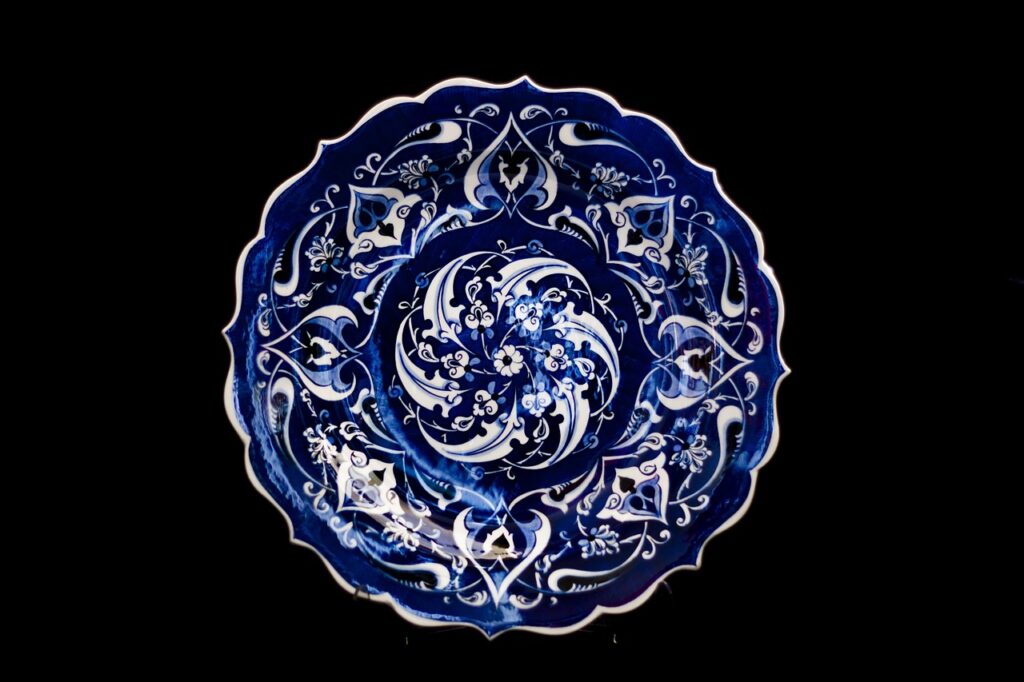
The colors of Turkish ceramics are its signature. The classic palette combines a brilliant cobalt blue, a turquoise green, and a deep purple, with white as the ground. These colors, arranged in elegant patterns, define the Iznik style at a glance.
The most famous color is the Iznik red. This rich, sealing-wax red, raised slightly above the surface like a coral, is the trademark of the finest period. The secret of its production was lost with the workshops, and its revival in modern times was a triumph of research.
The palette evolved through the decades: early blue-and-white, then the polychrome glory of the sixteenth century, then the softer tones of the later period. Reading a piece’s colors is reading its date and its workshop.

The Motifs and Their Meanings
The decoration of Turkish ceramics is a garden of motifs. The floral vocabulary is the richest: the tulip, the rose, the carnation, and the hyacinth, each with its own associations, bloom across tiles and plates in endless variation.
The saz style brought the art of the leaf, the long, elegant leaves that curl through Ottoman designs, and the cloud bands and other abstract motifs added movement. The patterns are composed with a rhythm that makes the surface sing.
The motifs carried meaning as well as beauty. The tulip, for example, was more than a flower; it was a symbol of divine unity and of the Ottoman world itself. The gardens of the tiles were images of paradise, made to decorate the houses of prayer.
Tiles in Architecture and Mosques
The tile found its grandest stage in architecture. The great mosques and palaces of the Ottoman world are sheathed in tile, and the effect is overwhelming: walls of blue, turquoise, and red that turn a building into a jewel box.
The mosques of Istanbul display the tradition at its peak. The architects ordered tiles by the thousand, and the interior walls, the mihrabs, and the galleries became vast compositions of ceramic art. The same tiles adorned the palaces, the tombs, and the public fountains of the empire.
For the visitor, the lesson is simple: the best ceramic museum in Turkey is the buildings themselves. Every mosque with tiled walls, from Istanbul to the provinces, is a gallery of the craft, free to enter and more moving than any display case.

Ceramics Beyond Tiles: Vessels and Pottery
The Iznik workshops made more than tiles. Their plates, bowls, jugs, and mosque lamps are among the most beautiful pottery ever produced, and they were treasured in their own time across Europe and the East.
The vessels carried the same palette and motifs as the tiles. A great Iznik plate, with its red flowers and blue borders, is a complete composition, designed to be seen from above as it stood on the table or hung on the wall.
Beyond Iznik, the tradition continues in other regions. The pottery of the towns of western Anatolia, the rustic wares of the villages, and the modern revival workshops all descend from the same family tree, and each has its own beauty.
The Craftsmen and Their Workshops
Behind the masterpieces stand the craftsmen. The Ottoman ceramic industry was organized in workshops, each with its master, its apprentices, and its specialities: some painted, some glazed, some fired, and the division of labor produced consistent, expert work.
The modern revival has recreated this world. The great ceramic centers of today, where Iznik techniques were brought back to life, employ painters, throwers, and kiln masters who have relearned the old recipes, from the quartz body to the sealing-wax red.
The workshop is the visitor’s window into the craft. Watching a painter draw a tulip with a single confident stroke, or seeing the kiln open on a batch of red-fired plates, connects the art to the hands that make it, and no museum can quite replace that.

Reading Quality: Antique vs. Modern
A genuine antique Iznik piece is a museum treasure and a serious investment. The antique market is governed by scholarship: provenance, age, and condition are everything, and the great pieces sit in the collections of the world’s museums.
For the everyday visitor, the modern revival is the practical field. Modern Turkish ceramics range from the highest quality, faithful to the old techniques, to the merely decorative. Quality shows in the clay, the colors, and the precision of the painting.
The honest approach is to buy for love. A modern plate with a true red, a tile with a clean tulip, a bowl that pleases the eye, these are the pieces that give daily pleasure. The antique market is a museum; the workshop is a home.
Buying Ceramics and Tiles in Turkey
Buying ceramics is one of the joys of a Turkish trip. The bazaars are full of plates, bowls, and tiles, and the quality varies as much as the price. Look for pieces that are well-painted, with clean lines and colors that glow rather than glare.
The workshops are the better source for serious pieces. In the ceramic towns and the artisan districts, you can buy from the makers, watch the work, and choose from pieces that carry the craft’s full attention. The prices are fair, and the story is included.
Handle your purchase with care. Ceramics travel well if wrapped properly, and many shops will pack them for you. Choose pieces that fit your life: a tile for the wall, a plate for the table, a bowl for the kitchen, and the craft will live with you daily.
One final tip for the visitor: before you buy, look at the back of a plate or the edge of a tile. The small marks of the workshop, the glaze drips, and the tiny imperfections of the hand are the signatures of real craftsmanship. They are not flaws; they are the proof that a person, not a machine, made the piece, and they carry the tradition forward.
Frequently asked questions
What is Iznik pottery?
Iznik pottery is the finest ceramic art of the Ottoman world, produced in the town of Iznik between the fifteenth and seventeenth centuries. It is famous for its white, quartz-rich body, its brilliant underglaze painting, and its palette of cobalt blue, turquoise, purple, and the distinctive raised red, applied to both architectural tiles and magnificent vessels.
Why is the Iznik red so famous?
The Iznik red, a rich, sealing-wax color slightly raised above the surface, is the trademark of the finest period of the craft. Its production was a closely guarded secret, and the technique was lost when the workshops declined in the seventeenth century. Modern researchers eventually reconstructed it, making its revival a celebrated achievement.
Where can I see the best Turkish tiles?
The best tiles are still in the buildings they were made for. The great mosques of Istanbul, with their tiled walls, mihrabs, and galleries, are the finest galleries of the craft. Museums such as the great collections of Istanbul hold the finest vessels, and the modern workshops of the ceramic towns show the craft alive today.

All Over Information
The All Over Information editorial team researches and writes practical English-language guides to Turkey. Facts are checked against official and local sources before publication, prices are published as dated ranges rather than quotes, and guides are revised when things change. We accept no sponsored posts, paid placements or paid links.
More guides like this

Understanding the Ottoman Naval History: A Beginner’s Guide
The Ottoman Empire was a land power that became a sea power, and its navy carried its flag across three seas for…

Gift-Giving Customs in Turkish Culture
Gift-giving in Turkey is a heartfelt ritual, and understanding it deepens every friendship you make here.
Understanding Traditional Turkish Folk Instruments
Turkish folk music is carried by a family of instruments that most visitors hear before they ever see them: the twang of…

A Deep Dive into Respect for Elders in Turkish Culture
Respect for elders is often described as a Turkish value, but it is really a civilization in miniature: a thread connecting the…

Turkish Football Fan Culture Explained for Foreigners
If you are planning to experience football in Turkey, you are about to discover something far more intense than a typical match…

The Concept of Misafirperverlik (hospitality) Explained for Foreigners
You will meet the Turkish word misafirperverlik early in your visit, and you will meet its practice even earlier.