Few buildings tell the story of Turkey’s last imperial century as completely as Dolmabahce Palace. Stretching along the European shore of the Bosphorus in the Besiktas district of Istanbul, it was the seat of the Ottoman sultans from 1856 until the empire’s end, and it later became the stage for the founding of the Turkish Republic. In this guide you will follow the palace from its origins in a reform-minded empire, through its dramatic construction and its years as the imperial heart, to its transformation into one of the most visited museums in the country.
Before the Palace: Topkapi and a Changing Empire
For nearly four centuries the Ottoman sultans ruled from Topkapi Palace, the walled compound on the old city’s eastern tip. By the early nineteenth century, however, that setting felt increasingly out of step with the world around it. The empire was deep in a period of reform known as the Tanzimat, and its rulers wanted a residence that spoke the visual language of modern Europe.
Topkapi was also, by design, a palace of many courtyards and low pavilions, built around the logic of seclusion and ceremony. It looked inward. The sultans of the reform era wanted a palace that looked outward, toward the sea and toward the West, and that matched the diplomatic ambitions of an empire remaking itself.
The spot chosen for the new palace was the Dolmabahce district, whose name means “filled garden” in Turkish. The site had been a natural bay, gradually filled in over the centuries to create a level stretch of shore along the Bosphorus, and it had long been used for imperial leisure and recreation.
The Decision to Build a New Palace
The push to build came from Sultan Abdulmejid I, who took the throne in 1839. He was young, educated in European ideas, and determined to present the empire as a modern power. The older wooden palaces along the Bosphorus were aging, and Topkapi no longer matched the image he wanted for the dynasty.
There was also a catastrophic spur. In 1839 a fire devastated the Besiktas area, including older imperial residences on the site, clearing the ground for something entirely new. The sultan decided that the new building would be a palace in the European manner: stone, marble, and glass, with grand ceremonial rooms designed to impress visiting ambassadors and rival the courts of Paris and Vienna.
Planning and construction began in earnest in 1843, and the project absorbed enormous resources of money, materials, and skilled labor for more than a decade.

Construction, 1843-1856
The building works ran from 1843 to 1856, a thirteen-year campaign that consumed the energies of thousands of workers. Craftsmen came from across the empire and from Europe, and materials arrived from many lands: marble, stone, crystal from Bohemia, glass, and gold leaf by the ton.
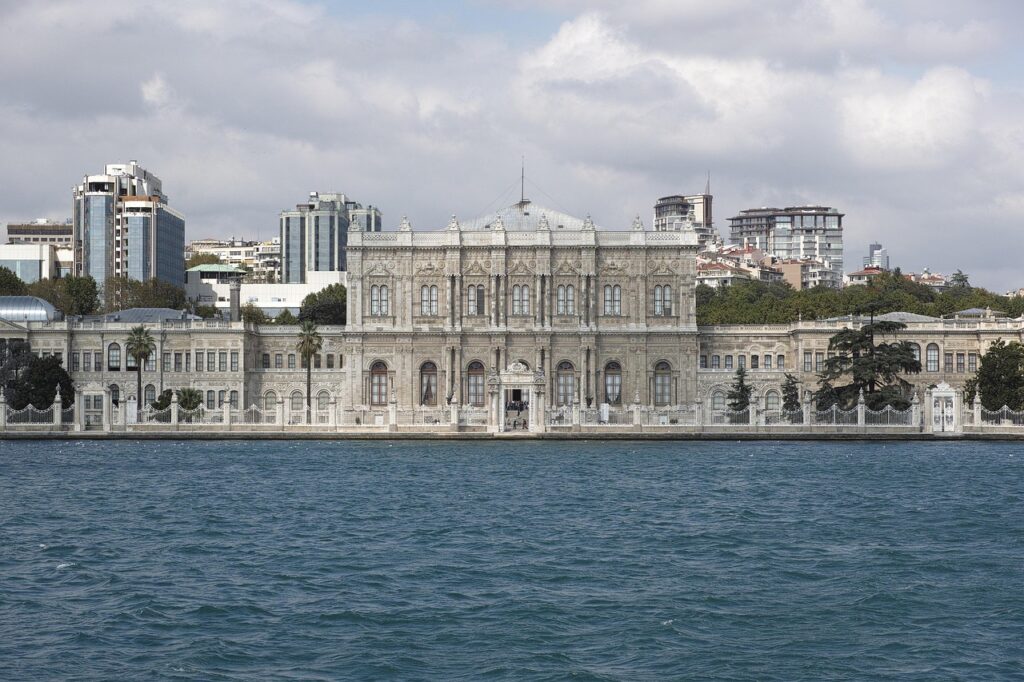
The main structure rose along a waterfront of roughly six hundred meters, its long facade facing the Bosphorus. The palace contained hundreds of rooms and halls arranged around a series of grand interior spaces, with the state apartments on the land side and the harem wing extending along the shore.
When Sultan Abdulmejid moved in with his court in 1856, the palace immediately became the administrative and ceremonial center of the empire. Ministries, foreign delegations, and state functions all gravitated to the new building, and for the first time the sultan could receive ambassadors in halls designed for exactly that purpose.
The Balyan Family, Master Builders
The palace bears the signature of the Balyan family, the celebrated Armenian architect dynasty of the Ottoman capital. Garabet Amira Balyan and his son Nigoğayos Balyan are credited with the overall design, and they worked in a blend of European styles filtered through Ottoman taste and courtly tradition.
The Balyans had served the empire for generations, designing barracks, mosques, and palaces across Istanbul. For Dolmabahce they produced an eclectic vision that mixed elements of Baroque and Rococo with Neoclassical order, and they adapted those Western forms to the requirements of an Ottoman court, from the sultan’s private quarters to the vast throne hall.
Their work set the pattern for the state architecture of the late empire. Dolmabahce’s marble detailing, its monumental staircases, and its confidence in European forms became the model that other palaces and public buildings across Istanbul would follow for the rest of the century.
A New Imperial Center, 1856-1909
For more than half a century the palace stood at the center of Ottoman imperial life. Sultans received foreign dignitaries in its great halls, celebrated religious festivals on its terraces, and conducted the business of state from its offices. The palace was also the residence of the harem, the private world of the sultan’s family and household, which had its own ceremonial rhythm.
Abdulmejid’s successors continued to use the palace, and each added his own touches. Sultan Abdülaziz extended the decoration and made the palace a showcase of collected art, while the reign of Abdulhamid II, which began in 1876, saw the sultan retreat increasingly into the palace’s protective walls as the empire faced war and unrest.
The very grandeur that made the palace a symbol of reform also made it a symbol of the gulf between the court and a struggling empire. Critics pointed at its cost, and the palace became part of the political argument about the future of the state, an argument that would soon overwhelm the dynasty itself.
The Last Years of the Dynasty, 1909-1922
In 1909 Sultan Abdulhamid II was deposed, and the empire entered a turbulent period of constitutional government, wars, and revolution. The palace remained the sultan’s residence, but its authority shrank with each passing crisis. The Balkan Wars, the First World War, and the Allied occupation of Istanbul followed in quick succession.
During the occupation years after 1918, the palace complex was caught up in the political storm. The last sultan, Mehmed VI, remained in residence until November 1922, when the Grand National Assembly in Ankara abolished the sultanate.
With the dynasty gone, the building lost its purpose overnight. Its rooms were emptied of much of their movable treasure, and for a time the great palace stood as a magnificent, uncertain relic, waiting to see what the new Republic would decide to do with it.
The Republican Era Begins
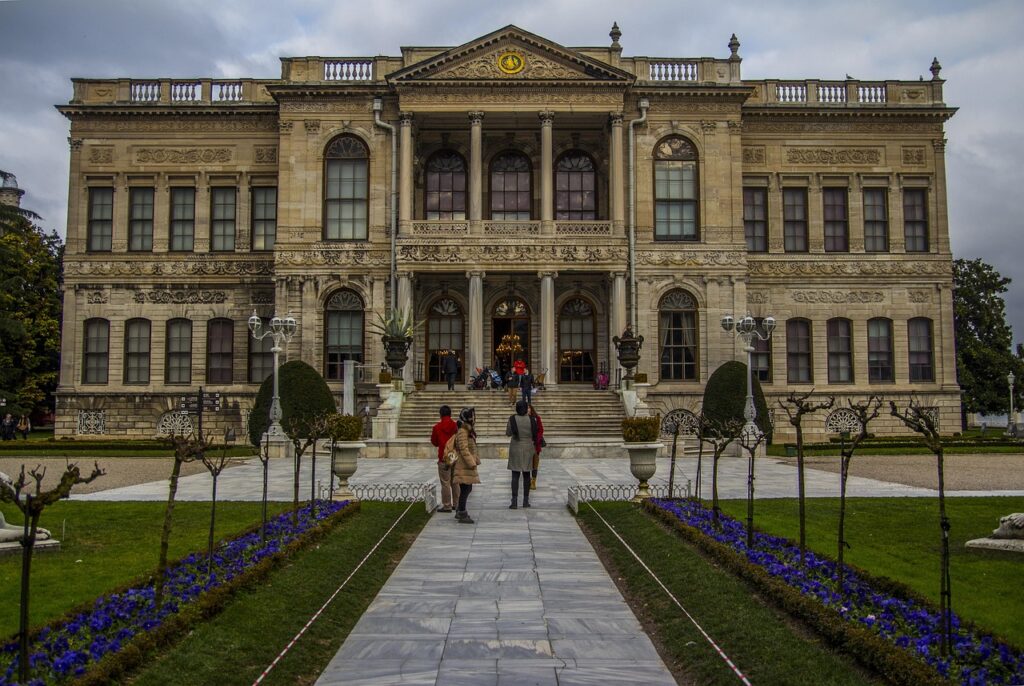
The young Turkish Republic claimed the palace as its own, and the building entered its most famous chapter. Mustafa Kemal Atatürk, the republic’s founder and first president, made Dolmabahce one of his principal residences in Istanbul, using the state wing whenever he was in the city.
Atatürk’s attachment to the palace was practical as well as symbolic. It was the most prestigious building in the country’s largest city, ideal for receiving foreign heads of state and for the ceremonies of the young republic.
Throughout the 1920s and 1930s the palace hosted state visits, official banquets, and historic political meetings. The building that had been raised to impress the courts of Europe now served the diplomacy of a new nation, and its halls echoed with the voices of the men and women building modern Turkey.
Atatürk’s Final Days, November 1938
The palace’s most poignant chapter came at the very end of Atatürk’s life. His health had declined through the autumn of 1938, and he was brought to Dolmabahce in November to be near his doctors in Istanbul. The room he occupied, a bedroom in the state wing overlooking the Bosphorus, became the focus of the nation’s anxious attention.
On the morning of November 10, 1938, Atatürk died in that room at 9:05 in the morning. The palace instantly became a place of national mourning. Hundreds of thousands of people filed past his coffin as it lay in state in the palace’s great hall before the funeral took him to Ankara.
In a gesture that has become part of Turkish memory, the clock in his bedroom was stopped at 9:05, the minute of his death. The tradition is honored to this day, and the room itself is preserved exactly as it was, a pilgrimage site within the palace for every generation since.
The Palace Becomes a Museum
After Atatürk’s death the palace passed to the state, and the decision was made to open its doors to the public. Parts of the complex were used for official purposes for years, but by the mid-twentieth century the palace was being presented as a museum of the Ottoman and early Republican eras, drawing visitors from around the world.
The task of preservation has never been simple. A building of this size, with its gilded ceilings, painted canvases, crystal, and textiles, demands constant care, and successive restoration campaigns have worked to undo the damage of decades. The museum administration has also had to balance tourism with the palace’s status as a national monument.
Today the palace is managed as part of Turkey’s national palaces organization, and it receives hundreds of thousands of visitors each year. The tour route leads you through the state apartments and the harem, past the crystal staircase, the great hall, and the bedroom where Atatürk died, telling the palace’s long story in one continuous walk.
Dolmabahce Today
Visiting the palace today means stepping into a layered history. The building is at once a monument to the Ottoman reform era, a museum of nineteenth-century decorative arts, and a shrine of the Turkish Republic. Its long waterfront facade remains one of the defining views of the Bosphorus, and its clock tower and gates are landmarks in their own right.
The palace is also part of a living neighborhood. The surrounding district of Besiktas bustles with ferries, markets, and daily life, and the palace gardens open onto the same shore where the sultans once disembarked. A visit can be combined with the nearby mosque and the waterfront walks that run along the strait.
For anyone trying to understand modern Turkey, the palace is a necessary stop.
Frequently asked questions
Why is Dolmabahce Palace so important to Turkish history?
The palace served as the last imperial residence of the Ottoman sultans and later as a residence of Mustafa Kemal Atatürk, the founder of the Republic of Turkey. It therefore connects the empire’s reform era with the birth of the modern state, and Atatürk’s death there in 1938 turned it into a national shrine visited by every generation.
Why are the clocks in the palace stopped at 9:05?
The clocks in Dolmabahce Palace, and especially the clock in the room where Atatürk died, are kept stopped at 9:05 in memory of the exact minute of his death on November 10, 1938. The gesture is a national tradition kept to this day.
When was Dolmabahce Palace built and who designed it?
The palace was built between 1843 and 1856 for Sultan Abdulmejid I, replacing Topkapi as the imperial residence. It was designed by the Balyan family, the Armenian architect dynasty of the Ottoman court, and its style blends European Baroque, Rococo, and Neoclassical elements with Ottoman tradition and craftsmanship.

All Over Information
The All Over Information editorial team researches and writes practical English-language guides to Turkey. Facts are checked against official and local sources before publication, prices are published as dated ranges rather than quotes, and guides are revised when things change. We accept no sponsored posts, paid placements or paid links.
More guides like this
Visiting Mevlana Museum: Tickets, Hours, and Tips
The Mevlana Museum of Konya — the tomb of the great mystic Rumi — is one of the most visited museums of…

The Architecture of Spice Bazaar Explained
The Spice Bazaar is one of the finest surviving examples of Ottoman market architecture, a building that has done the same job,…

The Architecture of Galata Tower Explained
Galata Tower looks simple at first glance, but it is a sophisticated piece of medieval engineering that has been tested by centuries…

Spice Bazaar Through the Centuries
The Spice Bazaar has stood on the waterfront of Eminönü since the 1660s, and in that time it has witnessed the transformation…

Why Chora Church Should Be on Your Turkey Bucket List
The Chora Church — the Kariye — is the greatest treasure of the Byzantine art in Istanbul, and one of the essential…

Visiting Dolmabahce Palace: Tickets, Hours, and Tips
Planning a visit to Dolmabahce Palace takes a little more thought than most Istanbul sights, because the palace runs on guided tours,…