Turkish hospitality is one of the most commented-on aspects of the country, and also one of the least examined. Most accounts stop at the tea and the insistence, treating it as a charming quirk. This deep dive traces the concept of misafirperverlik through its history, its rituals, its social mechanics, and its current transformation, so you understand why it works the way it does.
The Concept at the Heart of Turkish Life
The Turkish word for hospitality, misafirperverlik, literally means guest-loving, and it is far more than a courtesy. It is a moral category, a marker of honor, and a central value of social life. The guest, misafir, occupies a special position: a person who enters the home places the household under an obligation to welcome, feed, and protect them.
The concept shapes behavior at every level of society: it is taught to children from infancy, frames the marketplace, and is extended to strangers and foreigners in public life. The consistency across all these settings is what makes Turkish hospitality feel distinctive.
Understanding the concept means understanding its paradoxes. Hospitality is generous but hierarchical: the host gives, the guest receives, and honor flows to the giver. It is warm but demanding: the guest must eat, must accept, must respond with gratitude. The concept works because both sides know the rules.
Historical Roots of Misafirperverlik
The roots of Turkish hospitality reach deep into the history of Anatolia. The region has been a corridor of peoples for millennia: merchants, pilgrims, soldiers, and nomads crossed it constantly, and the survival of travelers often depended on the welcome of settled communities. Hospitality was necessity before it was etiquette.
The Ottoman period refined the tradition and gave it institutional forms. The empire supported guesthouses for travelers, the sultans were expected to embody generosity, and the ability to receive guests lavishly was a mark of status. The religious tradition reinforced the value, with the guest described as bringing divine blessing.
Modern Turkish identity absorbed all of these layers. When the republic was founded, hospitality entered the national self-image as a distinctly Turkish virtue, and it remains central to how the country presents itself. It is not a surface courtesy but a sedimented value built from geography, religion, empire, and memory.
The Anatomy of a Turkish Welcome
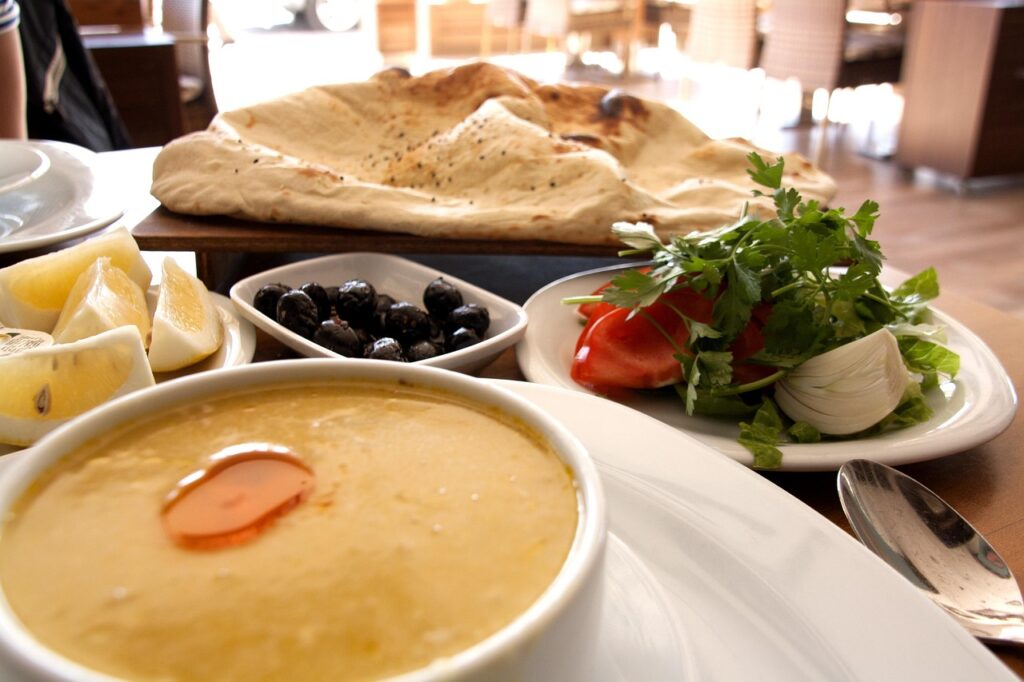
A Turkish welcome follows a remarkably consistent pattern, whether in a village or a city apartment. The greeting comes first, warm and personal, often with an offer of tea. The guest is guided to the best seat, food and drink follow with an insistence that has its own grammar, and the conversation comes last, unhurried and open-ended.
Each element carries meaning. The greeting establishes the relationship, the seat establishes the guest’s status, the offering establishes the host’s generosity, and the conversation establishes the bond. The sequence is an inherited choreography, and its predictability is what makes it comfortable.
For the guest, the anatomy of the welcome is a map. Accept the greeting, take the seat, receive the offering, and stay for the conversation. The welcome is designed to move you from stranger to guest in the span of a single visit.
Tea, Coffee, and the Language of Drinks
Drinks are the vocabulary of Turkish hospitality. Tea, çay, is the everyday word: offered constantly, served in small tulip glasses, and drunk slowly over conversation. Coffee, kahve, is the ceremonial word, often accompanied by fortune telling, and water is the practical word offered at the start of a visit.
The choice of drink communicates status and intent. In a shop, tea signals that you are a guest rather than a customer; in a home, tea marks the ordinary visit while coffee marks a formal occasion. The number of glasses matters too: the first tea is welcome, the second is conversation, the third is friendship.
Learning the language of drinks gives you fluency in the culture. Accept the water, receive the tea, and know that the coffee, with its grounds, is the prelude to a longer stay. The drinks are never incidental: they are the medium through which the hospitality does its work.

The Meal as Ritual
The meal is the fullest ritual of Turkish hospitality, built on principles that differ from Western dining. First comes abundance: the table holds more than anyone can eat. Second comes insistence: the host presses you to eat and treats your appetite as a compliment. Third comes leisure: the conversation after the meal matters as much as the food.
The structure follows tradition: soup or shared meze dishes, a main course, then fruit, sweets, and tea. Turkish meals are communal, with food passed and offered rather than plated. The host watches the guest’s plate closely, and the guest’s enjoyment is the host’s reward.
For the visitor, the ritual demands participation. Eat a little of everything, accept the second serving, praise the cooking, and stay for the conversation. Your role is not to eat efficiently but to receive generously, and the pressure of the Turkish table becomes the celebration of the guest.
The Social Mechanics of Generosity
Turkish hospitality is often described as generosity, but it is more precisely a system of social exchange. The host gives, and the giving creates a bond; the guest receives, creating an obligation of gratitude and relationship. Over time, the exchanges build networks of mutual obligation that glue Turkish social life together.
The mechanics explain behaviors that puzzle outsiders. The host who insists you eat more is demonstrating generosity, because the demonstration is the point. The guest who accepts a second serving is gracious, because the acceptance completes the exchange. Both sides perform their roles in the bond-building.
These mechanics extend beyond the home. In business, tea and meals create the trust that transactions require; in community life, hosting cements social ties; in diplomacy, lavish hospitality builds the relationships on which everything depends.

Hospitality Across the Regions
Turkish hospitality is national, but its expression varies by region. In the Black Sea region, tea culture is at its most intense, and the visitor may be offered glass after glass. In the southeast, guests are treated as family, while in the Aegean and Mediterranean the tradition is lighter, adapted to tourism.
The variations follow geography and history. Mountain villages, where guests are rare, practice the most generous hospitality because the tradition is a survival memory. The cities practice a compressed version, and the tourist coasts offer warmth that is genuine but structured by commerce.
For the traveler, the regional map is a guide to expectations. In a village, prepare for the full ritual: the meal, the insistence, the long conversation. In a city, accept the warmth but move at the city’s pace. The tradition is one, but its dialects are many.
Hospitality in the Modern Economy
The modern economy has both tested and transformed Turkish hospitality. Urbanization has weakened the village network of mutual obligation, and tourism has made hospitality a commodity, with the state turning it into a brand. The tradition has proven adaptable, but the adaptation has costs.
The commercial hospitality of hotels blends genuine warmth with professional service, while the sharing economy has revived older forms, with travelers hosted in homes as guests rather than customers. The digital age has globalized the tradition through stories spread on social media.
The deepest question is whether the tradition can survive its own success. As hospitality becomes a brand, it risks becoming a performance. Yet Turkish people still host strangers, still offer tea, still treat the guest as a blessing: the economy has changed the forms, but the concept remains intact.

The Future of an Ancient Value
What will happen to Turkish hospitality in the coming decades? Urbanization, busy lives, and economic pressure work against it, while a deep cultural commitment, a national identity built partly on the value, and a tourism economy that rewards it work for it. The future will be decided by which forces prove stronger.
The signs are hopeful. Young Turkish people still describe hospitality as a core value, and the state promotes the tradition as national heritage. The tradition is also being renewed from below, as travelers and hosts together recreate the old forms in new settings.
For you, the future is already present. The hospitality you receive is the living edge of an ancient value, and your visit is part of its story. Accept the tea, praise the food, and be a good guest, and you will have participated in the tradition at a moment of transformation.
Hospitality and the Art of Conversation
Conversation is the invisible center of Turkish hospitality, and the rituals exist partly to make it possible. The tea slows the clock, the meal extends the evening, and the after-dinner sitting, with the table cleared and the tea refilled, is where the real hosting happens. In Turkish homes, a guest is rarely rushed out, and the long exchange of stories, opinions, and family news is considered the most valuable part of the visit.
The topics of such conversations are shaped by the culture’s warmth. Guests are asked about their families, their journeys, and their impressions of Turkey, and the questions come from genuine interest rather than small talk. Praise flows in both directions, jokes pass easily, and the atmosphere is deliberately comfortable. Politics and religion may come up, but the tone is usually respectful, and a good guest follows the host’s lead.
For the visitor, this means that conversation is part of the hospitality you should prepare for. Bring questions about Turkish life, stories about your own country, and patience for a long evening. The ability to sit, talk, and laugh is itself a form of participation, and many travelers find that the conversations they share over tea become the deepest memories of their trip. The meal feeds the body; the conversation feeds the relationship.
Frequently asked questions
What is the literal meaning of misafirperverlik?
The word combines misafir, meaning guest, with perverlik, from a Persian root meaning loving or nurturing. It therefore means guest-loving. The word itself expresses the concept: hospitality is not a duty performed for guests but a love directed toward them.
Why is food pushed on guests in Turkish homes?
The abundance and insistence are deliberate. The host’s honor depends on the guest’s satisfaction, so the table must overflow and the guest must be pressed to eat. The exchange of insistence and refusal is a ritual both sides understand.
Has Turkish hospitality weakened in modern cities?
The forms have changed: the tea is quicker and the invitations shorter. But the value itself remains strong, and young Turks still describe hospitality as a core identity. The tradition has adapted to urban life rather than disappearing.

All Over Information
The All Over Information editorial team researches and writes practical English-language guides to Turkey. Facts are checked against official and local sources before publication, prices are published as dated ranges rather than quotes, and guides are revised when things change. We accept no sponsored posts, paid placements or paid links.
More guides like this

Understanding the Ottoman Tile and Ceramic Tradition: A Beginner’s Guide
If you have ever stood inside a great Ottoman mosque and felt the walls glow around you, you already know the power…

A Deep Dive into Turkish Coffee Fortune Telling
Turkish coffee fortune telling, fal, is a tradition that travelers encounter with delight and scholars approach with curiosity.
Understanding Turkish Barbershop Culture
If you spend any time in Turkey, you will notice the barbershops on nearly every street corner, their windows polished, their chairs…

Turkey’s Agricultural Heartlands Explored
Turkey is one of the great agricultural countries of the world, a land where the Fertile Crescent's first farmers found their footing…
Turkish Etiquette: Dos and Don’ts for Visitors
Turkish culture runs on warmth, respect, and hospitality, and the rules visitors worry about are simpler than they fear.

Understanding Turkish Humor and Comedy
Humor is the fastest way into any culture, and Turkish humor is a rich, layered tradition that rewards attention.