Adana kebab looks simple, a skewer of seasoned minced meat over charcoal, but the gap between the real thing and a homemade imitation is wide. The authentic version depends on four things that are easy to overlook: the right cut of lamb, the tail fat, the isot pepper, and a long, patient kneading. Get those right, and the grill will do the rest. This guide walks you through every step of making authentic Adana kebab at home, from the butcher to the fire.
The Meat You Need
Authentic Adana kebab is made from lamb, and the choice of cut matters. The classic choice is the leg or the shoulder, cut from young lamb, and the meat should be fresh, not frozen, since frozen meat loses the texture the kebab needs.
The second essential is the tail fat, the firm white fat from the tail of a fat-tailed sheep. It is sold at Turkish butchers and some specialty shops, and it is the ingredient that keeps the kebab moist and juicy over the fierce heat of the fire.
The proportion of fat to meat is around one part fat to four or five parts meat. Too little fat, and the kebab will be dry; too much, and it will be greasy. The tail fat should be chopped finely, not melted, so that it melts slowly during grilling.
If you cannot find tail fat, a mix of lamb shoulder and a little additional fat from the leg is an acceptable substitute, though the authentic result is hard to match.
The Isot Pepper
The seasoning of Adana kebab is isot, the dark, crumbled red pepper of the southeast. It is the soul of the dish, and it cannot be replaced with regular chili flakes, which lack the smoky, fruity depth of the real thing.
Isot is available from Turkish grocers and online, and it keeps well in an airtight jar. Before using it, soak the isot in a little warm water for ten minutes, which softens it and releases its flavor into the meat.
The amount is a matter of taste, but the authentic kebab is generous with the pepper. Start with about two tablespoons of soaked isot per kilogram of meat, and adjust from there. The heat of isot builds slowly, so do not judge it by the first bite.
The color is the clue: a proper Adana mixture is dark red, almost burgundy, stained by the pepper.

The Equipment
You will need a heavy knife or a coarse mincer. The meat should be minced coarsely, not ground fine, and a hand-cranked mincer with a coarse plate gives the best texture. If you are using a knife, chop the meat and the fat together until they are uniformly minced.
You will need wide, flat metal skewers, about three centimeters wide. These are available from Turkish cookware shops and online, and they are essential, since round skewers will not hold the soft mixture properly.
A charcoal grill is the ideal, since the smoke and the high heat are part of the flavor. If you must use a gas grill or a broiler, you can still make a fine kebab, but the smoky character will be reduced.
Finally, have a mixing bowl, a tray for the skewers, and the serving plate ready before you start. A small dish of warm water is also useful, since wetting the hands makes the shaping of the sticky mixture far easier.
The Mixing and Kneading
Combine the minced meat, the chopped tail fat, the soaked isot, and salt in a large bowl. The salt is important; it seasons the meat and helps the mixture bind. Use about a teaspoon and a half per kilogram of meat.
Now comes the kneading, the step that separates the authentic kebab from the imitation. Work the mixture by hand, picking it up and slapping it back into the bowl, folding it over itself, for a full ten minutes.
The kneading develops the proteins of the meat, creating a sticky, cohesive mass that will hold together on the skewer. The mixture should become tacky and smooth, and it should hold its shape when pressed. If it crumbles, knead longer.
Cover the bowl and rest the mixture in the refrigerator for at least an hour. The resting firms the mixture and makes the shaping easier.

Shaping the Skewers
Take a wide, flat skewer and press a portion of the mixture along its blade. The meat should form a long, even band, slightly thicker in the middle, and the edges should be smoothed and rounded with wet hands.
Press the meat firmly onto the skewer, working it around the blade so that it grips. A properly shaped kebab will not slip or fall during grilling, and it should come off the skewer in one piece when cooked.
Wet your hands as you work, since the mixture is sticky, and keep the shaped skewers on a tray in the cold until you are ready to grill. The cold helps the meat hold its shape.
The traditional shape is long and elegant, about the length of the skewer, and the kebab should be even in thickness so that it cooks uniformly.
Building the Fire
The fire is half the flavor of Adana kebab. Use lump charcoal, and light it well ahead of time, so that the coals burn down to white-hot embers with no open flame. The heat should be fierce but steady.
Let the coals ash over completely before you begin grilling, which takes about thirty to forty minutes. The embers should glow evenly across the grill surface, and there should be no black, unlit spots.
The grilling position matters. Hold the skewer close enough to the coals to brown the meat quickly but far enough that the fat does not ignite and burn the surface. A hand-width above the coals is a good starting point.
If you are using a gas grill, preheat it on high for ten minutes, and if you are using a broiler, place the skewers close to the heat source and watch them constantly.

Grilling the Kebab
Place the skewers over the coals and turn them regularly. The kebab should cook for eight to twelve minutes in total, depending on the heat, and it should be turned every minute or so to cook evenly.
The outside should brown and crisp, with charred spots here and there, while the inside stays juicy and slightly pink. The fat will drip onto the coals and flare, and those brief flares add the smoky flavor.
Do not press the meat with a spatula; the juices belong in the kebab, not in the fire. And do not cut into the kebab to check it; the color and the feel of the meat are the guide. If the kebab is thick, cook it a little longer at a slightly lower heat; the goal is a crusty outside and a juicy inside, and the griller’s eye is the only thermometer.
When the kebab is done, slide it onto the serving plate, or serve it directly on the skewer, the way the kebab houses do. The meat should come off the blade in one piece.
Serving the Table
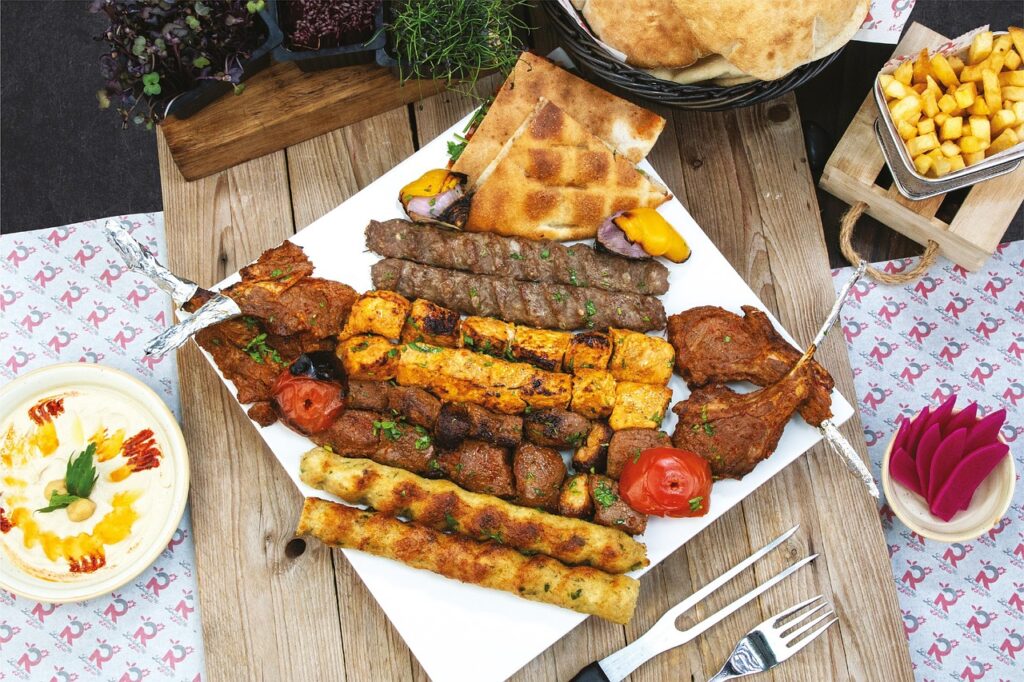
Serve the kebab on a bed of warm flatbread, which will soak up the juices. Add grilled tomato and green pepper, a pile of raw onion, and a sprinkling of parsley and sumac. A squeeze of lemon completes the plate.
The eating is hands-on: tear the bread, wrap a piece of kebab, add onion, and eat. The accompaniments are not optional; they balance the heat of the meat.
Ayran, the cold, salty yogurt drink, is the essential companion, cutting through the richness and the heat. For the traditionalists, a glass of the local spirit with water is the alternative. The kebab houses also set out a plate of the charred, peeled peppers of the grill, which the locals eat alongside the kebab as the fire of the meal.
Serve the kebab immediately, while the bread is warm and the meat is still sizzling. Adana kebab does not wait.
Troubleshooting and Tips
If the kebab falls off the skewer, the mixture was not kneaded enough or the skewers were too narrow. Knead longer and use the wide, flat skewers.
If the kebab is dry, the fat content was too low, or the heat was too high and the cooking too fast. Add more tail fat and keep the skewer a little farther from the coals.
If the kebab lacks heat, the isot was too little or not soaked. Soak the isot longer and use a more generous hand; the pepper should stain the meat dark red.
If the outside burns before the inside cooks, the heat was too high or the skewer too close. Raise the skewer and turn it more frequently.
Feeding a Crowd: Scaling Up
Adana kebab is a generous food, and the recipe scales beautifully for a crowd. Increase the meat, the fat, and the isot in the same proportions, and knead the larger batch a little longer, since the bigger mass needs more work to bind.
The grill is the practical limit. A home grill holds only so many skewers, so shape the kebabs ahead of time and keep them chilled on trays, then grill in waves, holding the first batches warm in a low oven without letting them dry.
The table for a crowd follows the kebab tradition: plenty of warm bread, bowls of the onion and sumac salad, grilled vegetables, and a pitcher of ayran. The kebab is made for sharing, and a table of friends is its natural home.
Frequently asked questions
Where can I buy isot pepper and tail fat?
Both are available from Turkish grocers and specialty butcher shops, and isot is also sold online. Tail fat is the firm white fat from a fat-tailed sheep and may need to be ordered in advance from a halal or specialty butcher. Isot keeps well in an airtight jar, so it is worth buying for future kebabs.
Can I make Adana kebab without a charcoal grill?
Yes. A gas grill preheated on high works well, and a broiler can produce a respectable kebab. The charcoal adds a smoky flavor that the other methods cannot fully replace, but the kneading, the meat, and the isot matter more. Turn the skewers frequently, and watch closely under a broiler.
How spicy is homemade Adana kebab?
The heat is entirely in your hands. Use a modest amount of isot for a mild kebab, or a generous, soaked handful for the authentic southern version. Isot warms slowly and builds as you eat, so taste cautiously at first. The accompaniments, especially ayran, are the traditional way to balance the heat.

All Over Information
The All Over Information editorial team researches and writes practical English-language guides to Turkey. Facts are checked against official and local sources before publication, prices are published as dated ranges rather than quotes, and guides are revised when things change. We accept no sponsored posts, paid placements or paid links.
More guides like this

How to Make Authentic Manti (Turkish Dumplings) at Home
Making manti at home is one of the most rewarding projects in Turkish cooking.
Balik Ekmek (Fish Sandwich): A Taste of Turkish Culture
Balik ekmek is not just the most famous sandwich in Turkey; it is a ritual of the waterfront that connects the city…

How to Make Authentic Turkish Delight (Lokum) at Home
Making lokum at home is a small adventure in patience, but the reward is a tray of soft, fragrant Turkish delight that…

Michelin-Starred Restaurants in Turkey
When the Michelin Guide arrived in Turkey, it marked a new chapter for the country's dining scene.

Lahmacun Vs. International Variations: What Makes It Turkish
The thin flatbread with a meat topping is not unique to Turkey.

The History Behind Lahmacun
Lahmacun is a dish with a name that speaks of distant origins. The word comes from the Arabic for dough and meat,…