Kaymakli Underground City has a history measured in millennia, written not in documents but in stone. Beneath a quiet village in Cappadocia, generations of builders carved, expanded, and refined a city that sheltered thousands of people across dozens of centuries. Its story follows the great currents of Anatolian history, from the volcanic formation of the landscape through the Hittite and Phrygian ages, the Byzantine centuries of refuge, and the quiet years of obscurity, to its rediscovery in the twentieth century. This article traces Kaymakli through the centuries, era by era, and shows how the city beneath the village became what it is today.
The Making of the Rock
The history of Kaymakli begins with the eruptions of the great volcanoes of central Anatolia. Millions of years ago, Mount Erciyes and its neighbors hurled ash across the plateau, and the ash settled into thick layers that slowly hardened into tuff, a soft and workable stone.
That geology shaped everything that followed. The tuff gave the region its fairy chimneys and valleys, and it gave its people a building material of extraordinary flexibility. Where other civilizations quarried stone and raised it into the air, the people of Cappadocia carved downward, using the rock itself as their fortress, their home, and their storehouse.
The same geology also explains the region’s abundance of hidden sites. The tuff extends across the whole plateau, which is why Cappadocia is honeycombed with underground cities, rock-cut churches, and cave dwellings. Kaymakli is one chapter in a much longer story of people living with, and within, the stone.
The First Settlers
Human settlement in Cappadocia goes back to the earliest periods of Anatolian history, and the Kaymakli region was part of that story. The soft rock offered natural caves for shelter, and the fertile plain offered farmland, water, and grazing.
The first chambers beneath Kaymakli may have been cut in very ancient times, perhaps more than three thousand years ago. The Hittites, who ruled central Anatolia in the second millennium BC, knew the region well, and the Phrygians, who followed them, were famous for carving entire cities from rock. The earliest levels of Kaymakli may preserve the work of these first builders, though the city as we know it came much later.

The Persian Age
In the sixth century BC, the region fell to the Persian Empire, and Cappadocia became a province of the great eastern power. For the people of the plateau, the change brought new rulers, new taxes, and new dangers, and the underground refuges grew more important.
The Persian centuries left their mark on the region’s culture and trade, and the roads that crossed the plateau carried soldiers, merchants, and travelers. The underground cities of the region were maintained and extended, ready for the troubles of the age. The chambers of Kaymakli were already old when the Persians arrived, and they were already being adapted to new needs.
The Persian period also brought new connections. The royal road and the trade routes that crossed Anatolia passed through the region, linking Cappadocia to the wider world. Even as the underground cities hid their communities, the surface world was part of a great network of exchange.
The Hellenistic and Roman Centuries
When Alexander the Great swept through Anatolia in the fourth century BC, the Persian order collapsed, and Cappadocia passed into the orbit of the Hellenistic world. Greek cities, Greek customs, and Greek religion spread across the region, and the old rock-cut traditions absorbed the new culture that came with it.
Under the Roman Empire, Cappadocia prospered as a province, connected by roads, dotted with towns, and increasingly Christian. The early churches carved into the region’s rocks date from this era, and the underground cities became places of worship as well as refuge. Kaymakli, still growing, began to take on the character of a Christian community, with chapels and gathering places added to its chambers.
The Byzantine Age of Refuge
The great age of Kaymakli came with the Byzantine era and its wars. From the seventh century, the region faced wave after wave of Arab raids, and the population of Cappadocia developed a desperate strategy: when the raiders came, they vanished underground.
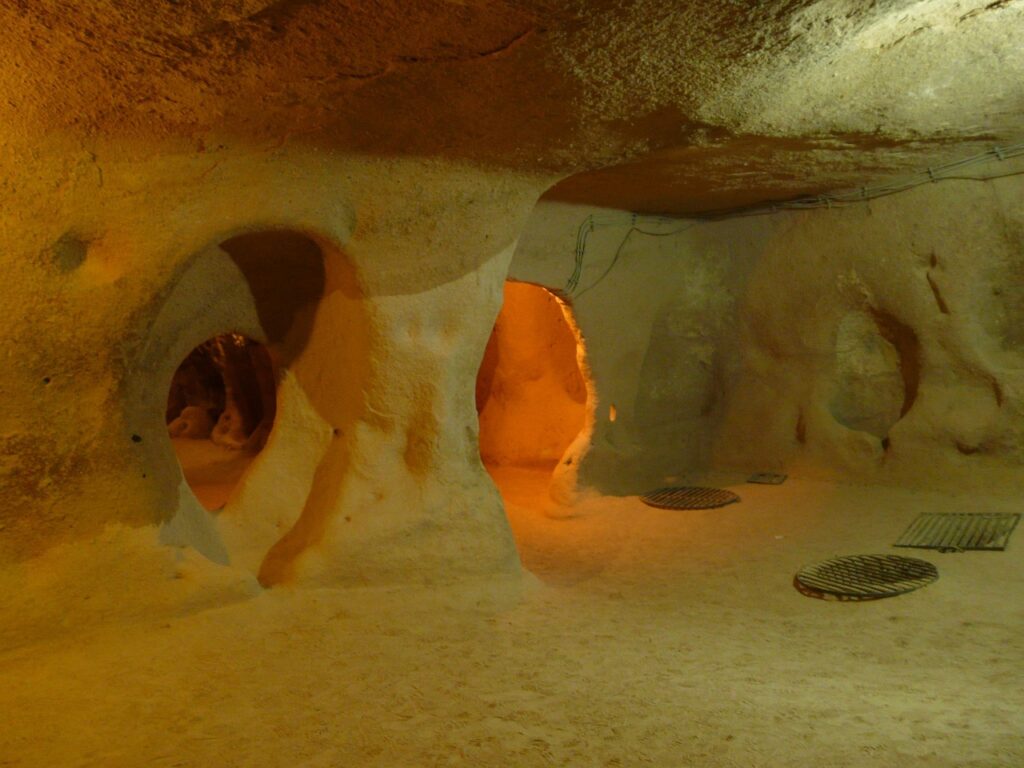
Kaymakli was expanded and fortified for this role. Rolling stone doors were installed, ventilation shafts were improved, and storage rooms were enlarged until the city could hold its people for months. The chapels were carved deeper, the wineries were expanded, and the whole city was organized around survival. It was a time of fear, but also of extraordinary achievement, and the architecture of the period survives almost intact today.
The chapels carved into the city’s levels are among the most moving of its features. Cut in the shape of a cross and lit only by the lamps of the faithful, they show how deeply religion was woven into the life of the refuge. The faith that sustained the community was carried with it into the darkness.
Life Under the Raids
The centuries of raids shaped the daily rhythm of life at Kaymakli. The fields were worked under the watch of sentinels, and at the first alarm the whole community descended, driving their animals before them and rolling the stone doors shut.
Inside, the city became a world of its own. Bread was baked in the rock-cut kitchens, wine was pressed in the cellars, and the chapel rang with prayers. The raids could last days or weeks, but the city was built to wait them out. Time and again, the strategy worked, and the people of the region survived invasions that destroyed countless surface settlements.
The raids also shaped the landscape above. Watchtowers and signal points were built on the heights, and the fields were arranged so that no approach could go unseen. The surface and the underground were two halves of one defensive system, each dependent on the other.

The Later Centuries of Quiet Use
As the great raids faded, Kaymakli’s role changed. The Seljuk conquests of the eleventh century and the rise of the Ottomans brought new political orders, and the region’s great age of refuge gradually passed.
The city was not abandoned. In the centuries that followed, the upper levels were used for storage, for shelter in times of unrest, and for the everyday work of the village: cool cellars for wine and grain, rooms for pressing and storing the harvest. The deepest chambers were forgotten, sealed by debris and time, and the full extent of the city passed from memory.
The Ottoman centuries brought their own small chapters to the story. The village grew around the site’s entrances, and the upper chambers served the daily economy of the area. In quiet times, the city was a cellar; in troubled times, it was a refuge again, proving that its architecture never lost its purpose.
The Forgotten City
For centuries, the village above carried on with little knowledge of the world beneath it. The entrances were blocked or built over, and the great chambers lay in darkness. The tuff that had preserved the city for millennia held it safe, waiting.
The village’s traditions, however, kept a flicker of memory alive. Stories of hidden rooms and secret passages were passed down through generations, half legend and half truth. When the discovery finally came, it seemed less like a revelation than a confirmation, the old stories made real at last.

1964: The Rediscovery
The modern history of Kaymakli began in 1964, when a local resident enlarging his house broke through into a hidden room. The discovery opened a passage, and the passage opened the underground city that the village had unknowingly stood upon for centuries.
Word spread quickly, and archaeologists soon recognized the scale of the find. Within a year, Kaymakli had been cleared, studied, and opened to visitors, joining Derinkuyu as the great underground attractions of Cappadocia. The village, which had lived above the city for so long, found itself at the center of the world’s attention.
Kaymakli Today and the Future
Today Kaymakli is one of the essential experiences of Cappadocia, a UNESCO World Heritage site within the rock sites of the region, and a favorite of travelers who prefer its intimate scale to the depths of its great rival. Four levels are open, and millions of visitors have descended into its chambers.
Yet the city is still revealing itself. The lower levels remain largely unexcavated, and new surveys continue to map the passages that lie beyond the visitor route. Each generation of archaeologists adds to the story, and the centuries keep giving up their secrets. Kaymakli, after thousands of years, is still writing its history.
For modern visitors, the deepest pleasure of Kaymakli is the sense of time made visible. Each level represents centuries of work, and each room carries the marks of the hands that made it. Walking through the city is like walking through a timeline, and the story it tells is the story of Cappadocia itself.
Frequently asked questions
How old is Kaymakli Underground City?
The earliest chambers may date back more than three thousand years, to the Hittite or Phrygian periods. The city reached its full form in the Byzantine era, between the seventh and ninth centuries, when it was expanded as a refuge from Arab raids. It remained in use, in various ways, for centuries after.
When was Kaymakli rediscovered?
Kaymakli was rediscovered in 1964, when a local resident broke through into a hidden room while enlarging his house. The underground city was opened to visitors the following year, and four levels are accessible today. The lower levels remain unexcavated.
What was Kaymakli used for?
Kaymakli was primarily a refuge, sheltering the population of the region during invasions, especially the Arab raids of the Byzantine era. It also served as a working community, with stables, kitchens, wineries, and chapels. In later centuries, it was used for storage and as a shelter in times of unrest.

All Over Information
The All Over Information editorial team researches and writes practical English-language guides to Turkey. Facts are checked against official and local sources before publication, prices are published as dated ranges rather than quotes, and guides are revised when things change. We accept no sponsored posts, paid placements or paid links.
More guides like this

The Complete History of Pamukkale Travertines
The white terraces of Pamukkale, the cotton castle of southwestern Turkey, look like a frozen waterfall poured over the hillside.

Why Aphrodisias Should Be on Your Turkey Bucket List
Deep in the Aydin countryside, far from the Aegean coast's biggest tour routes, lies Aphrodisias, a city that worshipped Aphrodite and spent…
The Architecture of Gobekli Tepe Explained
Gobekli Tepe is the oldest monumental architecture in the world, and its design is unlike anything built before or since.

Why Termessos Should Be on Your Turkey Bucket List
Turkey is full of ancient cities, but there is only one Termessos.

Why Xanthos Should Be on Your Turkey Bucket List
Turkey's southwest coast is full of ancient wonders, but Xanthos stands apart. It is not the biggest site or the best preserved,…

The Architecture of Pergamon Explained
Pergamon was the showpiece of Hellenistic architecture, and its genius was the marriage of building and hillside.