Pergamon is a site of many parts, and that is the secret of enjoying it. The acropolis on its steep hill, the Asclepieion healing sanctuary in the plain, the Red Basilica in the town, and the Bergama Museum together tell the story of one of the greatest cities of the ancient world, and a full day is the honest time needed to see them all. This guide covers tickets, hours, and the practical details, so you can plan the day with confidence and spend your energy on the ruins rather than the logistics.
Where Pergamon Is and How to Reach It
Pergamon lies in the Bergama district of Izmir province, in the fertile plain of the Caicus River in northwestern Turkey. The modern town of Bergama surrounds the ancient sites, and the acropolis hill rises dramatically above the rooftops.
The nearest transport hub is Izmir, about one hundred kilometers to the south, with regular buses and minibuses running to Bergama. The town is also easily reached by car, and it makes a natural stop on a tour of the Aegean coast, between Izmir and the north.
Once in Bergama, the sites are spread around the town, and the distances between them are walkable or a short taxi or minibus ride. Plan your day around the geography, and the logistics become simple.
Tickets and Opening Hours
Each of the major sites of Pergamon, the acropolis, the Asclepieion, and the Red Basilica, has its own entrance and its own ticket, and the Bergama Museum has another. There are also combined tickets that cover several sites at a saving, so ask at the first ticket office you visit.
Opening hours follow the seasonal pattern of Turkish sites: in summer the sites open early, around 8:30, and close in the early evening, while in winter the hours shorten. Confirm the current times locally, as they change between seasons.
The sites are open daily through the year, and the low season offers the great reward of solitude. Arrive early, particularly for the acropolis, because the morning light and the empty terraces are the best the site offers.

The Acropolis: The Main Event
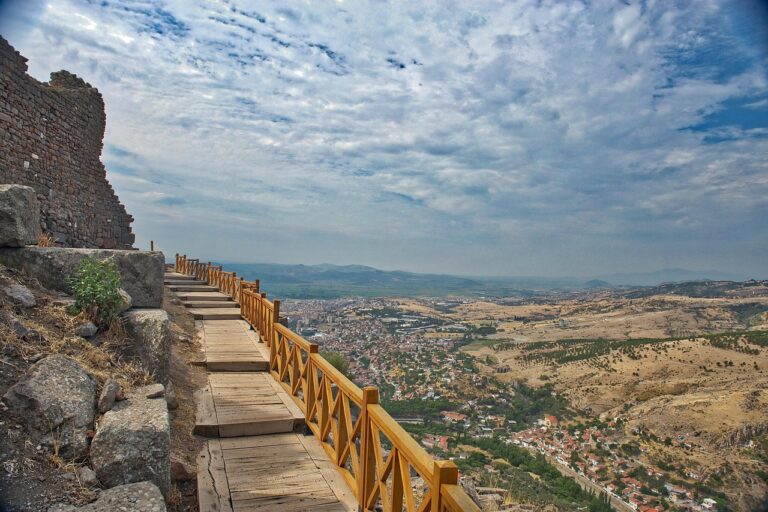
The acropolis of Pergamon is the heart of the site, a spectacular complex built on a hill that rises several hundred meters above the plain. The view alone, over the red roofs of Bergama and the green valley, is worth the climb.
Inside the walls, you walk through the remains of the royal city: the palaces of the Attalids, the barracks, the sanctuary of Athena, the library terrace, and the foundations of the Great Altar of Zeus, whose sculpted frieze now stands in Berlin.
The most dramatic remains are the Trajaneum, the temple of the Roman emperor Trajan on the summit, with its columns being restored, and the great theatre cut into the hillside below. Allow two to three hours for the acropolis alone.
The Theatre and the Steepest Slope
The theatre of Pergamon is the steepest of the ancient world, with seating that climbs the hillside at an extreme angle, holding around ten thousand spectators in rows that seem to rise almost vertically. It is one of the most breathtaking monuments in Turkey.
The seating is cut into the natural rock and supported by massive terraces, and the stage building stood on a long terrace below, with the temple of Dionysus at one end. From the top rows, the view over the plain is vertiginous and unforgettable.
Below the theatre, the great terrace stretches along the hillside, where the library and the palaces once stood. Walking the terrace and climbing the theatre is the physical highlight of the acropolis, and the climb is steep, so allow time and water.

The Red Basilica in the Town
In the town below the acropolis, the Red Basilica, known in Turkish as the Kizil Avlu, is the most visible monument of Roman Pergamon. It was originally a vast temple of the Egyptian gods Serapis and Isis, built in the second century AD.
The building gives its name its color from the red brick of its walls, which still stand in enormous, windowed masses above the modern street. A bridge and arches carried processions to the temple, and the complex included courtyards and subsidiary temples.
In the Byzantine period, the great hall was converted into a church, and one of its towers now houses a small mosque. The Red Basilica is a masterpiece of Roman engineering, and its scale, right in the middle of the modern town, is astonishing.
The Asclepieion: The Second Great Site
Two kilometers from the acropolis, the Asclepieion is Pergamon’s second great site, the healing sanctuary of the god Asclepius that made the city famous in the Roman world. It is a peaceful, green place, very different in character from the rocky acropolis.
The sanctuary had a grand entrance with a colonnaded street, a treatment hall where patients slept awaiting the god’s dreams, a sacred spring, a theatre, baths, and a library. The tunnel through which patients were led to the temple still survives.
Allow about an hour and a half. The Asclepieion is the site where Galen, the greatest physician of antiquity, trained, and standing in the courtyard where patients came to be healed is one of the most atmospheric experiences of the whole region.
The Bergama Museum
The Bergama Museum, in the town center, holds the finds from the sites that were not carried to Berlin. Its collection includes the sculpture, mosaics, and pottery of the acropolis, the altar fragments, and the objects of the Asclepieion and the Roman city.
The museum also displays the remarkable finds from the ancient cemetery, including the terracotta figures and the grave goods that show the daily life of the city. The exhibits are clearly arranged, and a visit of about an hour gives valuable context.
The museum is a good first stop if you arrive early, before the sites open, or a good final stop to round off the day. It complements the ruins, and together they make the history of Pergamon comprehensible.
Cable Car or Walk
The acropolis is a steep climb, and the practical question for every visitor is how to get there. A cable car, installed in recent years, carries visitors up the hill in minutes, and it is the choice of most travelers, especially in summer.
The walking route, from the town through the remains of the lower city and up the ancient road, takes the better part of an hour and is hot and tiring, though it passes the remains of the gymnasium and the lower terraces.
The best combination is to ride up and walk down, or to walk part of the way and use the cable car for the summit. In summer, take the cable car up early, explore the summit, and descend by the path to see the terraces on the way.
The practical movement between the sites is simpler than the map suggests. The acropolis cable car station, the Red Basilica, the Asclepieion, and the museum all lie within a compact area of the town, and taxis are cheap and plentiful for the longer hops. The minibuses that run through Bergama also pass most of the sites. Walking between the Red Basilica and the museum is easy, while the Asclepieion is best reached by taxi or a pleasant ride, with the cable car station serving the acropolis.
Combining the Sites in One Day
A full day at Pergamon is the honest recommendation. The classic order is the acropolis in the morning, when the light and the air are best, the Red Basilica after lunch, and the Asclepieion in the late afternoon, with the museum fitted around them.
Each site takes about one to two hours, and the distances between them are short, with taxis and minibuses available in the town. The day has a natural rhythm: the high citadel, the town monument, the healing sanctuary, and the museum.
If you have only half a day, prioritize the acropolis, add the Red Basilica if time allows, and leave the Asclepieion and the museum for another visit. Bergama itself, with its Ottoman houses and its bazaar, is also worth an hour of wandering.
A final note on comfort: the acropolis is windy as well as hot, and the plain below can be humid, so layers work better than a single garment. The sun in summer is fierce, and the shade is scarce on the summit, so pace yourself and use the museum and the Red Basilica for midday relief. In winter, the hill can be cold and the paths slippery, and a rain layer is essential. However you time it, the view from the theatre across the valley, in the long light of the late afternoon, is the image that will stay with you.
Practical Tips and Common Mistakes
The first mistake visitors make is underestimating the acropolis climb and arriving without water, in the heat of midday. The hill is exposed, and a hat, water, and an early start transform the experience.
The second is missing the Asclepieion, which many travelers skip because the acropolis is the famous name, and the third is skipping the Bergama Museum, which holds the context for everything you have seen. All the parts of Pergamon deserve their time.
Finally, do not expect to see the Great Altar of Zeus: its frieze is in Berlin, and the site shows only the foundations. Come for the theatre, the terraces, the view, and the sanctuary, and Pergamon will reward you far beyond its reputation.
Frequently asked questions
How long do you need to see Pergamon?
A full day is the honest answer. The acropolis needs two to three hours, the Asclepieion about an hour and a half, and the Red Basilica and the Bergama Museum about an hour each. With travel between the sites, the day is full but never rushed, and half a day covers only the essentials.
Is the cable car to the acropolis worth it?
For most visitors, yes. The acropolis sits high above the town, and the climb on foot is steep, hot, and takes close to an hour. The cable car carries you up in minutes and saves your energy for the ruins and the descent. In summer, it is close to essential.
Can you see Pergamon without a guide?
Yes, comfortably. The sites are well signed, and the Bergama Museum provides the context. The acropolis in particular benefits from some reading beforehand, because the great altar and the library are mostly in Berlin, and the ruins need interpretation. A guide adds color but is not required.

All Over Information
The All Over Information editorial team researches and writes practical English-language guides to Turkey. Facts are checked against official and local sources before publication, prices are published as dated ranges rather than quotes, and guides are revised when things change. We accept no sponsored posts, paid placements or paid links.
More guides like this

Derinkuyu Underground City Through the Centuries
The history of Derinkuyu Underground City is measured not in years but in centuries, and even in millennia.

The Architecture of Mount Nemrut Explained
Mount Nemrut is an architectural puzzle wrapped in a mountain.

The Complete History of Aspendos
Aspendos is known to the world for one thing: its theatre, the best-preserved ancient theatre anywhere, a two-thousand-year-old building so intact that…

The Complete History of Pamukkale Travertines
The white terraces of Pamukkale, the cotton castle of southwestern Turkey, look like a frozen waterfall poured over the hillside.
Why Pergamon Should Be on Your Turkey Bucket List
Every traveler to Turkey knows Ephesus, and far fewer know Pergamon, which is precisely why it deserves a place on your list.

The Complete History of Aphrodisias
Aphrodisias, in the Aydin province of southwestern Turkey, is the city of the goddess Aphrodite and one of the best-preserved ancient cities…