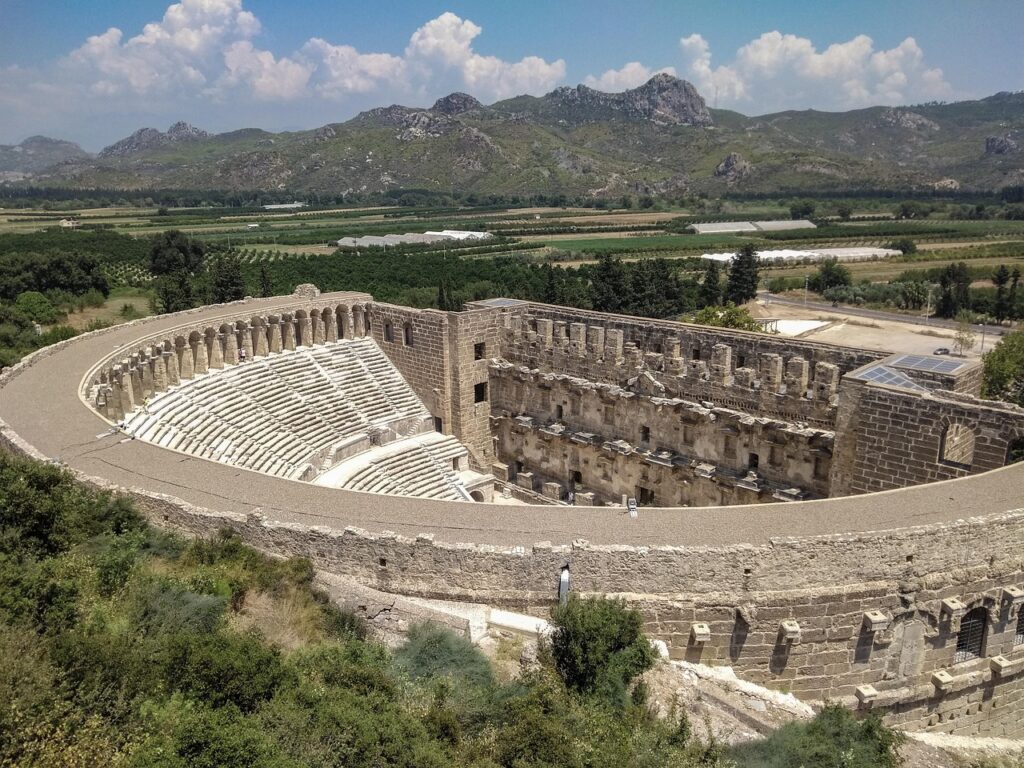
Near the south coast of Turkey, in the ancient region of Pamphylia, stands the best-preserved theatre of the Roman world. The Aspendos Theatre, built in the second century AD, has survived earthquakes, invasions, and the passage of seventeen centuries so completely that it still stages performances today, with its great stage building intact and its curved banks of seats rising against the sky. It is a monument that makes the ancient world feel close enough to touch. This is the complete history of the theatre, from the rise of the city that built it to the festivals that fill its seats in the twenty-first century.
The City of Aspendos
Aspendos was an ancient city of Pamphylia, the coastal region of southern Anatolia that also produced Side and Perge. It stood on the plain beside the Eurymedon River, which was navigable in antiquity and gave the city a route to the sea and to trade.
According to tradition, the city was founded by Greek colonists who came to this coast in the first millennium BC, and its coinage, which uses the name Estwediiys, shows a city of ancient lineage and considerable pride. The river made it rich, and the plain made it fertile.
By the Roman period, Aspendos was one of the leading cities of Pamphylia, wealthy enough to build on a grand scale. Its monuments, of which the theatre is the greatest survivor, were paid for by this prosperity and by the competitive generosity of its leading citizens, who funded public buildings as a way of winning honor and influence in the life of the city, a rivalry that produced some of the finest architecture of the ancient world.
The Rise of Roman Aspendos
The Roman period transformed Aspendos. The peace of the empire opened the Mediterranean to trade, and the city grew rich on the products of its fertile plain, on its river port, and on its position along the roads that linked the coast to the interior.
Roman Aspendos was a city of public buildings. The agora, the market and civic heart, was lined with colonnades; the bouleuterion housed the council; and a monumental fountain marked the center of the city, all built in the grand manner of the imperial age.
It was in this period of confidence and prosperity that the city undertook its greatest project: the theatre. The building we see today was the product of the high imperial age, when the cities of Asia Minor competed to raise the most splendid monuments.

The Architect Zenon and the Theatre
The theatre was the work of a named architect, which is rare and precious in ancient architecture. The inscription over the entrances records that the building was raised by Zenon, son of Theodorus, a citizen of Aspendos, and the record has preserved his name for two millennia.
The theatre is dated to the second century AD, in the age of the Antonine emperors, when the Roman world was at its peak. It was built partly into the hill, in the ancient manner, with the upper rows of seats rising against the natural slope.
Zenon’s design was both conservative and masterly. The great semicircular auditorium, the vaulted passages, and the monumental stage building followed the established Roman model, but the proportions and the execution raised the type to perfection.
The Theatre at Work
The theatre was built for spectacle, and in its heyday it staged the great events of Roman civic life. Gladiatorial combats, animal hunts, and theatrical performances filled the program, and the building could seat a substantial portion of the city’s population.
The acoustics, for which the theatre is still famous, were part of the design. The curved banks of seats, the shape of the orchestra, and the towering stage wall behind the performers all worked together to carry sound to the highest rows without amplification. Visitors still test this effect by speaking or dropping a coin on the stage and hearing it clearly from the top of the auditorium, a demonstration that the ancient engineer’s calculations have never needed updating.
The theatre was also a place of civic identity. The seating was arranged by rank, the elite closest to the stage and the ordinary citizens above, and the great festivals that filled the building celebrated the gods, the emperors, and the city itself.
The City Beyond the Theatre
The theatre was only one of Aspendos’s monuments, and the city around it was equally impressive. The agora, the colonnaded streets, the basilica, and the monumental fountain formed a complete Roman city, now largely in ruins but still traceable in the landscape.
The most remarkable surviving structure after the theatre is the aqueduct. Aspendos’s water supply was carried across the valley on a bridge of masonry towers, a bold piece of engineering that still stands and that hints at the scale of Roman ambition here.
Walking the site today, from the theatre to the aqueduct, you can still read the shape of the Roman city: its public spaces, its water system, and its great place of spectacle, all the apparatus of a prosperous provincial capital.
The Late Empire and the Decline
The theatre’s golden age did not last forever. From the third century onward, the Roman world entered its long crisis, and the cities of Asia Minor, struck by war, plague, and economic trouble, could no longer sustain their great monuments.
Aspendos declined with the age. The theatre, like the rest of the city, fell gradually out of use, and the earthquakes that periodically shook the region took their toll on the great stage building and the seating banks.
The end of the ancient world was not a single catastrophe but a long fading. By the time the Byzantine centuries passed, the theatre was a ruin at the edge of a diminished settlement, and the once-proud city was becoming a memory. The river that had made Aspendos rich also slowly silted, cutting the city off from the sea trade that had been the source of its wealth, and the abandoned monuments were left to the fields and the farmers.

The Seljuk Reuse
The theatre’s next chapter belongs to the Seljuk Turks, who ruled this region from the thirteenth century. In an extraordinary act of reuse, the Seljuk sultans converted the ancient theatre into a palace and caravanserai, building structures into its stone.
It is to the Seljuks that we owe the theatre’s survival. Their sultan Alaeddin Keykubad is recorded as having ordered the building restored in the thirteenth century, and the Seljuk work protected the theatre from the total collapse that overtook most ancient monuments.
The reuse of a Roman theatre as a Seljuk palace is a striking image of the passage of civilizations. The conquerors did not destroy the monument; they absorbed it, and their restoration preserved for us the very building we admire today.
The Ottoman Centuries
Under the Ottomans, the theatre entered a long quiet. The region around it was farmed and lived in, and the great building, part ruin and part legend, stood in the countryside above the river, known to local people and to the travelers who passed.
Theatre and city alike were absorbed into the rural landscape. The ancient stones were reused in local buildings, the site was overgrown, and the great semicircle of seats became a grassy hollow in the hillside, still impressive but silent.
This was the state of Aspendos when the first European travelers reached it, and their descriptions and drawings began the process of rediscovery that would eventually bring the theatre back to the world’s attention.
The Rediscovery and the Modern Festival
The twentieth century changed everything for the theatre. Excavation and restoration revealed its structure and cleared the debris of centuries, and the building was recognized as one of the great monuments of the ancient world, a candidate for the world’s heritage list.
In the 1930s, Ataturk visited the region, and the theatre was celebrated as a national treasure. In the later twentieth century, the idea that had never quite died, the theatre as a place of performance, returned in full force with the founding of an opera and ballet festival in its ancient seats.
The festival was a homecoming. Musicians, dancers, and audiences now fill the theatre each year, and the building, designed for spectacle nineteen centuries ago, has resumed the purpose for which it was built.
Aspendos Today
Today the theatre of Aspendos is one of the most visited monuments of the Turkish Riviera, a short drive from Antalya, and one of the best-preserved ancient buildings anywhere in the world. Its stage building still stands to its full height, and its seats still ring with applause.
The site is a working monument: performances continue in the summer, restoration and conservation continue year-round, and the theatre has been placed on Turkey’s tentative list for UNESCO World Heritage status, along with the other monuments of the region.
Standing in the theatre today, in the front row or the top row, you are doing exactly what a Roman citizen did two thousand years ago, in a building so complete that the ancient world seems not so much remembered as present.
Frequently asked questions
Who built the Aspendos Theatre and when?
The theatre was built in the second century AD by Zenon, son of Theodorus, a citizen of Aspendos, whose name is recorded in the inscriptions over the entrances. It was raised in the Antonine age, when the Roman world was at its height.
How did the theatre survive so well?
The theatre survived because it was built into the hill, because it was restored by the Seljuk sultans in the thirteenth century, and because it was never systematically dismantled. Its reuse as a Seljuk palace and caravanserai protected it from total collapse.
Can you still see performances at Aspendos?
Yes. The theatre hosts the annual Aspendos Opera and Ballet Festival and other performances in the summer months, and its famous acoustics are still fully effective. Visitors can also tour the building and test the acoustics for themselves throughout the year.

All Over Information
The All Over Information editorial team researches and writes practical English-language guides to Turkey. Facts are checked against official and local sources before publication, prices are published as dated ranges rather than quotes, and guides are revised when things change. We accept no sponsored posts, paid placements or paid links.
More guides like this

The Architecture of Dolmabahce Palace Explained
Dolmabahce Palace is one of the most instructive buildings in Turkey because it is many styles at once: Baroque, Rococo, Neoclassical, and…

Why Dolmabahce Palace Should Be on Your Turkey Bucket List
Every trip to Turkey needs its defining moments, and few places deliver them like Dolmabahce Palace.

Visiting Chora Church: Tickets, Hours, and Tips
The Chora Church — the Kariye — is one of the great monuments of Istanbul, and the visit to its mosaics and…
Why Rumeli Fortress Should Be on Your Turkey Bucket List
Istanbul is a city of monuments, but the Rumeli Fortress belongs to a special category: it is a place where you can…
Visiting Maiden’s Tower: Tickets, Hours, and Tips
The Maiden's Tower is one of the most romantic experiences in Istanbul, but it is also one of the least like a…

Visiting Selimiye Mosque: Tickets, Hours, and Tips
The Selimiye Mosque in Edirne is the masterpiece of Ottoman architecture, the building that the great architect Mimar Sinan called his own…