Konya is a city you come to for one famous sight and stay for a dozen more. The Mevlana Museum draws the crowds, but the old Seljuk capital rewards visitors who dig deeper: medieval medreses glowing with turquoise tiles, a bazaar that has barely changed in centuries, and one of the most important archaeological sites on earth just outside town. The list below is the essential Konya, ordered roughly by importance, with practical notes on how to make the most of each stop. Skip nothing if you can help it, and leave yourself time to sit still, because the city’s real atmosphere only appears to visitors who slow down.
1. Visit the Mevlana Museum
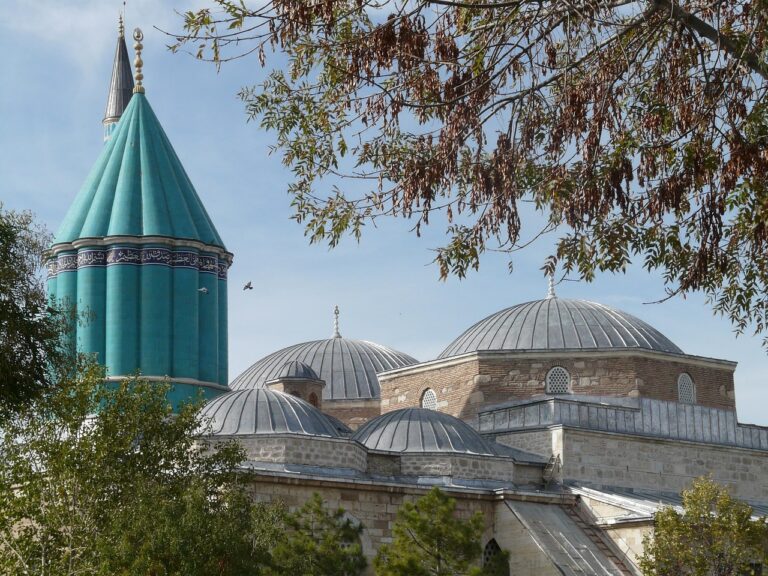
The green-tiled dome of the Mevlana Museum is the symbol of Konya, and the building inside it is the tomb of Mevlana Celaleddin Rumi, the 13th-century Sufi poet whose message of love and tolerance made him one of the most beloved writers in the world. The tomb chamber, draped in silver and gold embroidery, is the emotional heart of the visit, and crowds from around the world press quietly around it.
The museum rooms beyond hold illuminated manuscripts, dervish instruments, and the cells where Sufi students lived and studied. It is a place of pilgrimage as much as a museum, and the atmosphere stays with you.
Arrive at opening time to beat the tour groups, and allow two hours. Photography is restricted inside the tomb chamber, so keep your camera for the courtyards and the rose garden, where pilgrims linger and the green tiles of the dome catch the morning light. The faithful come here year-round, and watching them is part of the experience.
2. Watch the Whirling Dervishes
The sema is the meditation in motion of Mevlana’s followers: dervishes in white robes and conical hats spinning slowly in a trance-like rotation, one hand turned to heaven, one to the earth. Watching it is the single most memorable experience Konya offers, and it is available most of the year through the city’s cultural center.
The ceremony is religious, not theatrical, so arrive early, sit quietly, and hold your applause until the music ends. Photography during the performance is usually forbidden.
During the Mevlana Festival in December, the schedule expands and the atmosphere intensifies, with dervishes gathering from around the world. Tickets for festival performances sell out weeks in advance, so book early.

3. Climb Alaeddin Hill
In the middle of Konya rises the low mound where the Seljuk sultans built their palace and their mosque, and where the city’s oldest surviving monument still stands. The Alaeddin Mosque, begun in the 12th century, is an austere masterpiece with a forest of recycled antique columns and a courtyard tomb where Seljuk sultans are buried.
The hilltop offers the best views in the city: the Mevlana dome rising to the south, the flat plain stretching to every horizon, and, on clear days, the snowy line of the Taurus Mountains beyond the rooftops. On clear days the snow-covered Taurus Mountains frame the skyline.
The hill also holds the archaeological museum, with finds spanning thousands of years of the region’s history. The hill itself is free, and it is the perfect starting point for exploring the old city.
4. Explore the Ince Minare Museum
The Ince Minare Museum occupies a theological school built in the 1260s, and its name means “slender minaret,” after the pencil-thin tower that once rose beside it. Lightning destroyed the upper section in 1901, but the carved stone portal that survives is one of the great works of Seljuk art, dense with geometric patterns and calligraphy.
Inside, the collection focuses on Seljuk stonework: carved reliefs from the city’s old walls, fragments of palaces and caravanserais, and stonework showing lions, eagles, and fantastic creatures. It is a small museum, but every object is worth a careful look.
Allow an hour. The museum sits a few minutes’ walk from Alaeddin Hill, so it combines easily with the hilltop and the Karatay Museum in a single morning. Look closely at the portal before you go in: the carved band of inscription above the door announces the building’s founder in elegant calligraphy, a habit of Seljuk patrons who wanted their generosity remembered.

5. Marvel at the Karatay Museum Tiles
A short walk from the Ince Minare, the Karatay Museum is the Seljuk art experience in its most dazzling form. The building, a medrese founded in 1251, is covered inside and out with turquoise and cobalt tiles, the signature art of the Seljuk world, and the great dome above the central hall is a jewel box of glazed ceramic.
The tiles were once the decoration of palaces and mosques across the Seljuk capital, and the museum gathers the finest surviving examples in one place. The color is so intense that the hall glows even on gray winter days.
This is the museum to visit when you want to understand why the Seljuks are remembered as the great tile-makers of the medieval Islamic world. An hour is enough, but you may want longer just to look.
6. See the Aziziye Mosque
Konya’s most flamboyant building is its Ottoman showpiece. The Aziziye Mosque, rebuilt in the 19th century after a fire, wraps a classical Ottoman plan in a baroque facade of carved stone, with ornate twin staircases sweeping up to a gallery. It looks like nothing else in the city, and photographers love it.
The mosque stands at the edge of the old bazaar, so it is the natural pivot between sightseeing and shopping. Watch the crowds from the square in front, where families gather in the evenings.
As an active mosque, it closes to visitors during the five daily prayers, so plan your visit between them. Dress modestly, and women should carry a headscarf. Try to see it at dusk, when the facade is floodlit and the carved stone glows against the darkening sky, just as the city gathers for the evening prayer.

7. Eat Etli Ekmek Like a Local
No visit to Konya is complete without etli ekmek, the city’s signature dish. It is a long, thin flatbread topped with spiced minced meat, baked in a wood-fired oven until the edges are crisp and the center is juicy. It looks like a stretched pizza, and the locals eat it with their hands, straight off the tray.
Order it with cacik, the cold yogurt and cucumber soup, and a glass of sour cherry juice, the region’s famous drink. One tray per person is the honest portion.
For variety, add firik pilavı, the roasted green wheat pilaf, served with slow-cooked lamb. Konya’s food is simple, wheat-based, and deeply satisfying, and the best restaurants are the busy local ones with long queues at lunch. Etli ekmek is also the dish to order when you are in a hurry: it is served fast, eaten faster, and needs no table manners beyond washing your hands afterward.
8. Wander the Old Bazaar
Behind the Aziziye Mosque spreads Konya’s bazaar district, a network of covered lanes that has served the city for centuries. Here you will find goldsmiths hammering in tiny shops, spice sellers with pyramids of color, and stalls stacked with Turkish delight in a dozen flavors.
The bazaar is far less touristy than Istanbul‘s Grand Bazaar, and the pace is gentler. Browse, bargain politely, and buy: small dervish figurines, ceramic bowls, and packets of lokum make excellent gifts.
The bazaar is also where you will find the city’s best people-watching, as vendors and shoppers go about their day. Morning is the liveliest time, and Friday prayers bring a midday pause. Watch for the tea sellers who move through the lanes with brass trays, delivering glasses of cay to every shopkeeper; accepting one is the fastest way to make a friend in Konya.

9. Visit Catalhoyuk
Konya’s most extraordinary attraction lies 40 minutes outside town. Çatalhöyük is a Neolithic settlement occupied between roughly 7400 and 6000 BC, where a community of thousands lived in mud-brick houses packed together like a honeycomb, entering through the roofs. The walls were painted with bulls and goddesses, and the dead were buried beneath the floors.
UNESCO lists the site as a World Heritage Site, and the visitor center tells its story with exhibits and a partial reconstruction you can walk through. The excavated mounds themselves are surprisingly moving: nine thousand years of human life under a thin cover of earth.
Plan half a day for the round trip, and go with a guide if you want the full story. For many visitors, this is the highlight of the region.
10. Time Your Visit for the Mevlana Festival
If you can choose your dates, the Mevlana Festival in December is Konya at its most intense. Around the anniversary of Rumi’s death on December 17, the city fills with visitors from around the world for a program of sema ceremonies, concerts, exhibitions, and talks, known as Seb-i Arus, the “night of union.”
The city takes on a festive, spiritual atmosphere, with the museum draped in lights and ceremonies running daily. Hotels fill up and prices rise, so book months ahead.
For most visitors, the festival is the single best reason to visit Konya. If the December cold is not for you, come in May or September instead, when the weather is mild and the crowds are thinner.
Frequently asked questions
How many days do you need for these ten things?
Two full days covers everything on this list if you start early and move briskly. A third morning is needed only for Çatalhöyük, which takes half a day. During the Mevlana Festival in December, add an extra day for the ceremony program.
Is the sema performed every night?
No. Performances run on a schedule through the year, with more shows during the festival in December and fewer in summer. Check the cultural center’s schedule for your dates and book ahead, especially at festival time.
Which is better: the Ince Minare or the Karatay Museum?
See both if you can, since they are a five-minute walk apart. If you only have time for one, choose the Karatay Museum for its spectacular tiles, but know that the Ince Minare’s carved stone portal is equally magnificent in a quieter way.

All Over Information
The All Over Information editorial team researches and writes practical English-language guides to Turkey. Facts are checked against official and local sources before publication, prices are published as dated ranges rather than quotes, and guides are revised when things change. We accept no sponsored posts, paid placements or paid links.
More guides like this
A Solo Traveler’s Guide to Konya
Konya is an excellent destination for solo travelers, and in some ways it is better alone than in company.

48 Hours in Konya: The Perfect Itinerary
Two days in Konya is exactly the right amount of time. Long enough to see the great sights, eat the great food,…

How to Get to Konya from Istanbul
Getting from Istanbul to Konya is easier than most travelers expect, and the journey itself can be a highlight.

Konya on a Budget: Money-Saving Travel Tips
Konya is one of the easiest cities in Turkey to visit without spending much.

Nightlife Guide to Konya
Konya does not have a nightlife in the sense that Istanbul or the coastal resorts do, and that is exactly the point.
History and Culture of Konya
Konya is a city where history is not a museum exhibit but a living presence.