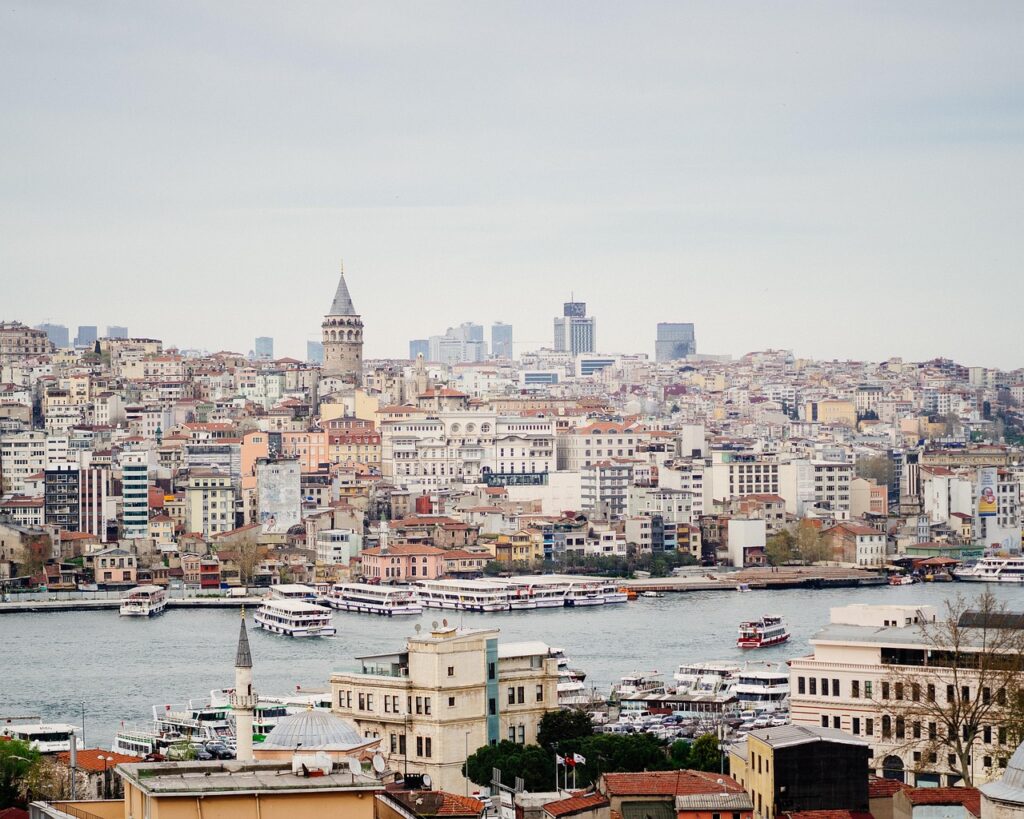
Galata Tower has outlived the empire that built it, the empire that adopted it, and most of the city that grew up around it. Its story runs from the medieval merchant republics of the Mediterranean to the observation deck of a modern metropolis, and each century added a new role to the tower’s long life. This guide walks you through those centuries in order, from the Genoese colony of the 1300s to the crowded viewing platform of today, so you can place the tower in the flow of Istanbul‘s history.
The Genoese Century
The fourteenth century belonged to the Genoese in Galata. This Italian merchant republic controlled the colony on the north shore of the Golden Horn, and its traders dominated the commerce of the Black Sea and the eastern Mediterranean.
In 1348 the Genoese raised the tower at the highest point of their walls, completing the fortifications that protected their warehouses and their families. The building was both a strongpoint and a symbol of their wealth and their permanence.
The tower watched over the colony’s golden decades, when ships came and went from the harbor below and the merchants of Genoa grew rich on the trade routes of the region. It was the proudest building on the north shore.
The Late Medieval Fortress
In the decades before the Ottoman conquest, the tower became part of a mature defensive system. The walls of Galata ran from the tower down both slopes of the ridge to the water, and the gates below were guarded day and night.
The tower itself held a garrison, and its watchmen scanned the strait for ships and the land approaches for threats. Life in the colony was tense, caught between the weakening Byzantine Empire and the rising Ottoman state.
When the Ottomans took Constantinople in 1453, the tower faced its first great test. The colony submitted, the walls were taken over, and the tower entered a new world, but it survived the transition intact.

The Ottoman Adoption
After 1453 the tower passed quietly into Ottoman hands, and the empire was quick to appreciate its value. The new rulers repaired and maintained the structure, and it took its place in the defenses of the imperial capital.
The district around the tower changed character as the Ottoman centuries unfolded. The old Latin colony became a mixed neighborhood of Muslims, Christians, and Jews, and the tower stood over a crossroads of communities and trade.`n`nThe tower also watched over the great ceremonies that passed along the strait. When the sultans sailed out with their fleets, or foreign embassies arrived by sea, the tower’s height gave the district its first view of the spectacle, and the watchmen could spread the news through the streets below.
The Ottoman era gave the tower its long service as a watchtower. Its height made it ideal for watching the harbor, the strait, and the city itself, and the tower became a fixed point in the life of the Ottoman shore.
The Sixteenth Century and Beyond
Through the sixteenth century the tower continued its watch over the city. The empire was at the height of its power, and Istanbul’s harbor was among the busiest in the world, with the tower keeping its silent oversight over the shipping below.
The century also saw the tower take on the role that would define it for centuries: fire watch. The city’s wooden quarters burned frequently, and a lookout high above the rooftops could raise the alarm before a blaze spread across whole neighborhoods.
The tower’s garrison and its watchers became part of the city’s safety network. From its top, the fires of Istanbul were spotted, the approaches were watched, and the tower earned its keep as the city’s eye on the skyline.`n`nThe fires the watchmen spotted could be terrifying. A blaze in the wooden districts could consume thousands of houses, and the city’s fire brigades of the era were simple and slow, so the early warning from the tower was genuinely lifesaving. The lookout’s cry, and the drums that carried the alarm, were part of the city’s soundscape for centuries.
The Seventeenth Century and the Legend
The seventeenth century brought the tower its most famous story. According to the traveler Evliya Çelebi, the adventurer Hezarfen Ahmed Çelebi launched himself from the tower’s top on glider wings and flew across the Bosphorus to the Asian shore.
The tale records the sultan watching the flight and rewarding the flier, and it has been retold for four centuries since. Whatever its factual basis, the story fixed the tower in the imagination of the city.
The century also saw the tower in its working role, watching over a city that was growing and changing. The legend added the layer of magic that the tower still carries, alongside its plain duties as watchtower and lookout.
The Eighteenth Century
The eighteenth century was a time of repairs and restorations. Earthquakes had shaken the tower, and the centuries of weather had taken their toll, so the city’s builders returned to reinforce the medieval masonry and keep the structure sound.
At different points in the century the tower also served as a prison, holding those the authorities wished to keep out of sight. Its thick walls and its height made escape difficult, and the tower’s role in the city’s justice system added another chapter to its story.
The surrounding district continued to grow, and the tower remained the landmark of the ridge. It was now a very old building, and its survival had become a matter of habit for the city that depended on it.

The Nineteenth Century
The nineteenth century transformed the tower and its neighborhood. Istanbul modernized rapidly, the Galata district filled with banks and offices, and the hill below the tower became one of the busiest commercial corners of the city.
A major fire damaged the tower’s upper works during this period, and the restoration that followed gave the tower the shape it wears today, including the cone that crowns it. The rebuilt top changed the tower’s silhouette and its future.
The century also brought the Tünel, one of the world’s earliest underground railways, to the foot of the hill. The tower now presided over a thoroughly modern district, and its medieval stone stood against the new world around it.`n`nThe tower also saw the arrival of photography in this century, and the first photographs of Istanbul made its silhouette known around the world. As the city’s image spread through prints and early travel books, the tower became a symbol that travelers recognized before they ever set foot in the city.
The Early Republic
With the founding of the Turkish Republic, the tower entered the care of the new state. The early decades of the century saw the tower maintained and studied, and its place in the city’s identity began to be recognized.
The twentieth century brought serious restoration work. The tower had survived centuries of earthquakes, fires, and weather, but it needed a thorough campaign to secure its structure and to open it to the public in a new way.
That campaign changed the tower’s future. An elevator was installed, the upper levels were fitted out for visitors, and the medieval watchtower began its transformation into one of the city’s most beloved viewpoints.

The Great Restoration
The mid-twentieth-century restoration was the turning point in the tower’s modern history. Engineers strengthened the ancient structure, conservators repaired the masonry, and the building was prepared for a new life as a public landmark.
The restoration respected the tower’s medieval character while making it accessible. The elevator, the gallery, and the café were all additions, but they were fitted into the historic structure without destroying its integrity.
When the tower reopened to visitors, it quickly became one of Istanbul’s essential experiences. The view from the top, long reserved for watchmen and prisoners, was now open to everyone, and the tower entered its most crowded era yet.`n`nThe work was not only about the stone. The restoration also considered how the tower would be used, including crowd flows, safety systems, and the services a modern public building needs. The result is a monument that functions as smoothly as it endures, a rare combination for a building of its age.
The Tower Today
Today the tower is one of Istanbul’s most visited monuments, and its viewing gallery draws crowds from morning to night. The elevator carries visitors up, the gallery delivers the panorama, and the café lets them linger above the city.
The tower’s daily life is a careful balance of access and preservation. Queues are managed, the structure is monitored, and the medieval fabric is maintained, so that the building can carry its popularity without losing its age.
After nearly seven centuries, the tower has found its final role as the city’s shared viewpoint. It has been a fortress, a prison, a fire lookout, and a landmark, and today it belongs to everyone who climbs the hill to look out over the Bosphorus.`n`nThe view from the top remains the view the Genoese watchmen saw, and that continuity is part of the tower’s magic. The ships below are different and the skyline has grown, but the strait, the Golden Horn, and the hills of the city are the same ones that have surrounded the tower for nearly seven centuries.
Frequently asked questions
How did the tower change under Ottoman rule?
The Ottomans maintained the tower after 1453 and used it as a watchtower, a fire lookout, and at times a prison. They repaired it through the centuries, and their restorations, including the work after a nineteenth-century fire, shaped the tower’s modern appearance.
When did the tower become open to the public?
The tower became a public viewpoint in the twentieth century, following a major restoration that added an elevator and fitted out the upper levels. Before that, its heights had been reserved for watchmen, soldiers, and prisoners across the centuries.
What was the tower used for as a watchtower?
Most importantly, fire watch. The tower’s height let lookouts spot fires in the city’s wooden quarters before they spread, and the alarm raised from the top saved whole neighborhoods. It also watched shipping on the Bosphorus and the approaches to the harbor.

All Over Information
The All Over Information editorial team researches and writes practical English-language guides to Turkey. Facts are checked against official and local sources before publication, prices are published as dated ranges rather than quotes, and guides are revised when things change. We accept no sponsored posts, paid placements or paid links.
More guides like this
Maiden’s Tower Through the Centuries
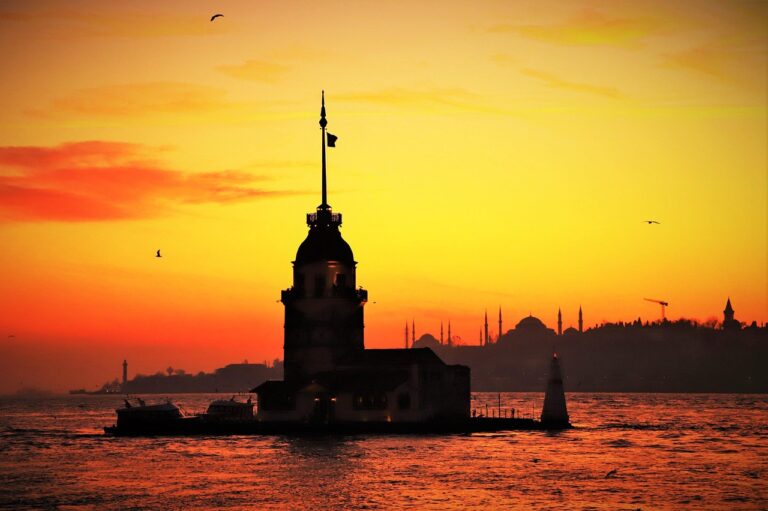
The Maiden's Tower has one of the longest and strangest resumes of any building in Turkey: customs post, watchtower, quarantine station, lighthouse,…

Visiting Chora Church: Tickets, Hours, and Tips
The Chora Church — the Kariye — is one of the great monuments of Istanbul, and the visit to its mosaics and…
The Architecture of Blue Mosque Explained
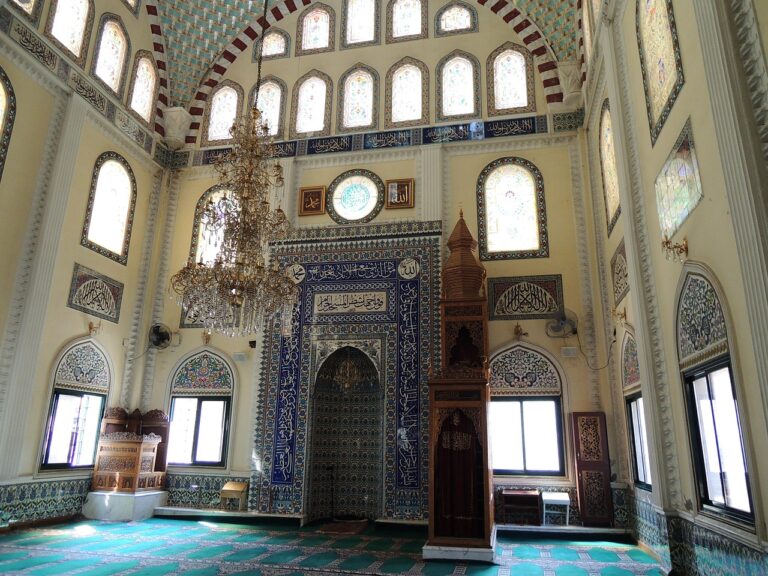
The Blue Mosque is the final masterpiece of Ottoman classical architecture, and reading its design is the best education in that tradition…

Visiting Ishak Pasha Palace: Tickets, Hours, and Tips
Ishak Pasha Palace is not a quick stop; it is a destination that demands a journey.

Visiting Sumela Monastery: Tickets, Hours, and Tips
Sumela Monastery is not an easy visit, and that is exactly why it is unforgettable.

Best Time to Visit Dolmabahce Palace to Avoid Crowds
Dolmabahce Palace is one of Istanbul's busiest sights, and its guided-tour system means crowds are not just uncomfortable but limiting: you wait…