Istanbul is one of the few cities where you can walk from a mosque that was once a church to a church that still holds Byzantine services within twenty minutes. For over a thousand years, this city was Constantinople, the capital of the Byzantine Empire and the greatest Christian city in the world, and its Greek and Byzantine heritage survives in astonishing abundance. For travelers, this layer of the city is endlessly rewarding: domes, mosaics, and frescoes hidden in plain sight among the crowds. This guide helps you find and understand the Greek and Byzantine heart of Istanbul.
The City of Constantine
In the year 330, the emperor Constantine dedicated a new capital on the site of the ancient Greek city of Byzantion, naming it New Rome. The city grew into Constantinople, the seat of the Roman Empire’s eastern half, and later of the Byzantine Empire, for more than a thousand years.
Constantinople was the largest and richest city of the medieval Christian world. Its emperors built churches, palaces, and fortifications on a colossal scale, and its patriarch was one of the most powerful figures in Christendom. Greek was the language of the court, the church, and the streets, and Greek culture saturated every level of city life.
The Ottoman conquest of 1453 did not erase this heritage. Many Byzantine buildings were converted rather than destroyed, and the Greek community continued to live, worship, and work in the city. Today, the Byzantine layer of Istanbul is everywhere, if you know where to look.
Hagia Sophia: The Great Church
The centerpiece of Byzantine Istanbul is Hagia Sophia, the Great Church of Holy Wisdom. Built by the emperor Justinian in the sixth century, it was the largest building in the world for nearly a thousand years, and its vast floating dome remains one of the greatest engineering feats of the ancient world.
For nine centuries it was the cathedral of the Orthodox world, the setting of imperial coronations and the most important liturgies of Christendom. After the Ottoman conquest it became a mosque, with minarets and calligraphy added to its Christian decoration, and in the twentieth century it served for decades as a museum before reopening as a mosque.
Today you can still see the astonishing architecture of Justinian’s builders, along with surviving Byzantine mosaics in the upper galleries and the marble of the original church. The building’s layered history, Christian and Islamic, makes it the single most important monument of Byzantine heritage anywhere.
The Church-Mosques of the Old City
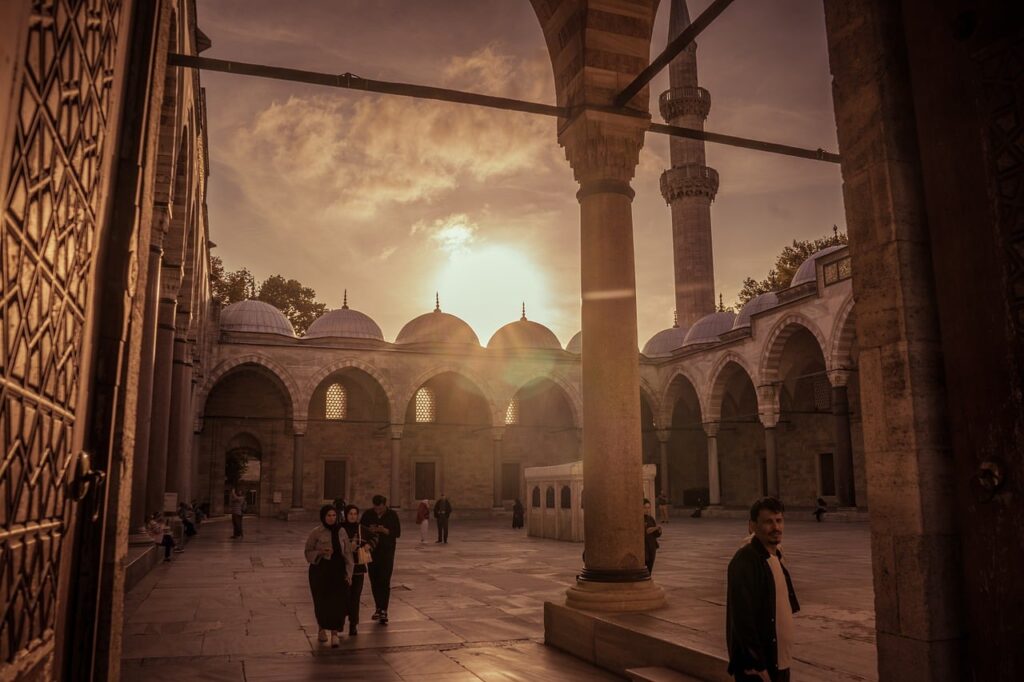
Hagia Sophia is only the beginning. Istanbul preserves a remarkable collection of Byzantine churches that became mosques, and many remain open for prayer and visitation. Their interiors hold mosaics, frescoes, and marble work that survived the centuries.
The Church of the Holy Saviour in Chora, now known as the Kariye, is the crown jewel of Byzantine art in the city. Its mosaics and frescoes, depicting the life of Christ and the Virgin, are among the finest in the world. The Church of St. Theodore, now the Vefa Kilise mosque, and the Church of the Pammakaristos, now Fethiye, are quieter masterpieces.
Others include the Church of St. Sergius and Bacchus, a small gem built by Justinian that mirrors the design of Hagia Sophia, and the Church of St. John of Studion, a ruined basilica that is the oldest surviving church in the city. Each tells a chapter of the Byzantine story.
The Mosaics That Survived
Byzantine art is famous for its mosaics, and Istanbul is the best place in the world to see them. Tiny cubes of glass and stone were set into walls and vaults to create images that glow with inner light, and the finest surviving examples are in the city’s churches.
The mosaics of Hagia Sophia, including the great Deesis of Christ in the upper gallery, and the narrative cycles of the Chora Church are the masterpieces. The Pammakaristos Church preserves mosaics of saints and the Virgin in its side chapel, and the Great Palace Mosaic Museum displays the floor mosaics of the imperial palace.
Seeing these works requires patience and some luck. Several church-mosques keep their mosaics hidden behind plaster or curtains, revealed only at certain times, and others are open to visitors during museum hours. The effort is rewarded with some of the most beautiful art ever made.

The Walls and Fortifications
The land walls of Constantinople, built in the fifth century under the emperor Theodosius, defended the city for more than a thousand years. Stretching from the Sea of Marmara to the Golden Horn, they are among the most impressive fortifications ever constructed.
You can walk along long stretches of these walls, through towers and gates that saw sieges, triumphs, and the final Ottoman conquest of 1453. The walls are crumbling in places but glorious throughout, and the surrounding neighborhoods retain a medieval atmosphere far from the tourist crowds.
The sea walls along the Marmara shore and the Golden Horn survive in fragments, as do the great gates like the Golden Gate, once the ceremonial entrance for emperors. For anyone who loves history, a walk along the Theodosian walls is one of the essential experiences of Istanbul.
Palaces and the Hippodrome
The imperial palace of Constantinople was a vast complex of halls, gardens, and churches beside the Hippodrome, the arena where emperors watched chariot racing. Both survive only in fragments, but those fragments are haunting.
The Hippodrome’s outline is now Sultanahmet Square, where the ancient monuments still stand: the Egyptian obelisk, the Serpent Column, and the Walled Obelisk. The palace beneath the square has been partly excavated, and the Great Palace Mosaic Museum shows its astonishing floor mosaics.
Elsewhere, the Palace of the Porphyrogenitus, a rare surviving palace building, stands beside the land walls, and the ruins of the Blachernae palace complex rise above the Golden Horn. These sites give you a sense of the imperial city’s scale and splendor.

The Cisterns Beneath the Streets
Beneath the streets of Istanbul lie the cisterns of Constantinople, vast underground water reservoirs built by the Byzantine emperors. The most famous, the Basilica Cistern, is a forest of hundreds of columns supporting vaulted brick ceilings, with the carved Medusa heads that attract every visitor.
The Basilica Cistern has been fully restored and is one of the most atmospheric places in the city, lit in amber tones with walkways above the shallow water. Several smaller cisterns are also visitable, including the Cistern of Philoxenos and the Theodosius Cistern, both beautiful in their quiet ways.
The cisterns remind you that Byzantine engineering was not only about churches and walls. The city’s water system, aqueducts, and cisterns sustained a population of hundreds of thousands, and exploring them is like visiting the machinery of an ancient metropolis.
The Greek Community Today
The Greek Orthodox community of Istanbul, once numbered in the hundreds of thousands, has shrunk dramatically, but it remains alive. The Ecumenical Patriarchate, the spiritual center of Orthodox Christianity, still stands in the Fener district, and its churches hold regular services.
The community maintains schools, hospitals, and cultural institutions, and its festivals and liturgies continue through the year. Visitors are welcome at many of these events, and attending a service in a historic church is a profound experience of living Byzantine tradition.
The community’s survival is itself a story of resilience. Its churches, from the great cathedral of the Patriarchate to the island monasteries of the Princes’ Islands, keep alive the language, music, and faith that once filled the whole city.

Neighborhoods of Orthodox Life
The historic Greek neighborhoods of Istanbul are worth exploring on foot. Fener, with the Patriarchate and its church of St. George, retains its old streets and grand houses. Balat, nearby, was once home to a large Greek community, and its colorful streets are now a favorite with visitors.
On the Asian shore, the neighborhood of Uskudar and the islands of the Marmara Sea preserve more Orthodox heritage, including the monastery of Halki with its celebrated theological school, now closed but full of history. The island churches and wooden mansions of the Princes’ Islands are a world of their own.
Walking these neighborhoods, you see the traces of Greek life everywhere: in inscriptions, in the foundations of churches, in the names of streets. They are places where the city’s Orthodox past and present meet.
Planning Your Byzantine Tour
A focused Byzantine tour of Istanbul can fill several days. Start in Sultanahmet with Hagia Sophia, the Hippodrome, and the Basilica Cistern, then move outward to the Chora Church and the land walls. Add the mosaics of the Pammakaristos, the Fener district and the Patriarchate, and a day on the Princes’ Islands.
Getting around is easiest by tram, bus, and ferry, and many of the sites cluster in walkable groups. Check opening hours carefully, because several church-mosques close during prayer times and some museums have changing schedules.
Above all, read a little before you go. The more you know about the emperors, the art, and the city’s thousand-year Byzantine life, the more every dome and mosaic will speak to you. Istanbul rewards the prepared traveler with one of the deepest historical experiences in the world.
Frequently asked questions
Which Byzantine churches are still functioning churches?
The Ecumenical Patriarchate’s Church of St. George in Fener holds regular services, as do several other Orthodox churches in the city, including those in the Balat area and on the Princes’ Islands. The former Byzantine churches that became mosques, like the Chora and the Pammakaristos, function as mosques today. A handful of churches are museums or ruins, so checking the current status of each site before visiting is wise.
How much of Byzantine Constantinople can you still see?
Remarkably much. The land walls, the Hippodrome’s monuments, the Basilica Cistern, the imperial palace mosaics, and over a dozen Byzantine churches survive, along with fragments of palaces, gates, and sea walls. The Byzantine street pattern still shapes the old city. With several days and good planning, you can experience the empire’s capital in extraordinary depth.
Where can you see Byzantine mosaics in Istanbul?
The finest mosaics are in Hagia Sophia’s upper galleries and in the Chora Church, whose narrative cycles are world famous. The Pammakaristos Church preserves mosaics in its side chapel, and the Great Palace Mosaic Museum displays the floor mosaics of the imperial palace. Some mosaics in church-mosques are covered and revealed only at certain times, so check schedules in advance.

All Over Information
The All Over Information editorial team researches and writes practical English-language guides to Turkey. Facts are checked against official and local sources before publication, prices are published as dated ranges rather than quotes, and guides are revised when things change. We accept no sponsored posts, paid placements or paid links.
More guides like this

Turkey’s Agricultural Heartlands Explored
Turkey is one of the great agricultural countries of the world, a land where the Fertile Crescent's first farmers found their footing…

Understanding Modern Turkish Pop Culture
Modern Turkish pop culture is everywhere, even if you do not realize it: television dramas that air on six continents, pop songs…
Turkish Hamam Etiquette: What First-Timers Should Know
A visit to a Turkish hamam, the traditional bathhouse, is one of the most memorable experiences Turkey offers, but it can be…

Understanding the Role of Tea in Daily Turkish Life
No symbol of daily Turkey is more universal than the tulip-shaped glass of tea. It arrives on your table within moments of…

The Street Cats of Istanbul Explained for Foreigners
If you have heard anything about Istanbul before visiting, you have probably heard about the cats. They are everywhere: on tram seats,…

Ramadan Iftar Traditions in Turkey
If you visit Turkey during the month of Ramadan, you will witness a transformation.